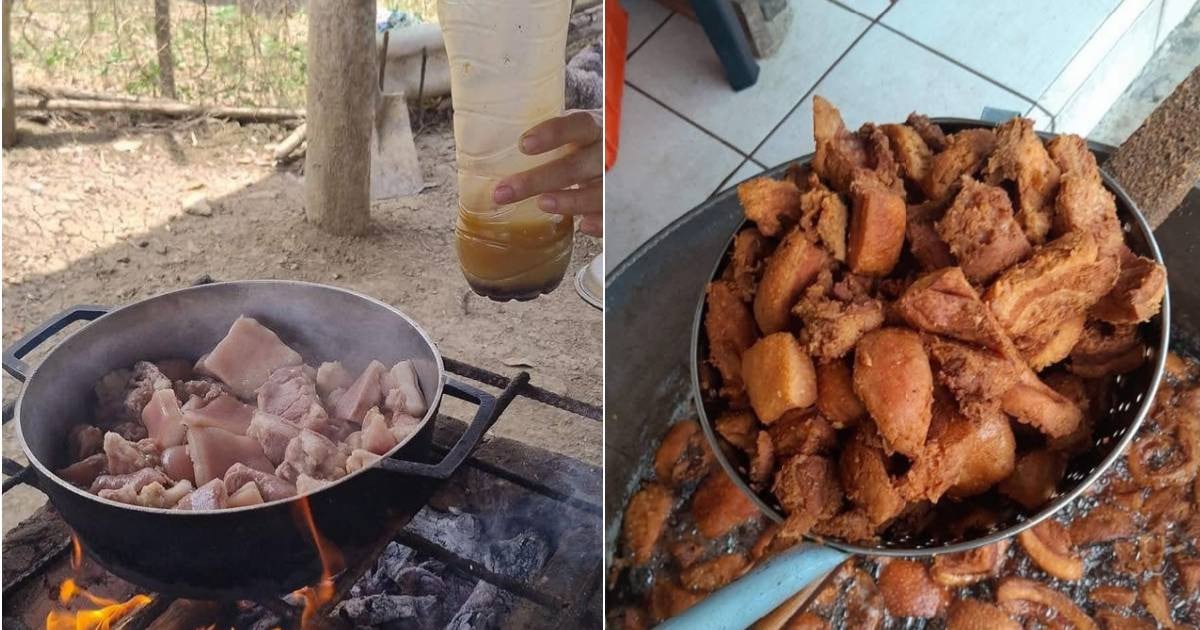
A Cuban identified as Osmel Diazboloy declared a "grease strike" this Saturday over the prices of the product and stated that he will return to cooking with lard.
"6,000… 7,000 for a bottle of oil. Oil or French perfume? Does it come with a fried chicken, an apartment, or what?", ironized Diazboloy on his Facebook profile.
"I'm not on a hunger strike... I'm on an oil strike. My frying pan is currently in therapy. The fryer is looking for a job. And the lard is watching from the corner saying: 'So who was the bourgeois now?'" he added.
Diazboloy's post provoked numerous comments from Cubans across different provinces, many of whom pointed out that lard is not a viable alternative either.
"If we’re talking about a strike... then we’ll strike against oil, eggs, sausages, and so on... because nothing is available anymore, and if by some magic it does appear, the price is beyond reach for most," wrote a commenter. The same user added that butter is also out of reach for most people's budgets.
From Guantánamo, another user stated that oil is sold for 5,500 pesos and that they can't find lard. Another person summarized the situation with a phrase similar to that of the original poster. "I join your strike, but mine is against lard as well, because the price is now competing with oil."
From Baracoa, a resident stated that they cook with coconut oil because "the oil ran out." Another commentator noted that butter has also increased in price because the population started using it for cooking.
The comments also reflected the return of lard to Cuban kitchens after years in which oil was presented as the usual option.
Some users recalled that in the past, lard was used for cooking, while oil was reserved for preparations like salads.
The debate thus highlights a situation where even alternatives to oil have become inaccessible to numerous consumers.
The "oil strike," initially posed as a joke by Diazboloy, ended up becoming a reflection of the decline in purchasing power and the difficulty in finding basic products at affordable prices.
The price surge occurred after Resolution 150/2026 of the Ministry of Finance and Prices, published on June 20, which removed the national caps on imported cooking oils and repealed the previous limit of 990 pesos per liter.
Since then, the price has risen from around 1,500 pesos in April to over 4,000 in some areas in August. Testimonials published by citizens report the cost to be as high as 7,000 pesos per bottle.
The Cuban government itself acknowledged that this year it has not distributed oil through the rationing booklet, a lack that contrasts with the product's importance in daily nutrition.
Faced with social pressure, municipal governments began to set their own limits. Guantánamo set the price at 2,200 pesos, Pinar del Río at 2,150 and Matanzas at 2,500, just weeks after the elimination of the national cap.
The post by Diazboloy is part of a wave of viral content that uses humor as an outlet in the face of the crisis. The troubadour Yordan Quintero went viral with a décima about oil costing 3,500 pesos in Ranchuelo, which garnered over 1.1 million views.
Moreover, a Cuban mother posed with a bottle of oil and wrote: "I have gold in my hands."
With a monthly minimum wage of 3,210 pesos since July, a liter of oil priced at 4,000 pesos represents more than what those earning the lowest salaries in Cuba make, while the lowest pension barely reaches 4,000 pesos, which is equivalent to less than eight dollars.
Related videos:
Filed under: