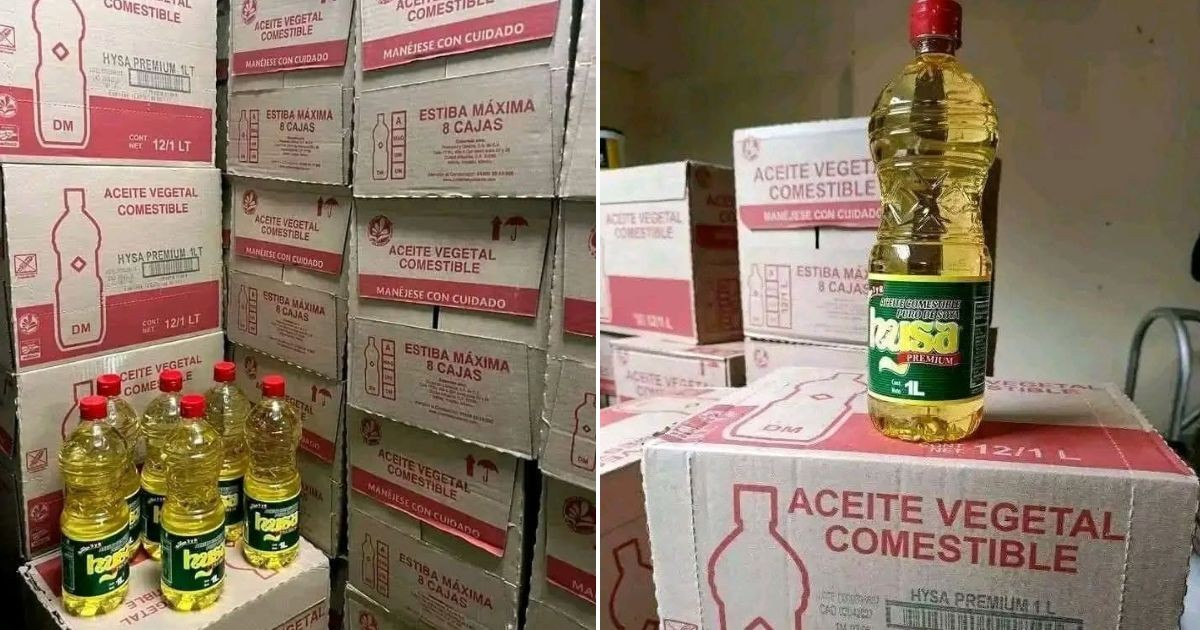
The municipality of Pinar del Río has set a maximum retail price of 2,150 pesos for the sale of cooking oil, amidst the rising cost of this essential product and a new wave of local controls in Cuba.
The regulation came into effect this Tuesday, according to the Provincial Government of Pinar del Río on Facebook.
The Municipal Administration Council also set the price for wholesale marketing of oil at 1,950 pesos.
The authorities justified the decision as a response to prices they described as "abusive and speculative," although they did not specify the presentation or quantity of oil to which the announced values correspond.
The local government stated that the measure is backed by the powers granted to municipal administrations by Decree-Law 24 of 2020 and resolutions 148 of 2023, 209 of 2022, 153 of 2025, and 173 of 2025.
These regulations allow the local bodies of the People's Power to regulate the prices of certain products within their territories.
The administration also announced that it will strengthen inspections at all points of food sales through rounds and control visits conducted by integrated task groups.
Sellers who do not comply with the new prices may face penalties as outlined in Decree-Law 91 of 2024 and Decree 30 of 2021.
Among the announced measures are fines, seizures, forced sales of products, temporary suspension of licenses, permits, and authorizations, as well as their final cancellation.
The authorities will also be able to permanently revoke the authorization to engage in self-employment and order the total or partial closure of establishments and premises.
The municipal government has activated the phone numbers 52173655, 52126364, and 52174194 for the public to report possible violations of the established prices.
The measure deepens a contradiction within the regime's economic policy. In June, the Ministry of Finance and Prices removed the national price caps for oil, chopped chicken, powdered milk, pasta, and sausages.
Miguel Díaz-Canel then acknowledged that those controls had not succeeded in curbing inflation and had led to the disappearance of products, diversion to the illegal market, reduced tax revenue, and even higher prices.
The central government stated that it would not continue to apply price caps in a general manner and decentralized the authority to intervene in prices to regional administrations.
However, less than two months later, numerous local governments once again limited the value of food.
Villa Clara set the price of oil at 2,500 pesos per liter and eggs at 110 pesos, although both products were already being sold above those prices in some places.
Matanzas has also joined the so-called "war" against inflation by setting price references for oil, eggs, chicken, rice, and beans, as well as capping the commercial margin at 30%.
In Songo-La Maya, Santiago de Cuba, the authorities set the price of oil at 2,500 pesos and eggs at 110 pesos, with threats of fines, confiscations, and closures for those who sell above these prices.
The price currently set in Pinar del Río is 350 pesos lower than that established for oil in Villa Clara, Matanzas, and Songo-La Maya, which highlights the inconsistent application of different prices for the same product depending on the territory.
In this regard, economists Pedro Monreal and Elías Amor criticized the return of local controls and warned that these measures could lead to shortages and shift goods to the black market without addressing the root causes of inflation.
"176 measures and only one achievement: to demonstrate that they learned nothing," Monreal stated while questioning how the supposed liberalization shift announced in June vanished in less than two months.
Related videos:
Filed under: