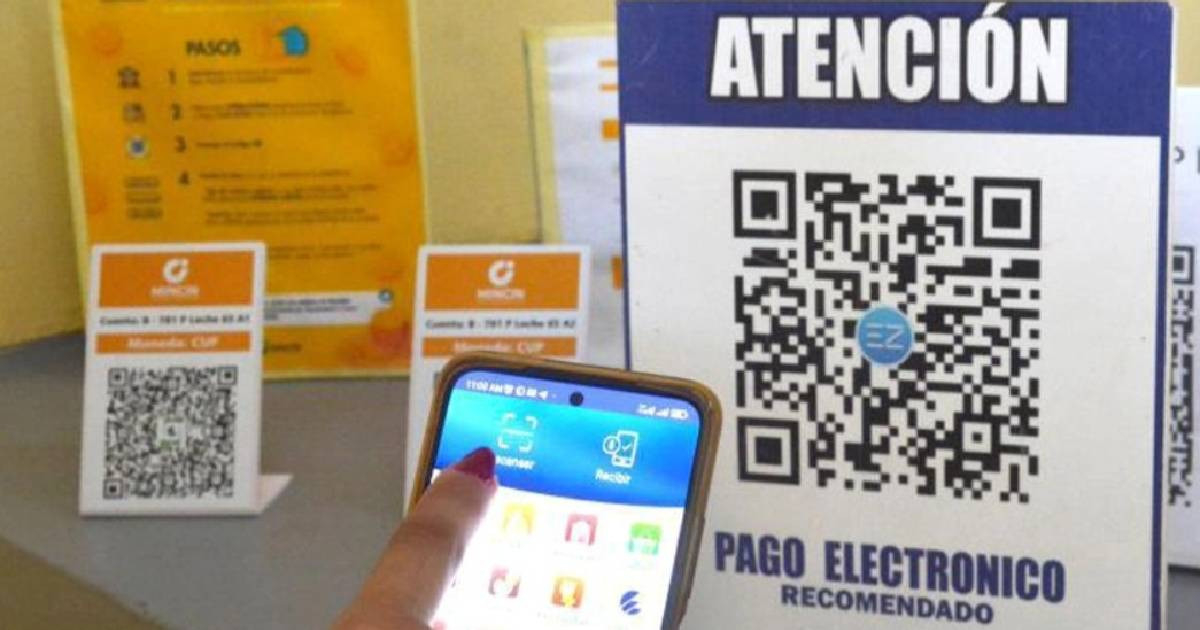
The Cuban government promotes banking and electronic payments as priorities to invigorate the economy, but in Holguín, small vendors face challenges in operating under those same regulations.
According to a report from the provincial station Radio Angulo published this Saturday, retailers are required to ensure payment through transfers in national currency, a measure presented as a way to facilitate consumer transactions.
The problem arises when it's time to restock goods. Small businesses rely on large suppliers, importers, and players associated with nodes such as the Mariel Special Development Zone, whose payment mechanisms do not align with the requirements imposed on retail trade.
While the seller receives payments in Cuban pesos (CUP), those suppliers require foreign currency or cash. The consequence for the merchant is having digital funds in the national bank that cannot be directly used to purchase the products needed to keep their business stocked.
Difficulties are increasing due to the liquidity constraints of the banking system. If the merchant attempts to withdraw cash from the deposited funds for operations or to seek merchandise where they can acquire it, they face restrictions that make it challenging to access their own money or convert it into the currency required by their suppliers, the media outlet argued.
The situation also highlights an inequality in access to commerce. Small vendors are required to strictly comply with digital payments in Cuban pesos, while businesses and entities that operate solely in foreign currency proliferate, a model that is beyond the reach of the average salary in national currency.
The report itself questions why oversight is not as strict against large companies, importers, and banking institutions when issues arise with users.
Radio Angulo stated that banking can only be consolidated if the rules are applied consistently to all participants in the commercial chain.
Under this approach, payment demands, fiscal control, and operational responsibilities should be applied with the same rigor to large importers and small businesses.
The repressive offensive this month is the most intense since the mandatory banking system was imposed in August 2023. Just in the last few days, in Centro Habana, the government audited 232 businesses, imposed 363 fines, closed 15 establishments, and executed 11 forced sales in a single day.
In Sancti Spíritus, an operation resulted in over 200 fines and at least five closures this month. In Guantánamo, authorities warned that "there is no middle ground" for those who fail to comply.
All of this happens when, three years after the regulation, only 3.77% of transactions in Cuba are digital, despite over 15,240 fines and 269 closures accumulated nationwide.
In parallel, the system of foreign currency stores has grown from 72 establishments in 2020 to over 85 locations, with new openings planned for 2026. These businesses accept cash dollars or international cards, but not Cuban pesos. Estimates suggest that between 80% and 90% of the population does not have real access to these establishments.
Since March, the Mariel Container Terminal has started charging private SMEs in dollars, while state-owned companies continued billing in CUP.
The banking transition promised by the government is faltering also because cash extraction "at a percentage", with commissions ranging from 35% to 50%, has become the standard means of liquidity for millions of Cubans.
In Santiago de Cuba, the police arrested people involved in that scheme in May, but the practice continues due to the lack of real alternatives.
The Central Bank attempted to correct its course with Resolution 74/2026, effective July 20, which eliminated the rigid cap of 5,000 CUP, reduced fees, and promised faster crediting.
But the reforms arrived when the system was already operating in collapse, and the regime's response has been to deepen coercive pressure on the most vulnerable instead of addressing the structural causes.
Related videos:
Filed under: