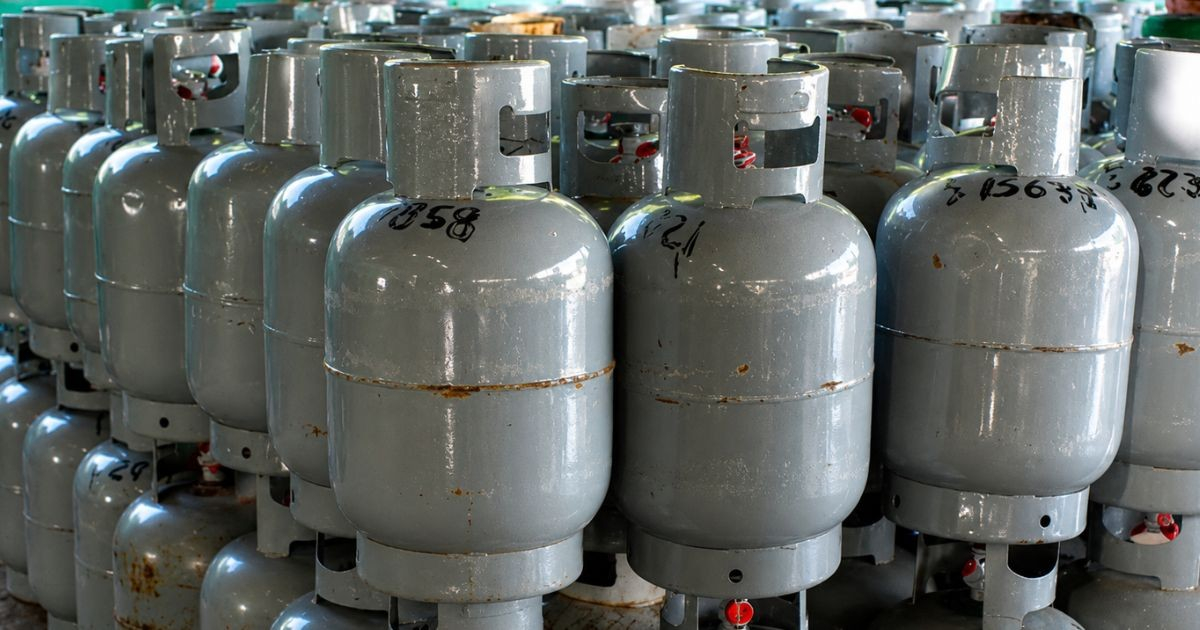
The prolonged shortage of liquefied gas in Santiago de Cuba continues to fuel private offers at prices that would have been unthinkable just a few years ago: a recent advertisement promises to deliver the product to the home for 65,000 pesos per fill and 75,000 pesos if it also includes the small cylinder, amidst users' doubts about the origin and conditions of the service.
The offer was published by Adiel Ernesto Reyes Sánchez in the Facebook group Compra y venta Santiago de Cuba, where he presented himself as a self-employed worker (TCP) and claimed to offer "guarantee" and "maximum security" for the product.
According to what she explained, they pick up the empty cylinder and deliver the gas to the home without charging extra for transportation.
In the comments, in response to questions about the price, Reyes Sánchez replied: “65 thousand for the liquid and 75 thousand for the canister with liquid”.
When another person expressed disbelief and asked if the offer was real, he firmly replied, "Yes, it's true."
The publication, however, quickly raised suspicions. One of the promotional images shared shows dozens of green cylinders and the name Vidagas, a brand that operates in Colombia under Inversiones GLP S.A.S. E.S.P., a subsidiary of Empresas Gasco.
A user specifically pointed out this detail: "Those are photos from a Colombian company. The offer seems suspicious."
The seller responded that, regardless of the origin of the images, "the transaction is done in person and payment is made in cash in national currency".
The explanation did not clear all the doubts. "I find this strange," commented another person.
Reyes Sánchez assured that he could provide numbers of regular customers so they could verify the service.
Another internet user questioned why, if it was truly a legitimate business like TCP, it was necessary to request information privately to purchase such a sought-after product.
The exchange intensified when a user claimed that sending interested parties to private messages suggested a "doubtful origin" and accused these types of sellers of profiting from the needs of the population.
The advertiser denied any irregularities: “There is nothing here with questionable origins”, he replied, and claimed that they too have to pay to obtain the products they sell.
Another woman asked, “How long are you going to play with the needs of the people?” To which the vendor replied, “No one is playing with anyone here, this is a serious matter.”
Beyond the advertiser's responses, the publication does not provide any documentation that would allow for independent verification of the gas's origin, the supply of the business, or the specific conditions under which it is marketed.
The use of promotional material associated with a company operating in Colombia does not, by itself, demonstrate that fraud exists, but it did raise doubts among potential buyers.
The context largely explains why such offers arise and why they can find interested buyers even at exorbitant prices.
CUPET indefinitely suspended the distribution of liquefied gas in Santiago de Cuba and the rest of the eastern provinces due to a lack of supply. At that time, cylinders were valued at up to 50,000 pesos in cities in eastern Cuba.
The prolonged absence of the product in state channels has created a gap that is filled by resellers, private businesses, and offers that are difficult to verify.
A similar phenomenon was revealed in July in Sancti Spíritus, where 10-kilogram canisters were offered for up to 70,000 pesos, while more than 37,000 customers had gone months without receiving gas through the usual distribution network.
The desperation to obtain fuel has also opened the door to fraud. In June, a family from Las Tunas paid 50,000 pesos for a small tank that turned out to contain mostly water.
The cylinder had been purchased for home delivery and seemingly weighed as expected, but the deception was only uncovered after using it for several days.
Related videos:
Filed under: