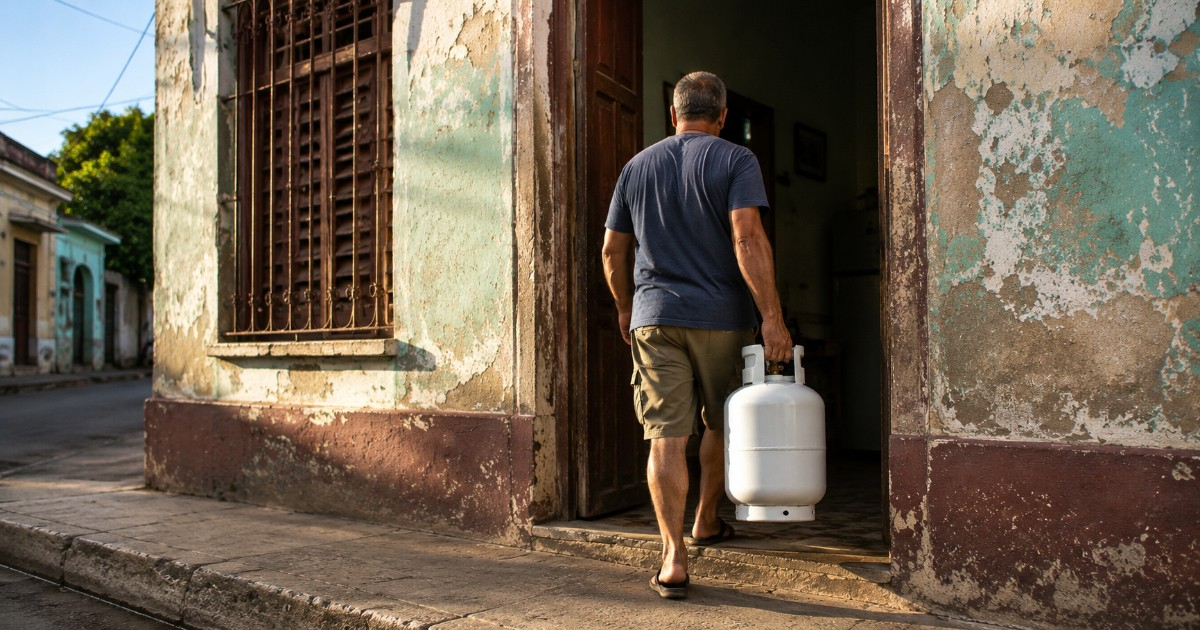
More than 37,000 liquefied gas customers in Sancti Spíritus have gone without fuel since October 2025, while the black market has filled this gap with 10-kilogram canisters that are being offered for up to 70,000 Cuban pesos.
The complaint was made this Wednesday by Elsa Ramos Ramírez in an article published by Radio Sancti Spíritus, in which she questions both the scarcity and the silence of the authorities.
Since last October, liquefied gas has not been sold at the eight distribution points in the city of Sancti Spíritus.
The situation affects more than 37,000 customers with a released contract and for even longer has impacted another 10,000 participants in the "door-to-door reservation delivery" system, who typically receive the product twice a year.
Amid this shortage, fuel continues to appear in the informal market at prohibitive prices.
Ramos reported that the small bullets have reached a cost of 70,000 pesos, describing what he called an impulsive gaze both on the streets and on social media.
A recent episode highlighted the existing confusion. On the outskirts of the Colón neighborhood, an improvised point appeared offering cylinders for 28,000 pesos: 14,000 upon arrival at the location and another 14,000 after the delivery was completed.
The operation raised suspicions because the purchase was recorded on the official card issued by the Fuel Marketing Company of the territory.
Numerous residents then began to wonder if any state entity was involved in the business, he explained.
The journalist stated that she attempted to obtain an explanation from authorized sources, but received no response.
Days later, he learned that the sale had been identified as illegal and that the location did not meet the technical or safety requirements necessary for trading liquefied gas.
Alberto Milián, director of the Fuel Marketing Company in Sancti Spíritus, denied any connection of his entity with that operation.
However, according to Ramos, he stated that he did not have information to answer the customers' questions.
The reporter recounted that she tried to interview him several times, amidst dropped calls and phones that were either turned off or out of service at the company's command center.
The situation became more complicated following the publication of new national measures regarding fuel prices.
Resolution 155/2026 from the Ministry of Finance and Prices, published on July 16 in the Official Gazette, established a non-subsidized retail price of 35 pesos per kilogram of liquefied gas.
This amount equates to 350 pesos for a 10-kilogram cylinder. However, the new price offers little benefit to customers in Sancti Spíritus as long as the product remains unavailable at state-run outlets, reported the official journalist.
However, Ramos raised several of the questions that remain unanswered: "Where is the gas that has been announced? Why is it being sold at such high prices in various places? Is the liquefied gas company now private? How will I be able to acquire the gas that I have had for over 60 years? Where does the value of the contracts with customers stand? Specifically, will the cylinder gas be sold in CUP or USD?"
"The gaps in explanation and the elusiveness of sources do not fill the gas canisters whose arrival is uncertain. They only fuel misinformation, uncertainty, and speculation," the journalist concluded.
Meanwhile, platforms like Supermarket23 and Katapulk sell 10-kilogram bags for 29 dollars, while KMCERO offers them for 24 dollars.
So far, the documented coverage of these services is mostly concentrated in Havana, and it has not been clarified whether it will extend to Sancti Spíritus.
However, if the service were to reach that province, it would not mean easier access. In June, the cylinders purchased for 24 dollars were KMCERO resold for 50 dollars in the informal market.
Moreover, the crisis is not new in the province. In 2025, distribution resumed after 54 days of interruption, although it was limited and conditioned on product availability.
At the national level, about 834,000 of the 1.7 million liquefied gas customers were unable to purchase it through the state network during the distributions in April, a figure that highlights the extent of the shortages.
Related videos:
Filed under: