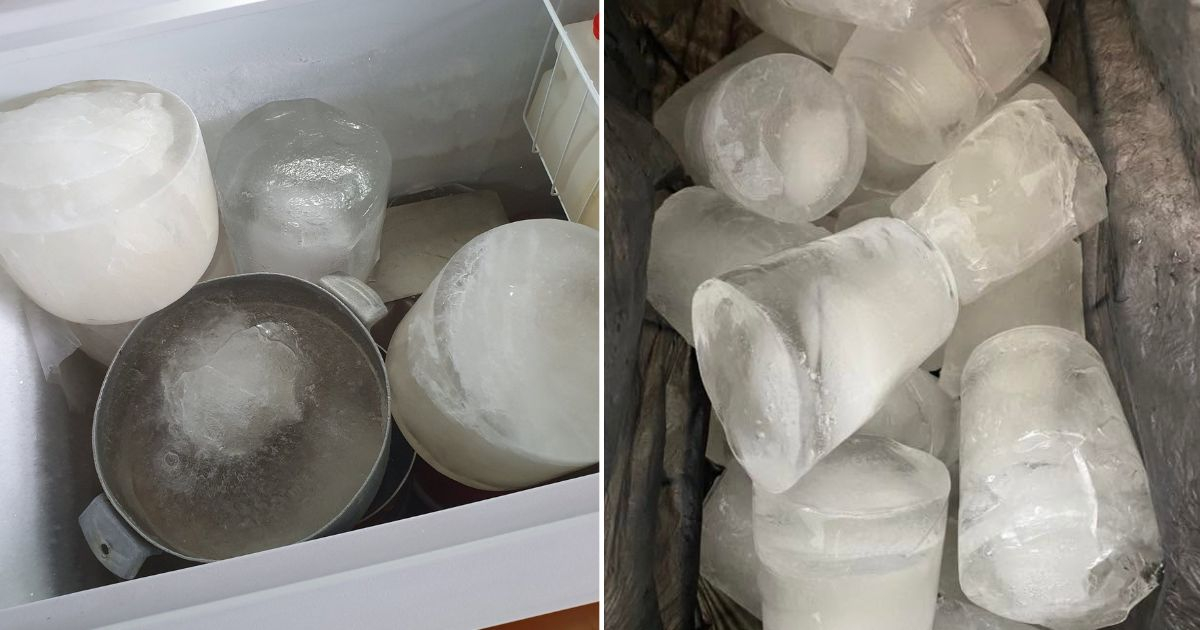
The ice business has become an increasingly widespread venture in Santiago de Cuba, driven by the prolonged blackouts that make it challenging to keep food and beverages cold, and by the ability of some individuals to keep freezers and refrigerators running through backup power systems.
Two residents of Santiago de Cuba explained to CiberCuba that business has skyrocketed in the city over the past few months, amidst an energy crisis that has worsened the challenges of maintaining refrigeration in homes.
At the same time, individuals who have made private investments, including the installation of photovoltaic systems, have found an opportunity to produce and sell ice even during power outages.
One of the testimonies comes from the neighborhood Los Pinos, where, as explained by a resident, it is common to see young people and children walking the streets selling ice.
"Very young boys, even children, pass by my house selling ice. Sometimes two or three of them are together, and they have a very rustic cart with some tanks that I imagine have some type of insulation, and inside they carry several thousand pesos worth of ice," he recounted.
According to the explanation, the blocks prepared in containers known as "five-pound jugs" are sold for about 200 pesos, while the so-called "balitas," made in 1.5-liter soda bottles, cost around 100 pesos.
Vendors walk the streets offering the product directly to the neighbors, a method that allows ice to be delivered to areas where families spend long hours without electricity and cannot produce it in their own homes.
Another resident of Santiago explained to our site that he sells ice directly from his home. In his case, the five-pound containers cost between 70 and 100 pesos, while the ice pots are sold for 120 pesos.
"The pots are set to 120 for straining and cooling beer or whatever people want," he explained about some of the uses his customers give the product.
"I know some people use it to drink. I explain to them that the water is untreated, because boiling it or purifying it with sodium hypochlorite would be much more expensive, but they tell me that drinking cold water is right now one of the luxuries that has been lost in Cuba. And that's how they drink it: they thaw the ice and drink that water very cold," he emphasized.
The offer has also extended to buy-and-sell groups on social media, where different quantities, formats, and prices can be found.
In the Facebook group 360 Compra Venta Santiago de Cuba, a user offered ice for 300 and 100 pesos, depending on the packaging.
Another seller announced in a post in another "ice blocks" group approximately four kilograms for 200 pesos each.
A particularly attractive offer appeared on Buy and Sell Santiago de Cuba, where an anonymous post offered a five-liter bucket of ice for 400 pesos and individual cups for 20 pesos.
The sale by the cup shows just how much value ice has gained commercially, even in small quantities intended simply to cool a drink or have cold water.
The sale of ice finds fertile ground in a reality that Cubans themselves have been documenting for months: getting a refrigerator to cool for a sufficient amount of time has become a small triumph amid the blackouts.
At the beginning of August, a young Cuban celebrated on social media that she had managed to freeze a bottle of water and humorously summed up a situation that has already become part of the routine for many families.
"The water bottle froze on me. I had to share this with you because for a bottle to freeze here today between blackouts, no one would believe it," she said.
Although it may seem unbelievable, this is not the first time someone has felt immense joy from freezing water in Cuba.
In June, another Cuban also celebrated having managed to freeze a "little ball" of water and presented the fact with irony as her "first unlocked achievement of June."
The post generated thousands of reactions, largely because many users identified with the challenge of producing ice during the prolonged power outages.
Related videos:
Filed under: