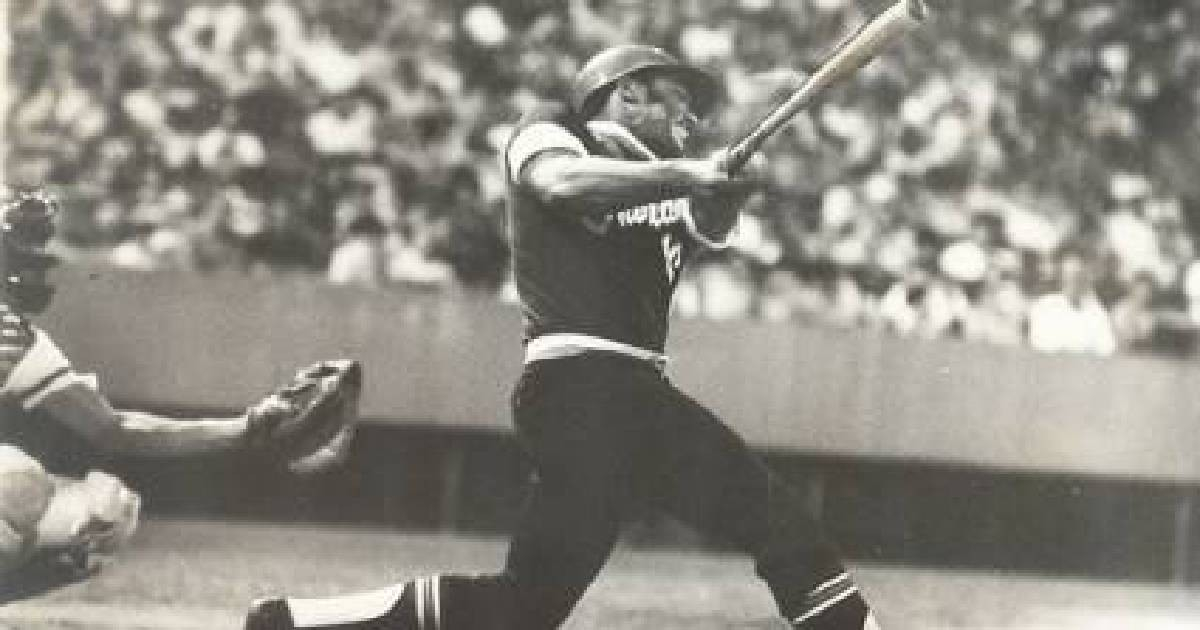
Cuban baseball is in mourning following the passing of Elpidio Mancebo Pérez, affectionately known as "Pillín," who passed away on Tuesday in Santiago de Cuba at the age of 82, as reported by the Cuban News Agency.
Born on April 18, 1944, in Santiago de Cuba, Mancebo was one of the most complete players of the early decades of the National Series: first baseman, outfielder, batter, and left-handed pitcher, he developed almost his entire career with teams from the eastern region, starting with his debut with Orientales in 1962 until his later years with Mineros, Cafetaleros, and Santiago de Cuba.
Over 17 seasons, he compiled a record that places him among the foundational figures of baseball played in Cuba after the 1959 revolution: 1,215 games played, 1,202 hits, 221 doubles, 664 runs scored, and 887 walks.
Among his individual achievements are the 26 doubles from the VIII National Series, the 77 hits and 45 walks from the X, and the 56 runs scored from the XII.
The batting title of the XI Series, with an average of .327, made him the first player from the east to receive that honor.
In 1968, he starred in one of the most notable offensive sequences of that era by connecting seven consecutive extra-base hits, including three home runs and four doubles.
His international performance was equally remarkable. At the Pan American Games in Winnipeg 1967, where Cuba won the silver medal, Mancebo was the team's leading hitter with an average of .353.
Four years later came his most memorable performance: at the XIX Amateur Baseball World Championship held in Havana in 1971, he was part of the Cuban team that finished undefeated with nine victories, contributed an average of .382, and led the tournament with 12 runs scored, which earned him a spot as first baseman of the All-Star team.
After hanging up his spikes, Mancebo kept his connection to baseball alive as an instructor and sports commentator on Santiago radio stations such as CMKC Radio Mambí and CMKW Radio Revolución, and he documented his knowledge in instructional texts like The Difficult Art of Hitting, Hitting Classes, and Hitting Conferences.
The National Institute of Sports, Physical Education, and Recreation (INDER) expressed its condolences through its social media: "He shone in national competitions and was a world champion in 1971, in the most significant of his incursions with the Cuba teams."
In just over a year, Cuban baseball has experienced the loss of significant figures such as Lázaro Junco, Armando Capiró, Pedro Medina Ayón, and Pedro Arozarena Zayas, among others.
Related videos:
Filed under: