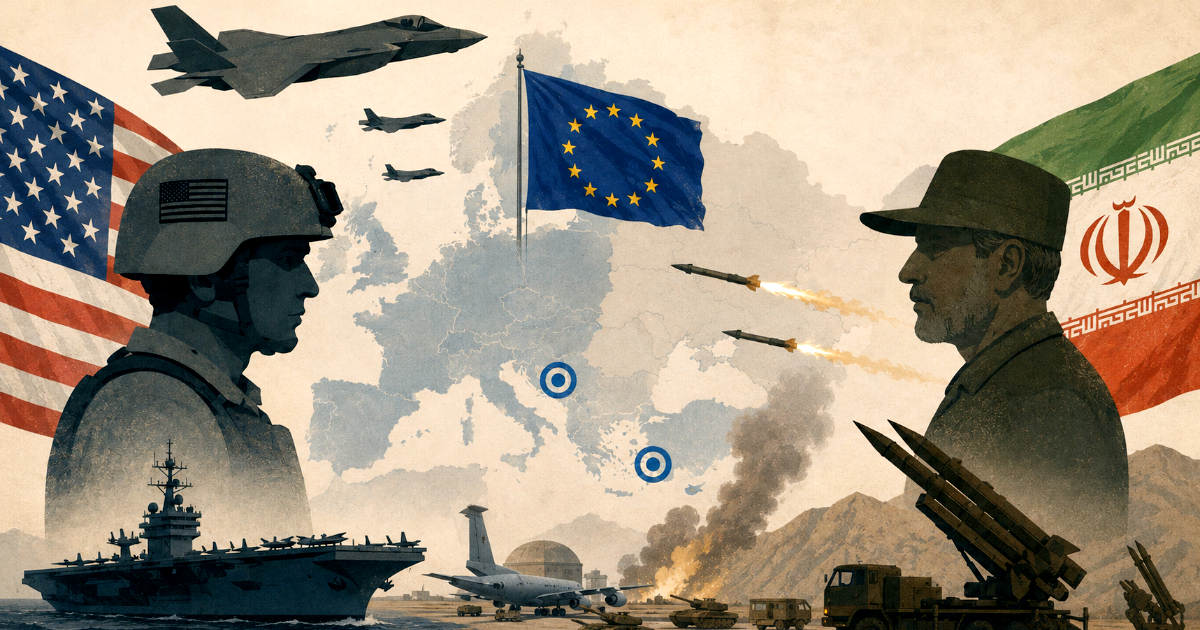
The Iranian regime is assessing striking U.S. military bases on European soil if Donald Trump decides to intensify the offensive, as revealed this Wednesday by the newspaper Financial Times, citing two sources from the Tehran government.
Among the possible objectives are U.S. assets in southeastern Europe, with particular attention to Bulgaria, which last month authorized the use of its Bezmer airbase for American refueling aircraft, and Cyprus, whose British Akrotiri airbase was targeted by a drone in March of this year.
The same sources indicated that Iranian forces have also considered attacking undersea fiber optic cables in the Strait of Hormuz as a retaliatory measure in response to a potential escalation of the conflict.
The Financial Times emphasizes that these threats reflect a challenging mood in Tehran, where large sectors of the regime consider a resumption of large-scale war to be inevitable.
The Islamic Revolutionary Guard Corps and other military commanders have warned that, in a new large-scale confrontation, Iran would abandon its previous strategy—focused on attacking military assets and energy infrastructure in the Middle East—to target much more distant objectives.
Experts consulted by the British newspaper indicate that Tehran could deploy medium-range ballistic missiles from the Shahab series against American positions in the south and southeast of the European continent.
In parallel, the chief of staff of the Iranian Armed Forces, General Ali Abdollahi, issued a direct warning to the countries of the Persian Gulf on Wednesday: "We warn: any assistance or facilitation provided to the aggressive U.S. military will be considered participation with the U.S. armed forces."
Abdollahi added that "nothing escapes our attention" with regard to Washington's military activities in the region.
The warning comes amid a new crisis between Iran and the United Arab Emirates: Abu Dhabi accused Tehran of launching two ballistic missiles against its territory and, in response, suspended all its commercial relations, trade exchanges, and financial transactions with the Persian country.
The spokesman for the Iranian Foreign Ministry, Ismail Bagaei, described those accusations as "groundless."
The conflict originates from the so-called Epic Fury Operation, the coordinated attacks launched by the U.S. and Israel against Iran on February 28, 2026.
After weeks of bombings, a ceasefire mediated by Pakistan came into effect in April, and in June, both parties signed a memorandum of understanding in Switzerland that included the cessation of hostilities and the opening of the Strait of Hormuz.
However, on July 18, Iran announced the suspension of its commitments under that agreement, Trump declared the truce over, and resumed aerial offensives on July 30.
Since then, Washington has combined military pressure with a strategy of economic suffocation: it revoked the exemption that allowed Iran to export oil, imposed new financial sanctions on August 7, and is preparing an economic isolation plan designed to strangle the regime's finances.
On Tuesday, Trump confirmed that there were no ongoing or scheduled talks with Tehran, highlighting the complete stagnation of diplomatic dialogue and fueling fears of a new military escalation that could, for the first time, extend to European soil.
Related videos:
Filed under: