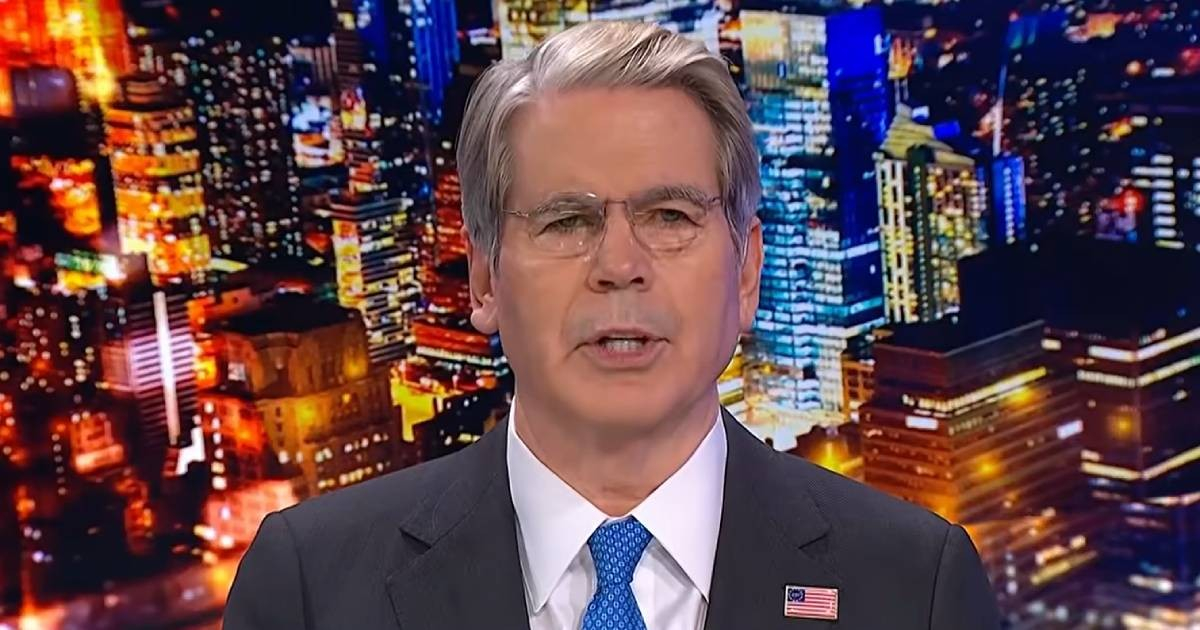
The U.S. Secretary of the Treasury, Scott Bessent, once again placed Cuba at the center of his discourse on Washington's economic pressure policy, this time comparing the prolonged survival of the Cuban regime under sanctions with what has occurred in Venezuela and the strategy that the Donald Trump administration applies against Iran.
During an interview on the program "Rob Schmitt Tonight" from Newsmax, aired on Thursday, Bessent referred to Cuba and Venezuela to address those who question how long a government can withstand severe economic restrictions.
"People say, well, Cuba lasted for a long time. Venezuela lasted for a long time. Venezuela collapsed immediately when we imposed the blockade," the secretary asserted.
The reference to the island arose while Bessent was arguing that the combination of unprecedented economic isolation and the naval blockade of the Strait of Hormuz would represent a "two-pronged blow" against Tehran. In that context, his remarks acknowledge that the Cuban regime has managed to persist for decades despite prolonged U.S. pressure, although the official maintained that the measures planned against Iran will have a different dimension.
Bessent announced that Washington will implement "measures like never seen before in the history of a country's economic isolation" against Tehran next week, which will be added to the naval blockade that, as he explained, prevents traffic through Iranian ports.
Cuba had already come up at the beginning of the conversation, although in a different context. When host Rob Schmitt asked about the progress of socialism within the Democratic Party, the secretary once again referred to the island as an example of the failure of that political and economic model.
"Show me where it has ever worked, whether it was the Soviet Union, Cuba, or Venezuela. With these policies, you always end up with less," he stated.
Bessent's mentions are not isolated. Cuba has become a recurring reference in his public statements since he took office, particularly when addressing the sanctions, the island's economic crisis, and the possibilities for political change.
In March 2026, during an interview with Fox Business, he predicted a "slow-motion regime change" in Cuba following the capture of Nicolás Maduro and linked the future of the Cuban government to the new political landscape emerging in Venezuela.
Two months later, he warned that U.S. sanctions against Cuba "can increase or decrease" depending on Havana's behavior, and he described Washington's policy as a strategy of "carrot and stick."
At the end of July, he intensified his rhetoric even further. During a speech in Marietta, Georgia, he included Havana, Moscow, and Caracas in what he described as “a hellish landscape of deprivation”, once again questioning the political and economic models of those governments.
The statements come amid a continued tightening of the Trump administration's policy toward Cuba in 2026.
In May, Executive Order 14404 introduced secondary sanctions against foreign companies operating with sanctioned Cuban entities. In June, Secretary of State Marco Rubio, designated CUPET as a sanctioned entity, while in July Washington sanctioned the Port of Mariel and other entities linked to the energy sector.
At the beginning of August, the United States took another step in this offensive by imposing new measures against five entities and eight individuals related to the island. Since January 2026, more than 240 sanctions against Cuba have reportedly been applied, according to reports gathered by this outlet.
In the face of increasing U.S. pressure, Havana has maintained its usual discourse of resistance. However, Miguel Díaz-Canel himself acknowledged in June that "creative resistance is not enough" to pull the country out of the deep crisis it is experiencing, characterized by power outages, shortages, deteriorating public services, and a prolonged economic contraction.
The Cuban government has also publicly rejected the forecasts from Washington regarding a potential political change on the island. In March, Deputy Foreign Minister Carlos Fernández de Cossío stated in an interview with NBC News that regime change "is off the table," in direct response to the projections made by Bessent.
The new statement from the Treasury Secretary thus reinstates Cuba and Venezuela as points of comparison within the Trump administration's pressure strategy, although this time to argue that the economic blockade designed against Iran aims to achieve an intensity that, according to Washington, would be unprecedented.
Related videos:
Filed under: