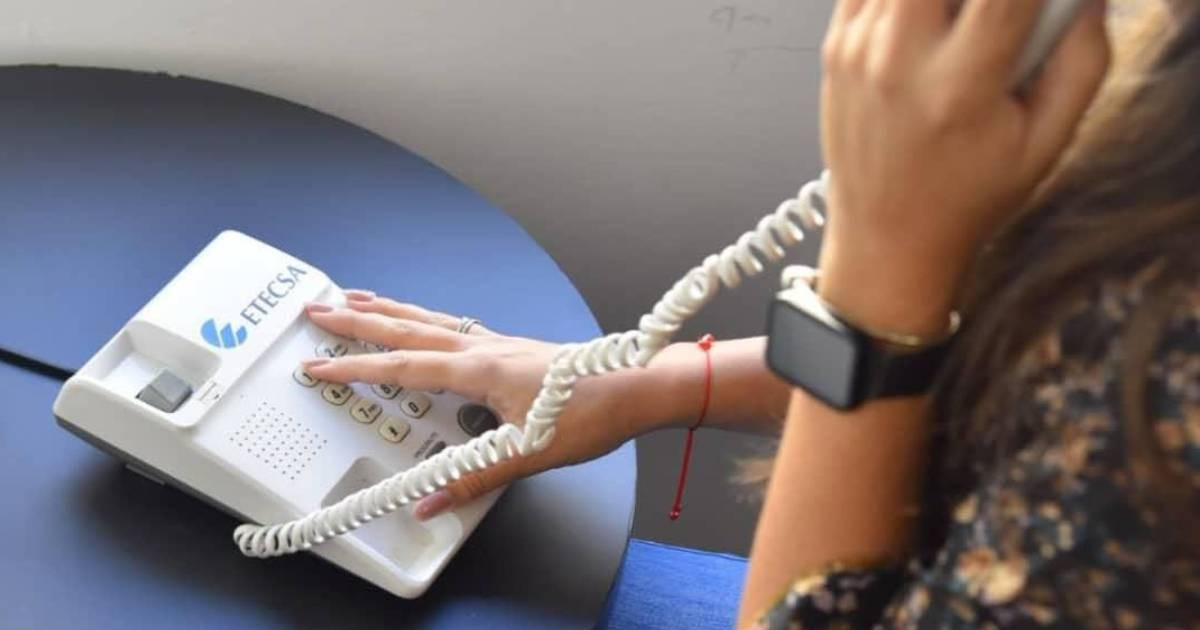
A massive earthquake alert that turned out to be false triggered panic this Tuesday in at least nine Cuban provinces, and the citizens' reaction quickly pointed towards ETECSA as a possible culprit, amid the accumulated distrust towards the state telecommunications monopoly.
Shortly after 3:00 p.m., millions of Android phones and tablets received the seismic alarm in Mayabeque, Granma, Holguín, Matanzas, Havana, Ciego de Ávila, Camagüey, Las Tunas, and Santiago de Cuba, causing evacuations and scenes of chaos in various cities.
The National Center for Seismological Research (CENAIS) immediately refuted any basis for the warning.
However, many Cubans directed their criticism straight at ETECSA, questioning why the company did not clarify or manage the situation.
The writer and activist Laritza Camacho was one of the most direct voices on the matter, with a Facebook post that combined irony and critique about the state of the country.
"When the phones went off, everything was already shaking. Looking for a simple pumpkin in Cuba is like navigating through an earthquake, and this is how it is with everything. You look at the city, walk through it, and are amazed to find life among the rubble," wrote Camacho, before posing the question that many were asking: “Who set off the alarm? ETECSA?”
Although a minor earthquake was recorded that same day in Ciego de Ávila, the authorities clarified that its characteristics did not match the mass alert received on the devices.
The most likely technical cause points to Google's Android earthquake alert system, which uses the accelerometers of millions of phones as a distributed detection network: when enough devices report vibrations consistent with an earthquake, the system automatically generates an alert without intervention from local seismic authorities, and it can produce false alarms when the data is ambiguous.
The episode adds to a growing atmosphere of distrust towards the state-owned company, which has faced ongoing criticism since the rate hike of 2025 for not having improved service quality despite the price increase.
The comedian Ulises Toirac, who has been leading a public campaign against ETECSA for months, attacked the company again following the false alarm.
Since June 2026, Toirac has repeatedly demanded that ETECSA reinvest the profits from the rate hike into infrastructure— including backup batteries for its towers— or allow the entry of private alternatives like Starlink to Cuba.
Until this Wednesday, Cuban authorities had not officially determined the exact cause of the massive activation of notifications, leaving unanswered the question that thousands of Cubans continue to ask themselves.
Related videos:
Filed under: