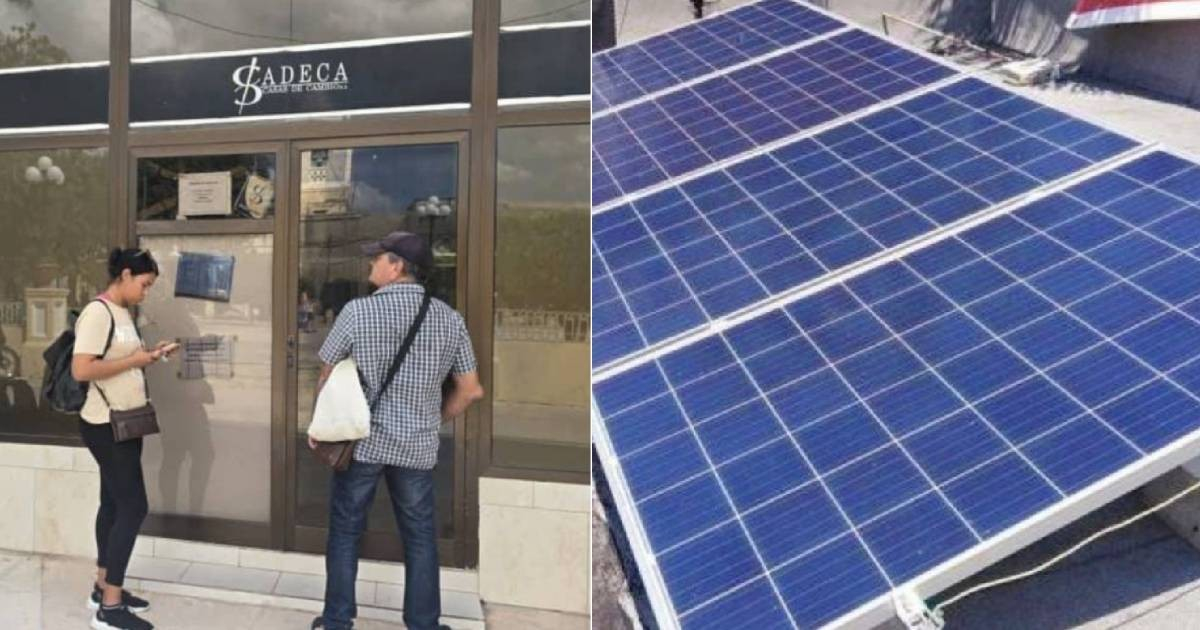
The user L. Eduardo Domínguez posted on Facebook an analysis that contrasts seven economic promises of the regime with the reality faced by the Cuban population, in a recount that covered everything from stores in foreign currency to the electricity crisis.
"Today I just want to jog your memory a bit, in case the top executives forget what they promised," wrote Domínguez at the beginning of a post that reviews the main failures of Cuba's economic policy between 2019 and 2026.
The first target is the creation of stores in freely convertible currency (MLC). In July 2020, according to the official Granma, officials from Tiendas Caribe and CIMEX stated that there would only be 72 establishments for mid-range and high-end products, without displacing the supply in Cuban pesos. What followed was the opposite: chicken, oil, and hygiene products disappeared from the markets in national currency and migrated to the shelves that required foreign currency.
The promise that the currency collected would replenish the market in pesos also was not fulfilled. "The markets in CUP were never replenished," says Domínguez, who points out that the MLC stores themselves ultimately collapsed while the regime expanded sales directly in dollars. By May 2025, at least 80 stores operated exclusively in dollars, far exceeding the limit that authorities had promised not to surpass.
Regarding dollarization, the contrast is even more striking. In October 2020, the then Minister of Economy, Alejandro Gil, stated at the Round Table that "Cuba will not dollarize its economy" and that the stores in MLC were "necessary but temporary". Years later, the regime itself acknowledged a "partial and temporary dollarization," as the dollar spread to commerce, services, telecommunications, and even gasoline.
Another point of the analysis focuses on the Ordering Task from December 2020, which directed that "people, not products, should be subsidized." The removal of universal subsidies, combined with inflation that closed 2024 at 24.88% year-on-year according to the National Statistics Office, left workers and retirees without real economic protection. The UN linked this reform to the worsening of the food crisis on the Island.
The substitution of imports, a slogan echoed in every Communist Party congress for decades, receives similar treatment. Cuban agricultural and industrial production has seen declines greater than 30% and 50% respectively, and today Cuba imports more than 80% of the food it consumes, with an expenditure nearing 2.5 billion dollars annually.
The "tarifazo" by ETECSA in May 2025 —which limited reloads in pesos to 360 monthly and launched plans in dollars— was justified by company executives as a step towards "self-financing" to modernize the infrastructure. More than a year later, ETECSA collects millions while the service sinks: mobile telephony sees constant drops worsened by power outages and the lack of energy autonomy of the radio bases.
The last point of the report addresses the program of 92 solar photovoltaic parks announced in 2024, with a total capacity of 2,000 MW. The Minister of Energy and Mines, Vicente de la O Levy, promised in December of that year that daytime electricity demand would be met starting in June 2025. The reality in 2026 is quite different: the National Electricity System is experiencing deficits exceeding 2,000 MW, with blackouts lasting between 30 and 40 continuous hours in Havana and up to 70 hours in other provinces, along with at least six total system collapses so far this year.
Domínguez concluded his post with an open invitation: "Leave other unfulfilled promises in the comments and I will add them." The comments quickly flowed in, with users sharing their own memories of historical shortcomings and agreeing that the regime's tactic has always been the same: "to make us lose our sense of time" with recycled resolutions that never lead to real improvements.
Related videos:
Filed under: