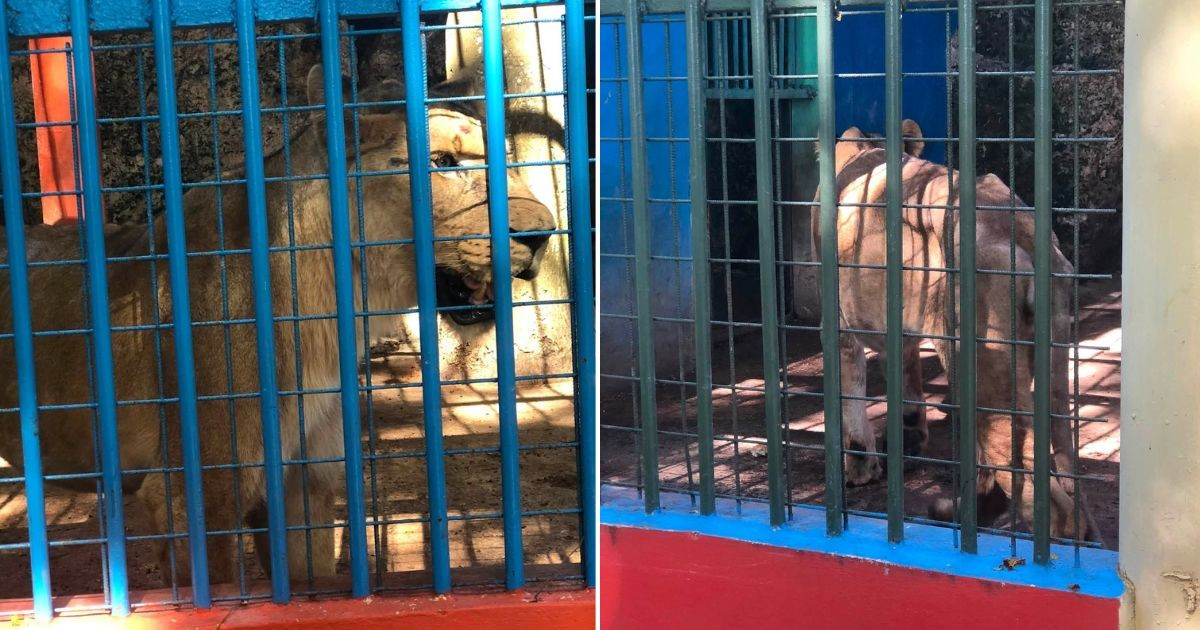
Reports about animals showing signs of malnutrition in state-run zoos in Cuba continue to emerge. Following the recent scandal in Las Tunas, where one of two extremely thin lions died after being attacked by the other, a new alert now highlights the deteriorating condition of several animals at Watkin Park in the city of Matanzas.
The Cuban Arielys Pérez reported this Friday on Facebook that the lions at the Matanzas zoo show, in her opinion, a "very advanced level of malnutrition", and she stated that the situation also affects monkeys and other animals in the facility.
"Matanzas is not lagging behind when it comes to the hunger of the animals in the zoo," wrote Pérez, who identified the facility as Watkin Park.
The complainant stated that in the lions, the bones can be clearly distinguished due to their thinness.
"If you enlarge the images, you can see each vertebra of the spine," he stated in his complaint, which was accompanied by photos and video.
According to their testimony, the monkeys also show signs of malnutrition, a situation that they found particularly difficult to justify because their diet, like that of other herbivorous or omnivorous animals in the enclosure, could be supplemented with fruits, roots, and vegetables.
Pérez suggested that agreements could be established with agricultural markets to recover products suitable for animal consumption before they end up discarded.
"Not only carnivores are affected by the 'existing situation'; the ones that are easier to feed are also in poor nutritional condition," she reported, also mentioning rabbits and iguanas.
The new statement comes just days after a series of complaints that put the Las Tunas zoo under intense scrutiny and resulted in the death of one of its two lions.
The problems in that province, however, had been ongoing for much longer. In February, Bienestar Animal Cuba reported abandonment and hunger at the Puerto Padre zoo, where the lions showed visible signs of malnutrition, remained on concrete surfaces, and had limited access to water under suitable conditions.
Signs of weakness and malnutrition were also observed in birds and primates.
Months later, the alarm was raised again in the city of Las Tunas itself.
In mid-August, residents reported the extreme thinness of the two lions at the provincial zoo.
The images showed the felines with their ribs and other bones clearly visible, amidst questions about the institution's ability to provide them with food and proper conditions.
The situation had a fatal outcome a few days later: one of the lions died after being attacked by the other specimen.
Representatives from Animal Welfare Cuba in Las Tunas stated that the animals had gone about 13 days without food, while another report mentioned they had not received any meat products for over 15 days.
The activists linked the violent episode to the prolonged period without food and reported that the zoo did not have its own means to consistently provide the meat that the felines needed.
The official version arrived later: the Provincial Government of Las Tunas denied that one lion had killed the other with the intention of eating it, but acknowledged a fundamental point from the reports: the animals had indeed gone several days without being fed.
"Nothing justifies the failure to feed the animals for so many days," the authorities admitted, labeling the events as "unacceptable" and promising to investigate accountability.
The government itself also acknowledged the "deterioration and impoverishment" of the zoo. It stated that after becoming aware of the gravity of the situation, it coordinated with supplying agencies to deliver food for the surviving lion and the other species.
Related videos:
Filed under: