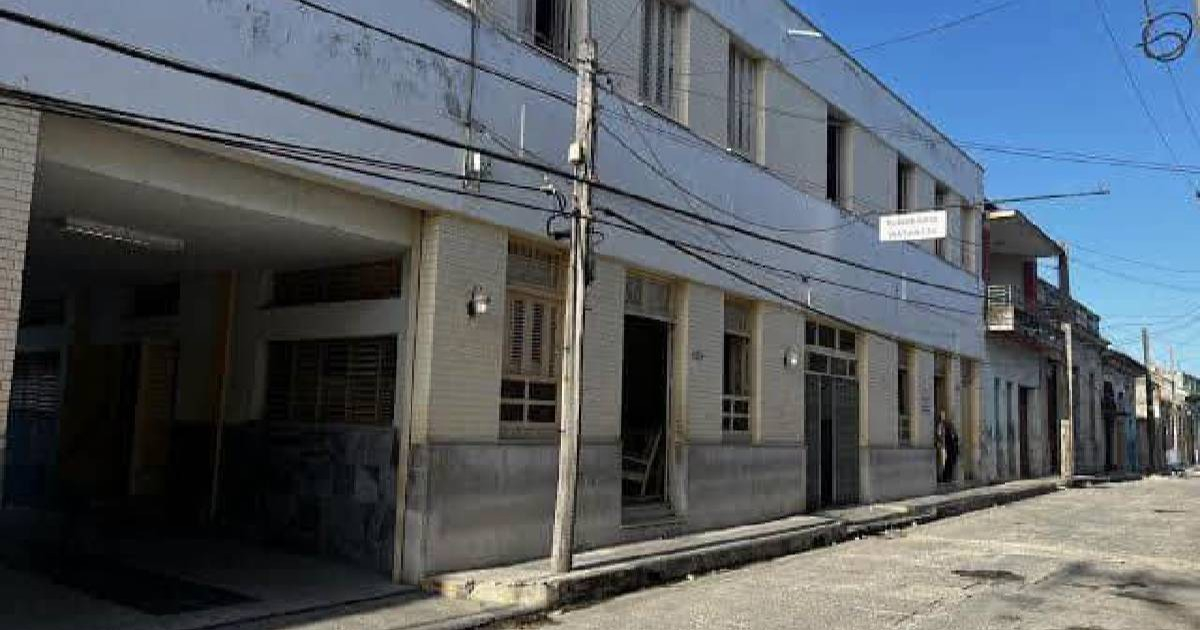
The Funeraria de Matanzas received a solar kit in March intended to ensure service during power outages, but the system has been malfunctioning for over four months, forcing families to keep vigil over their deceased in the dark.
Thus denounced Indira Hernández García, director of Necrological Services of the municipality, who described a pattern that repeats daily: the system operates for a few hours and then disconnects automatically, not recovering until the next day.
"In the morning, the panel goes off, and it isn't until the next day, around two in the afternoon or three in the afternoon, that it works again," explained the director.
The kit is installed on the ground floor of the building, where two wake rooms and the reception operate. The load it supports is minimal: energy-saving bulbs, a television that is hardly ever used, and a small water cooler. “We don’t even have cold light lamps, just energy-saving bulbs,” specified Hernández García.
In addition to the chapels, there is a crown factory operating in the funeral home, whose activity also comes to a halt whenever the system fails.
The director assures that the provider, Soluciones CEDAI Atenas, receives calls daily without the issue being resolved. "We call him every day. He says he has a lot of work and is going through the ones that have come in, but it’s still not our turn," she stated.
The company responded publicly with a technical explanation. According to CEDAI Atenas, the installed equipment has a nominal power of 2 kW and batteries equivalent to 6.7 kWh of storage, and it was designed for the "energy survival" of the center during blackouts, not as an unlimited substitute for the electrical grid.
The company asserts that the described behavior—operating for several hours and then turning off until the next day—"is precisely the expected behavior when the consumption approaches or exceeds the limits of the equipment, and not an indication of poor installation."
CEDAI Atenas points to two possible causes: an instantaneous overload that triggers the inverter as a protection mechanism, or the progressive depletion of the battery when consumption remains near the limit for hours. It also notes that the building’s old wiring could exacerbate the issue by causing voltage losses.
The company installed 87 solar kits in the municipality of Matanzas at the beginning of the year, as part of a provincial program of 326 photovoltaic systems distributed among isolated homes and essential centers, including 19 funeral homes, 32 polyclinics, and nursing homes, among others.
The case illustrates the gap between the expectations of the institutions receiving this equipment and their actual technical capacity, in a province that has recorded power outages of up to 85 consecutive hours and has eight substations out of service and 63 damaged transformers.
While the technical dispute between the funeral home and the supplier remains unresolved, the director is awaiting a specialized review to determine the cause of the shots. For now, the families from Matanzas who come to bid farewell to their loved ones have no guarantee that there will be light.
Related videos:
Filed under: