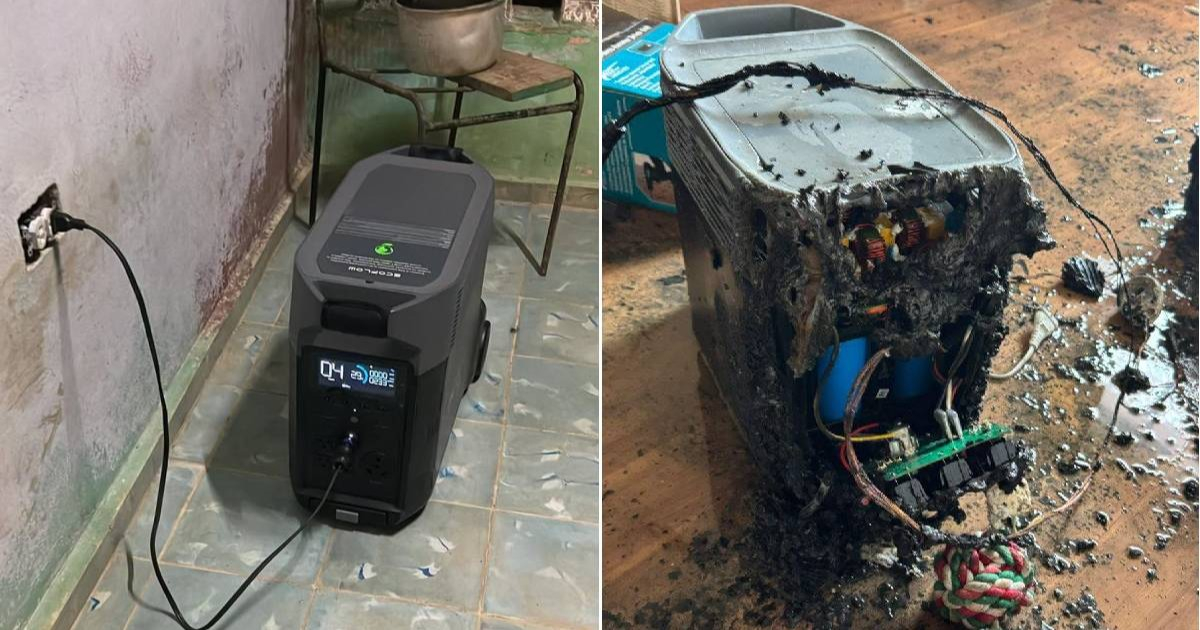
The portable energy stations that thousands of Cuban families use to survive blackouts — brands like EcoFlow, Bluetti, Jackery, or Anker — can become a deadly threat if used improperly, according to an alert shared by the page Santiago de Cuba Hoy that outlines the risks of overheating and fire associated with these devices.
The warning became urgent following the incident on July 9 at Miami International Airport, where a lithium battery caught fire inside a passenger's luggage as they were preparing to travel to Cuba.
On social media, the device was identified as an EcoFlow, although the official statement from the airport only confirmed it was a lithium battery, without specifying the brand or model. The fire was extinguished immediately, and there were no injuries.
Meanwhile, there is an official market recall in the United States that specifically affects the model EcoFlow DELTA Max 2000, identified as EFD310.
The Consumer Product Safety Commission recalled that model after receiving reports of equipment catching fire, with six confirmed incidents and over $850,000 in property damage.
The measure reaches approximately 25,032 units sold between July 2022 and May 2025. Those who own that specific model should check the label on the bottom of the device, cease its use, and contact the manufacturer to receive a free firmware update. The recall does not affect all models of the brand.
In Santiago de Cuba, incidents related to lithium batteries have occurred with alarming frequency. In July 2024, four motorcycles were burned in a garage in Micro 9. Months later, a motorcycle caught fire inside a home in the Santa Bárbara neighborhood.
On a national scale, specialists from the National Fire Department indicated that between 2019 and mid-2023, Cuban firefighters responded to more than 3,000 fires related to electric scooters or lithium batteries, resulting in around 200 fatalities or injuries. More than 67% of the victims experienced the incident between 10:00 p.m. and 7:00 a.m.
The technical danger behind the most severe cases is thermal runaway: "when a damaged cell starts to heat uncontrollably, it can transfer heat to the remaining cells and release toxic and flammable gases."
Lithium iron phosphate batteries (LiFePO₄) are more stable than other variants, but they are not flame-resistant if they are damaged, punctured, overcharged, or modified.
Among the most dangerous practices identified by specialists is connecting the station's output to a household power outlet using a cable with two male plugs, which can lead to fires and unexpectedly energize the electrical installation.
It is also advised not to charge devices unattended overnight, to avoid placing them in bedrooms or near combustible materials, and to refrain from using them with non-original chargers or homemade batteries.
Experts recommend unplugging chargers from the wall during power outages to prevent them from automatically starting to charge when the electricity returns with voltage fluctuations.
In the event of smoke signals, chemical odors, hissing, or equipment deformation, the message is clear: do not touch the device, evacuate the premises, and call 105, the Fire Department number in Cuba.
"The fundamental rule for families is simple: charge during the day, supervise the equipment, keep it in a ventilated area away from bedrooms and exits, do not attempt to fix it yourself, do not modify it, disconnect it during power outages, and evacuate immediately in case of smoke, strange odors, or hissing," concludes the alert.
Related videos:
Filed under: