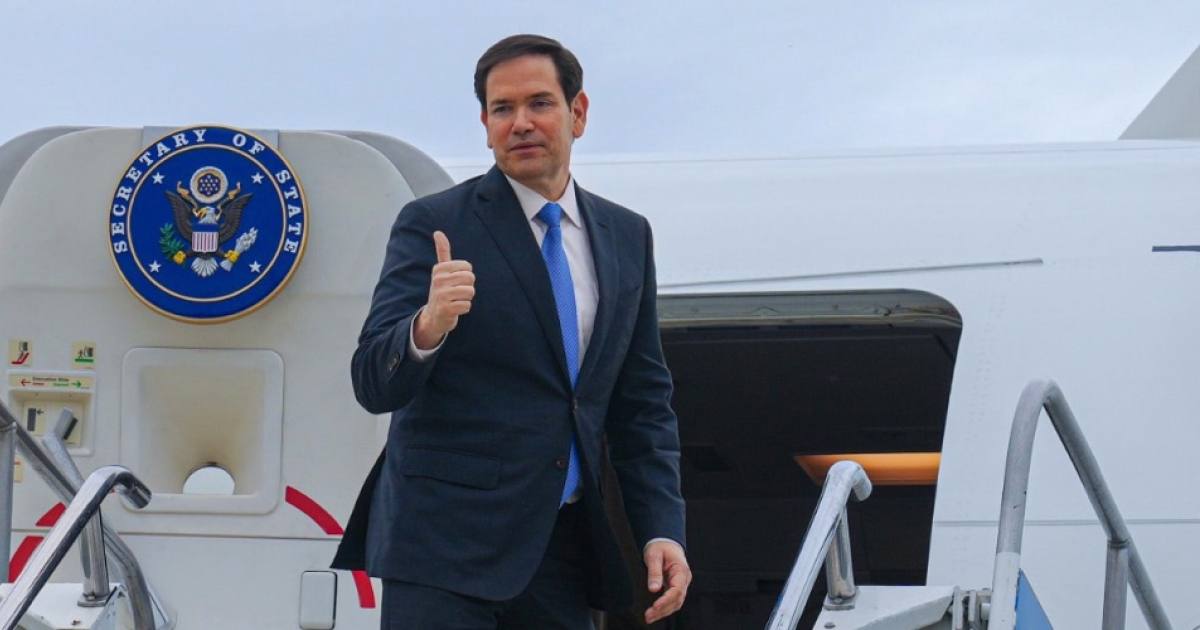
In Cuba, there is an expression that doesn't need much explanation: “That’s my rooster.” It refers to a person who enters a fight with potential, someone who knows how to handle themselves, who can withstand pressure, and who can succeed. Therefore, it is not surprising that when some polls about the hypothetical U.S. presidential elections of 2028 emerged, many Cubans felt a great sense of pride in having Marco Rubio in the high politics of this great nation. And there are numbers that explain the enthusiasm.
A new national poll from Emerson College Polling, published on August 20th, places the current Secretary of State in a particularly interesting position. The study separately compared Rubio and Vice President J. D. Vance, the two leading Republican figures for the 2028 elections, against five potential Democratic candidates. Emerson's conclusion is unequivocal: Rubio performs better than Vance in those hypothetical matchups.
The most surprising result is against Kamala Harris. If Harris were to face Vance, the former vice president would win 49% to 45%. But if the Republican were Marco Rubio, the result would change completely: Rubio 48%, Harris 43%. We're not talking about a small variation. When facing exactly the same opponent, there is a nine-point shift in the electoral margin: Harris goes from winning by four to losing by five.
Also against Gavin Newsom and Jon Ossoff, Rubio demonstrates greater competitiveness. Emerson notes that the advantages of both Democrats diminish when their opponent is Rubio. Pete Buttigieg, on the other hand, appears particularly strong and leads Rubio and Vance by five points.
It is certainly too early to declare favorites. There are still more than two years until the elections in November 2028, which feels like an eternity in U.S. political terms. The economy, a complicated war, a significant misstep by a candidate, or simply the emergence of a new figure can entirely change the landscape. However, polls can help identify trends. The interesting trend in this case is that Rubio seems capable of attracting voters that Vance is unable to engage, according to some surveys.
For Cubans, there is also a very important component. Marco Rubio is the son of Cuban immigrants and understands better than most the importance of the democratization of Cuba, Venezuela, and Nicaragua for the United States. Today, he holds one of the most important positions in the U.S. government: he is the 72nd Secretary of State of the United States.
There is another very interesting clarification. The Emerson survey did not directly pit Rubio against Vance in a Republican primary. Instead, it alternately positioned each one against potential Democratic candidates to see who would perform better in a general election.
Emerson precisely summarizes his finding by stating that Rubio "performs better than Vance" in multiple electoral scenarios for 2028.
In other surveys regarding the Republican primaries, the situation is much more contested. A national study by Overton Insights conducted this spring showed Vance at 39% compared to Rubio's 32% when multiple candidates were in the mix. However, when the question was narrowed down to a head-to-head match between Rubio and Vance, Rubio took the lead: 42% to 36%, with 22% still undecided.
Therefore, there are two different battles. One is to determine who would be able to secure the Republican nomination. In that fight, Vance remains a formidable opponent.
The other task is to determine which of the two would have better chances of capturing the White House against the Democratic candidate. And this is where the published figures now appear particularly favorable to Rubio.
It's also important to keep one's feet on the ground. Emerson interviewed 1,000 likely voters on August 16 and 17, 2026, and the study has a credibility interval of approximately ±3 percentage points. It's a snapshot of the moment, not an electoral prophecy.
But presidential races often begin just like this: first a poll appears, then another, the donors start to take notice, party leaders begin to make calculations, and voters start to wonder not only who they like more, but who can truly win.
In American English, that's referred to as 'electability.' In plain Cuban terms, the expression is much simpler: you need to closely examine which rooster has the better chances when the time comes for the fight.
But let's not forget that before the elections on November 5, 2024, most pollsters and analysts gave a slight advantage to Kalmala Harris over Donald Trump in what they considered to be a very close election. However, the Republican won the popular vote 49.8 to 48.3 for the Democrat. As for the Electoral College, Trump's victory was decisive: 312 to 226. So no matter what the polls say, until November 2028, no one knows who will be the next president of the United States.
But many Cubans cannot deny that we greatly wish to see Marco Rubio in the White House. He would do a great job for the United States, for the continent, for the planet, and, of course, also for the land of his parents. That is why I wanted to comment on this poll.
Related videos:
Filed under:
Opinion article: Las declaraciones y opiniones expresadas en este artículo son de exclusiva responsabilidad de su autor y no representan necesariamente el punto de vista de CiberCuba.