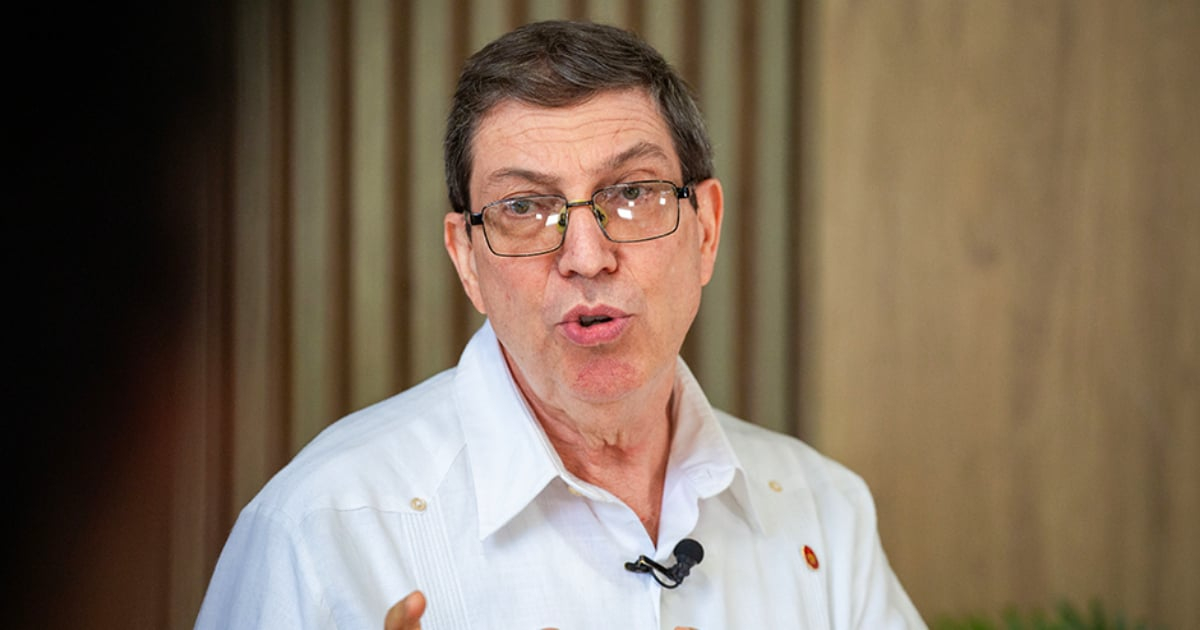
The Cuban Foreign Minister, Bruno Rodríguez Parrilla, responded this Thursday to a new round of sanctions imposed by the Trump administration against Cuban entities and officials, accusing Secretary of State Marco Rubio of deliberately acting to harm the island's economy and prevent the government from providing basic services to the population.
In a statement published on his X account, Rodríguez stated that the measures hinder the transport of containers with food, medicine, and medical devices, "mostly purchased by private Cuban small and medium-sized enterprises."
The new round of designations, announced this Thursday by the Office of Foreign Assets Control (OFAC) of the Department of the Treasury, added eight Cuban state-owned companies to the SDN list: Acinox Comercial, Acorec, Coratur, Transimport, Consumimport, the Comandante Ernesto Che Guevara Nickel Company, Metalcuba, and Geominsal.
The Ministry of Construction was also sanctioned, along with three individuals linked to the Cuban Institute of Friendship with Peoples (ICAP).
Among those designated is Fernando González Llort, president of ICAP since 2017 and a former member of the Cuban espionage network known as "Avispa," which operated on U.S. territory and was dismantled by the FBI.
González Llort served his sentence in U.S. prisons and was released in December 2014 as part of the normalization agreement between Havana and Washington under the Obama administration.
The ICAP had already been sanctioned as an entity on June 4, 2026, under Executive Order 14404 signed by Trump on May 1 of that year, which expanded the pressure framework towards sectors such as energy, defense, mining, metals, and financial services related to Cuba.
Rodríguez described the inclusion of ICAP on the sanctions list as part of a "failed obsession" of Rubio, and defended the institution as an organization that "for over six decades has promoted friendship, international solidarity, justice, and peace."
The chancellor contrasted that description with what he termed the "corrupt policy" of the Secretary of State, in a tone that has characterized his responses to each round of sanctions throughout 2026.
The sanctioning campaign of the Trump-Rubio administration against Cuba has been the most intense in decades. Among its milestones are the designations of GAESA and Moa Nickel in May, CUPET in June, the Ministry of Tourism in July, and Cuban military entities on August 6, when Washington targeted companies linked to arms imports and military cooperation.
The State Department maintains that the sanctions include explicit exemptions for food, medicine, and medical devices, which directly contradicts the central argument of the Cuban Foreign Minister.
Rodríguez, however, insisted that the measures affect the civilian population at a time when basic services are already in a critical situation, referring to the economic decline the island has experienced after years of the regime's management.
The former spy Fernando González Llort had already publicly challenged Rubio in previous weeks, following the initial sanctions against the ICAP as an institution, in a stance that the Cuban regime has turned into part of its narrative of resistance against U.S. pressure.
Related videos:
Filed under: