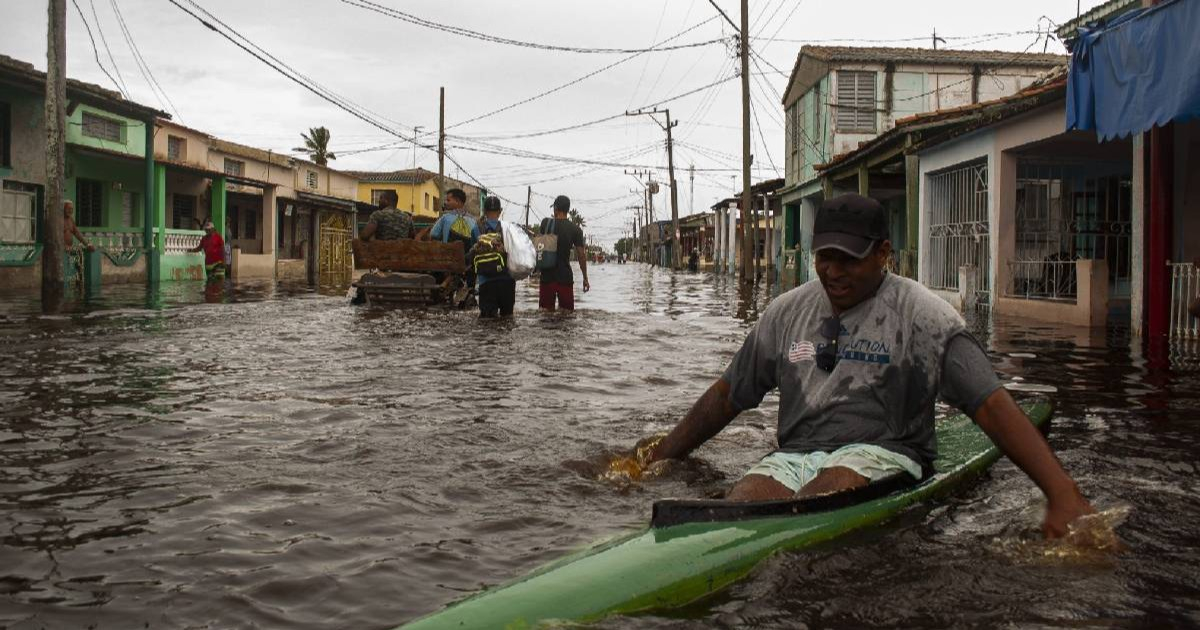
A coastal village founded over three centuries ago in the province of Mayabeque faces an existential threat today: the sea is encroaching, the mangroves are disappearing, and cyclones are hitting with increasing intensity.
Surgidero de Batabanó may face the risk of disappearing, and a series of photo reports published by Juventud Técnica documents this with images that leave no room for doubt.
The work is authored by the young journalist Yans Roberto Pérez Domínguez and is part of his undergraduate thesis on the impact of climate change on the community.
The photographs published this Thursday depict the devastation left by three weather events in just 50 days during the 2024 hurricane season: the tropical storms Helene and Milton, and hurricane Rafael.
"In just over 50 days, the inhabitants of Surgidero de Batabanó witnessed the violence with which water took over the streets of the community, a direct consequence of climate change and the gradual destruction of the coastal mangrove ecosystem," wrote the journalist.
Helene dropped 85.1 millimeters of rain on the town on September 26, 2024, overflowing all the river systems and leaving over a meter of water in the lowest areas.
Rafael was even more brutal: he accumulated 183.7 millimeters in just 24 hours during November of that same year.
Among the stories that illustrate the magnitude of the disaster is that of Yelenis Díaz and Marcos Iván Cintras, a married couple from Holguín with two children—one of whom is a newborn—living in one of the houses closest to the coast.
During Rafael's passage, the front wall of his house tilted, the roof flew off 90 degrees to the east, and the interior turned into a swamp of water and mud.
Almost two years later, Marcos repaired the house with his own means. The family has not left. "The family continues to live a few meters from the coast, hoping that no cyclone will come to flood their feet," the photo report recounts.
The problem, however, goes far beyond cyclones. Flooding in Surgidero is recurring: in June 2020, residents reported entire days of flooding caused simply by southerly winds, without any significant weather phenomenon involved.
The natural barrier that historically protected the settlement has been severely damaged: 83% of the mangroves between Surgidero and Playa Mayabeque are either totally or partially destroyed, according to the Ministry of Science, Technology, and Environment (CITMA).
Resolution 252/2021 from CITMA has already identified the stretch between Surgidero de Batabanó and Playa Tasajera as an area of moderate erosion with a total flooding risk by 2050.
Modeling studies project that the reach of coastal flooding could extend to 2,200 meters by that date and to 2,300 meters by 2100, in the event of a category 3 hurricane.
On a national scale, between 15 and 22 Cuban coastal settlements could be completely submerged by 2050, and up to 130 could experience partial impacts by 2100, according to estimates from the macroproject "Coastal Hazard and Vulnerability" by CITMA.
The Mi Costa project, funded by the Green Climate Fund and implemented by the Environmental Agency of CITMA with support from the United Nations Development Programme (UNDP) between 2022 and 2026, includes Surgidero de Batabanó among its seven priority intervention settlements, featuring actions for mangrove restoration and enhancement of coastal resilience.
"The sea continues to encroach, and the loss of the coastal ecosystem is becoming increasingly frequent, posing the risk of the disappearance of the human settlement of Surgidero," warned Pérez Domínguez in his report, summarizing in one sentence the fate that threatens a town with over 300 years of history.
Related videos:
Filed under: