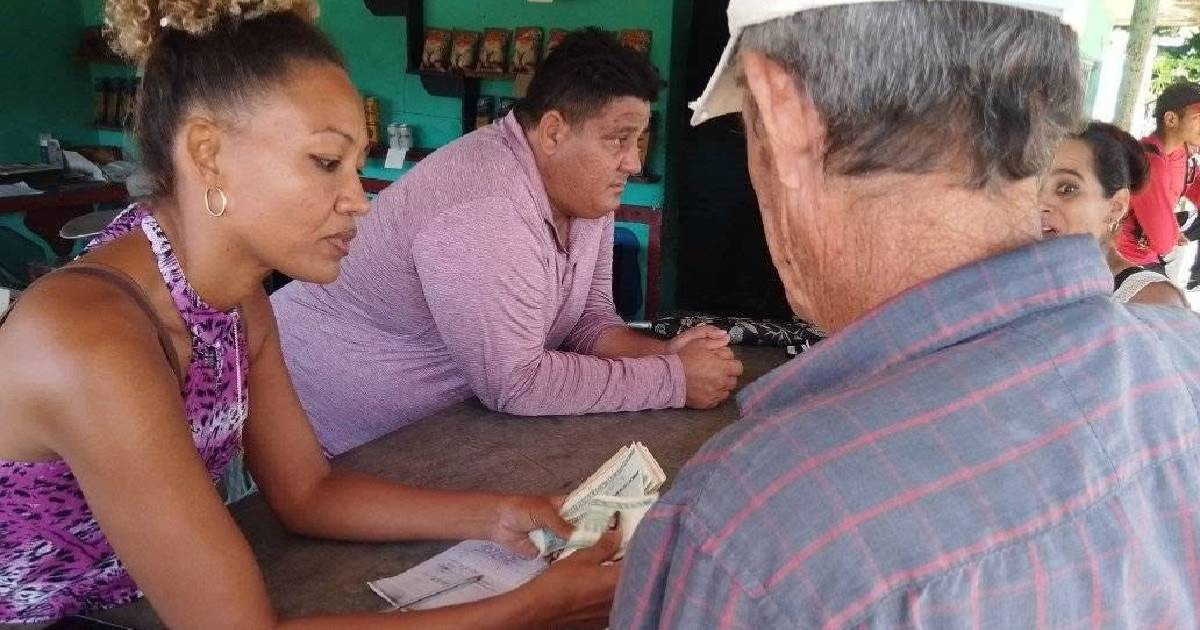
A private bar in the El Uno neighborhood of the municipality of Amancio, in the province of Las Tunas, has begun operating as a payment point for pensions, providing a service typically associated with banking institutions to self-employed workers.
Five self-employed workers took on the responsibility of paying the checks for more than 40 retirees in an initial phase, highlighted the official newspaper 26 this Friday.
The stated goal is to prevent elderly people from having to travel long distances and wait for several hours in banks to receive their money, assured the Communist Party entity in the eastern territory.
Everardo Suárez Báez, the owner of a bar located in the El Uno neighborhood, is one of the private workers involved in this task. He serves 10 retirees and manages the payment of checkbooks totaling over 50,000 pesos.
"They are checkbooks that are usually high; I have one that exceeds 8,000 pesos. People are very grateful for this measure approved by the Cuban state," stated Suárez, who also highlighted the role that, according to him, the so-called new economic actors are assuming in the municipality.
Since its establishment, the self-employed worker manages the payments for the assigned retirees this month.
Luisa and Humberto, two of the beneficiaries, expressed their satisfaction with the measure and thanked both the Government and the self-employed individual who decided to participate. They both noted that now they can collect their pensions without having to walk long distances or expose themselves to lengthy queues.
The initiative allows a private establishment to serve as a point for pension payments, while authorities aim to alleviate congestion in banking institutions and bring this service closer to communities.
The fact also highlights the extent to which private workers are being integrated into roles aimed at providing services that retirees need to receive regularly.
What the official media presents as a "high-impact social achievement" is, in fact, the direct consequence of the collapse of the Cuban state banking system.
More than 50% of the country's ATMs are out of service or empty, and retirees wait for hours, sometimes in vain, in lines to collect pensions that, at a minimum, are equivalent to less than 10 dollars at the unofficial exchange rate.
Amancio's case falls within a national framework formalized by the Central Bank of Cuba on July 17, as part of a package of 176 emergency economic measures.
The model, named Caja Extra, started as a pilot plan in April in four municipalities of Havana and has been expanding to other provinces.
In Guantánamo, 113 private businesses are already operating under this model, making payments to over 3,000 retirees. The provincial director of Labor and Social Security in that province, Oscar Mendoza Pérez, acknowledged that the number "is still insufficient" and that the goal is for 70% of the 68,000 retirees in the easternmost of Cuba's provinces to receive payments in this way.
The scheme, presented as voluntary, has coercive aspects. The accounting deputy director of Bandec in Guantánamo, Yuder Ortiz González, was explicit.
"It is not the same for someone who becomes a financial agent, helping the bank to make the payment, as it is for an actor who does nothing. Therefore, all those analyses will be taken into account when interacting with an economic actor," he argued.
Economist Elías Amor described the mechanism as "madness" and warned that if a business lacks funds on the payment day, the regime might use it as an excuse to shut it down. "Just imagine if a pensioner arrives on the 1st to collect their pension and it turns out that you have had a poor day selling plates of food," he analyzed.
The paradox is that the regime forces private businesses to accept electronic transfers under threat of fines and closures, while simultaneously tasking them with distributing the cash that state banks do not have.
Cuba has more than 1.7 million retirees, whose minimum pension is 4,000 pesos per month, compared to a basic basket that exceeds 30,000 pesos per person.
The official newspaper Venceremos, from Guantánamo, acknowledged at the beginning of July that the banking crisis "has ceased to be a banking difficulty and has become a social problem".
The National Assembly of People's Power ordered the government and the Central Bank of Cuba to adopt new measures to improve banking services for the population, through Agreement X-171, approved on July 29 and published this Friday in Official Gazette No. 67 Ordinary of 2026.
Related videos:
Filed under: