The provincial director of the Banco Popular de Ahorro (BPA) in Guantánamo, Yaritza León Mustelier, revealed this Friday that 113 private businesses are handling cash payments for pensions to retirees in the province, due to the banking system's inability to guarantee this service on its own.
"Currently, 113 individuals have embraced this mode, doing so solely out of a human interest in providing an essential service to society, to that segment of the population that one day we all, as wage earners, will be part of," declared León Mustelier during an exchange with the press reported by the official newspaper Venceremos.
Although the official presented the scheme as a voluntary initiative driven by humanitarian reasons, the scheme is not as voluntary as the official rhetoric suggests.
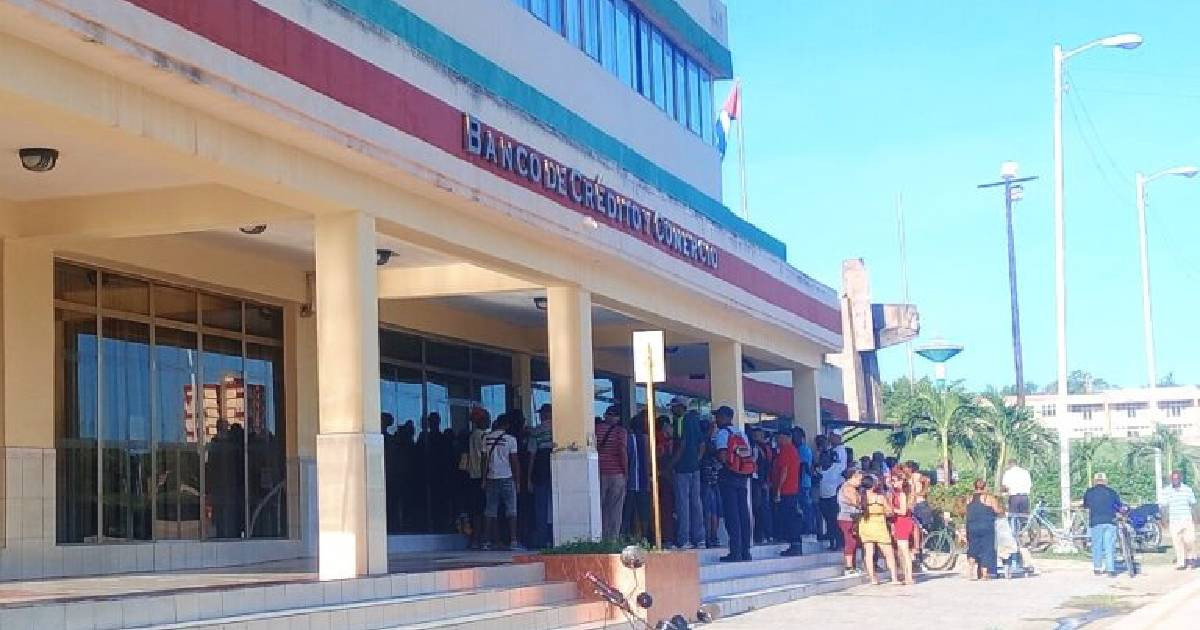
The accounting deputy director of the Credit and Commerce Bank (Bandec) in Guantánamo, Yuder Ortiz González, was explicit about the consequences of not participating.
"It's not the same for someone who becomes a financial agent and helps the bank process the payment as it is for an actor who does nothing. So all those analyses will be taken into account when interacting with an economic actor."
Businesses that sign contracts with the bank become banking and financial agents, and in return, they receive priority in banking services, expedited loans, and preferred access to cash, a very scarce resource in the province.
According to Venceremos, there are 68,000 retirees or pensioners in the province, of which 18,000 receive cash payments through the post, while the remaining 50,000 do so via card. "Those who want to convert their funds into physical currency face issues related to banking, a lack of cash at ATMs and branches, and even opportunists—new-style muggers with exorbitant interests in transactions with elderly individuals."
In this regard, Oscar Mendoza Pérez, the provincial director of Labor and Social Security, emphasized that "today there are 113 economic actors who have stepped forward in response to this call and are paying monthly contributions to over 3,000 retirees or pensioners, a figure that is still insufficient considering that we aim for 70% of all of them to receive payments through this channel."
The background is a liquidity crisis that the government of Guantánamo itself acknowledged in July. At that time, Bandec was capturing barely over 35% of the nearly 15 million pesos needed for daily operations, while more than 50% of the country's ATMs were either out of service or empty.
The very Venceremos acknowledged in early July that the situation "has ceased to be a banking difficulty and has become a social problem".
The model replicated in Guantánamo started as a pilot plan in April in four municipalities in Havana and expanded in May to Holguín, where about 20 micro, small, and medium enterprises paid pensions to nearly 5,000 retirees.
In July, the Central Bank formalized it as a nationwide measure within the package of 176 economic and social transformations approved by the National Assembly.
The paradox is striking, as authorities force businesses to accept electronic transfers under the threat of fines and closures, while simultaneously tasking them with distributing the cash that banks do not have.
In the easternmost province of Cuba, a municipal inspection director warned weeks ago that "there is no middle ground" for those who do not comply with digital payments, according to a report by Radio Guantánamo.
Three years after the regime implemented mandatory banking, only 3.77% of transactions in Cuba are digital, despite more than 15,240 fines and 269 closures of establishments nationwide.
Cuba has more than 1.7 million retirees whose minimum pension is 4,000 pesos per month, less than 10 dollars at the informal exchange rate, while a basic basket of goods requires more than 30,000 pesos.
The economist Elías Amor described the scheme as "madness" and warned that the payment of pensions is a state responsibility that cannot be shifted to the private sector.
"What I propose first is to immediately eliminate this madness. This is just another one of the many occurrences from the Castro regime, which later turn out poorly and they blame it on the blockade and the embargo for what goes wrong," he argued.
Related videos:
Filed under: