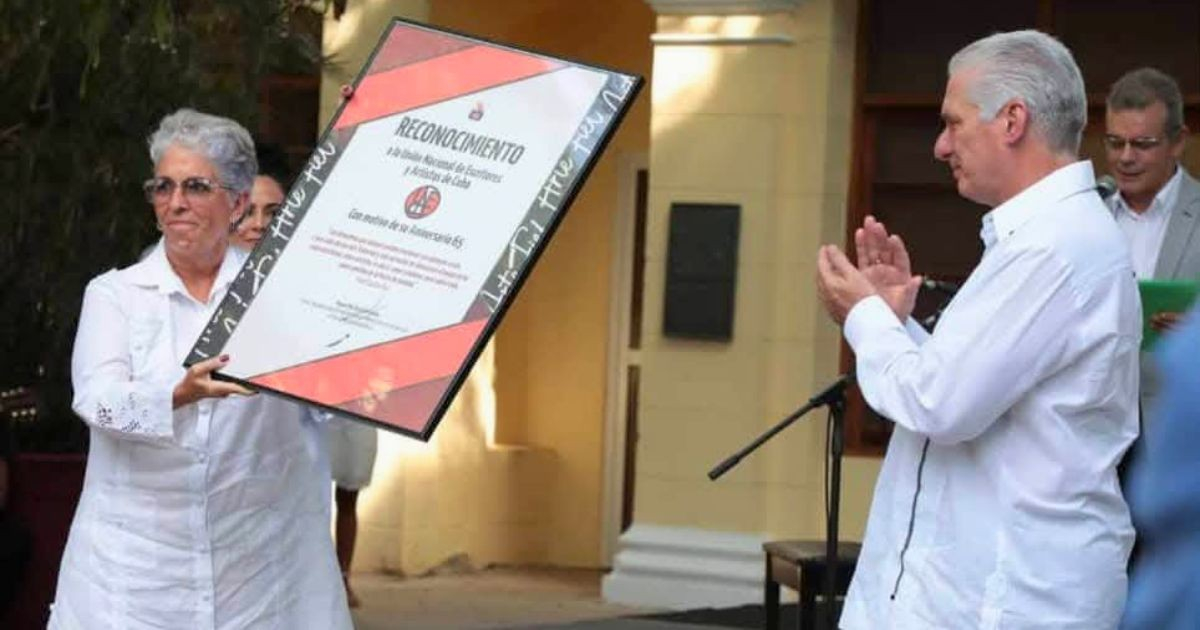
While Cuba endures blackouts of more than 20 hours a day, a peso that has plummeted to over 670 units per dollar, and a historic record of 1,415 protests and critical civic actions just in July, the regime found the perfect way to celebrate this Friday: gathering the "intellectual and artistic vanguard of the country" in the garden of the Union of Writers and Artists of Cuba (UNEAC) to commemorate its 65th anniversary with speeches of loyalty, awards for revolutionary merit, and artworks dedicated to or inspired by the Castros.
The ceremony was presided over by Miguel Díaz-Canel, in his dual capacity as President of the Republic and First Secretary of the Communist Party, along with the Minister of Culture Alpidio Alonso and the President of UNEAC, Marta Bonet de la Cruz. To ensure that no one from the ideological apparatus was absent, several officials from the Ideological Department of the Central Committee also attended, led by their head, Yuniaski Crespo Baquero.
The event began with the National Anthem, a recorded voice of Nicolás Guillén reciting "It’s All Over," and a fragment from the famous "Words to Intellectuals" delivered by Fidel Castro in 1961, where he forever defined the boundaries of Cuban culture: "Within the Revolution, everything; against the Revolution, nothing." Sixty-five years later, the UNEAC continues to demonstrate that it learned the lesson well.
The highlight was the awarding of the "Arte fiel" distinction to nine personalities: Miguel Barnet, Abel Prieto, Nancy Morejón, Verónica Lynn, Frank Fernández, Lesbia Vent Dumois, Santiago Alfonso, Digna Guerra, and Luis Morlote. On behalf of the group, Vent Dumois delivered the words the regime needed to hear: "Here we have been, we are, and we will be until life grants us the energy and clarity. The Homeland will always need our contribution, and the people require the spirit of service that we learned as the sweetest duty of a revolutionary."
The event also included a round of artistic gifts with very specific recipients. The screenprint with serial number 1 was symbolically presented to Army General Raúl Castro Ruz —although it was physically received by Díaz-Canel, as the elderly leader did not appear on stage—. Additionally, a piece by the artist Janette Brossard, inspired by the centenary of Fidel Castro, was gifted to Díaz-Canel himself. Ultimately, gifts for the family.
At the same time, the UNEAC received from Díaz-Canel an award "for its commitment and dedication to Cuban art and literature and to the defense of the Revolution." The regime rewards those who reward it: a circle of mutual servility that has been spinning without pause for six decades.
The history of UNEAC is not just one of applause. It is also one of expulsions. In September 2024, the organization expelled the intellectual Alina Bárbara López Hernández for "activities against the revolution," which led to the solidarity resignation of the writer Jorge Fernández Era.
This anniversary celebration takes place while the country sinks, but does not renounce tributes to Fidel Castro. According to the Cuban Conflict Observatory, as cited by Infobae, July 2026 was the month with the highest number of protests and critical civic actions in the recent history of the Island, according to information from the Cuban Conflict Observatory. CEPAL projects a GDP decline of 6.5% in 2026; however, independent economists estimate that it may be even greater.
The evening concluded with a concert by Pancho Amat and the Cabildo del Son, featuring works by Nicolás Guillén, Pablo Milanés, and Ignacio Piñeiro, among others. Music for the faithful with which UNEAC continues to glorify Fidel Castro while the people seek ways to survive the upcoming blackout.
Related videos:
Filed under: