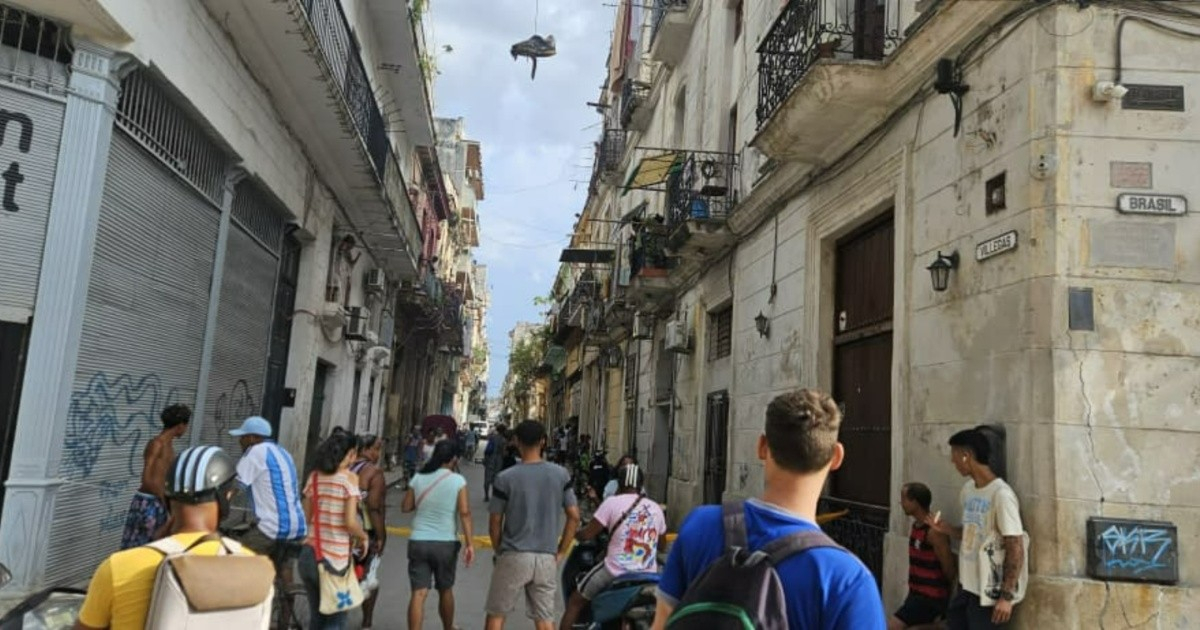
Residents of a building on Villegas Street 409, between Teniente Rey and Muralla, in Old Havana, blocked vehicular traffic in that block this Saturday as a form of protest against the repeated power outages and the inaction of the authorities, according to testimonies and images from the independent media CubaNet.
The neighbors made the decision after weeks of power supply failures exacerbated by problems with the building's own facilities, including breakers that caught fire without any technician coming to repair them.
"People are protesting because one of the phases keeps going out, the power goes out, and no one comes to fix it. The breakers caught fire and nobody is doing anything, so the residents of that building got fed up and closed off the block," a source told the media.
The protest in Villegas took place on the same day that Cubans protested in front of the Provincial Government headquarters in Cienfuegos, also due to prolonged blackouts and the deterioration of living conditions, in a gathering that brought together dozens of citizens, including mothers with children and families demanding to be received by the highest provincial authority.
The activist Raúl González shared a video of the protest and denounced, "We are day and night without electricity, without food, without medicine," while questioning why those who demand better living conditions are labeled as "counter-revolutionaries."
Both protests are taking place during one of the most critical moments for the Cuban electrical system so far in 2026. The Unión Eléctrica forecasted a mere 1,090 megawatts of availability this Saturday, compared to a maximum demand of 3,300 MW, resulting in a deficit of 2,210 MW and an anticipated impact of 2,240 MW during peak hours.
Throughout August, Cuba has only been able to meet between 32% and 35% of its electricity demand during peak consumption hours, leaving large areas of the country experiencing blackouts that in some regions exceed 20 hours per day. The highest deficit during this period was recorded on August 5, when another record for blackouts was broken with a deficit surpassing 2,400 MW.
The closure of streets as a pressure tactic has recent precedents. At the end of July, residents of El Fanguito blocked Avenue 23 after more than 48 hours without electricity, water, or gas, and the following day the State Security arrested two mothers linked to that protest.
The escalation of social conflict is reflected in the data from the Cuban Conflict Observatory (OCC), which recorded a historic high of 1,415 protests, complaints, and critical expressions in July 2026, a figure that is 40% higher than that of July 2025. Of these expressions of discontent, 72 were in-person protests, with 64 taking place in Havana.
The blockade of Villegas Street adds a new episode to this wave of discontent. While the residents of that building are demanding repairs for electrical issues in their property, communities across the Island are increasingly turning to public protest to demand solutions to an energy crisis that the regime has not been able to —and does not seem willing to— resolve.
Related videos:
Filed under: