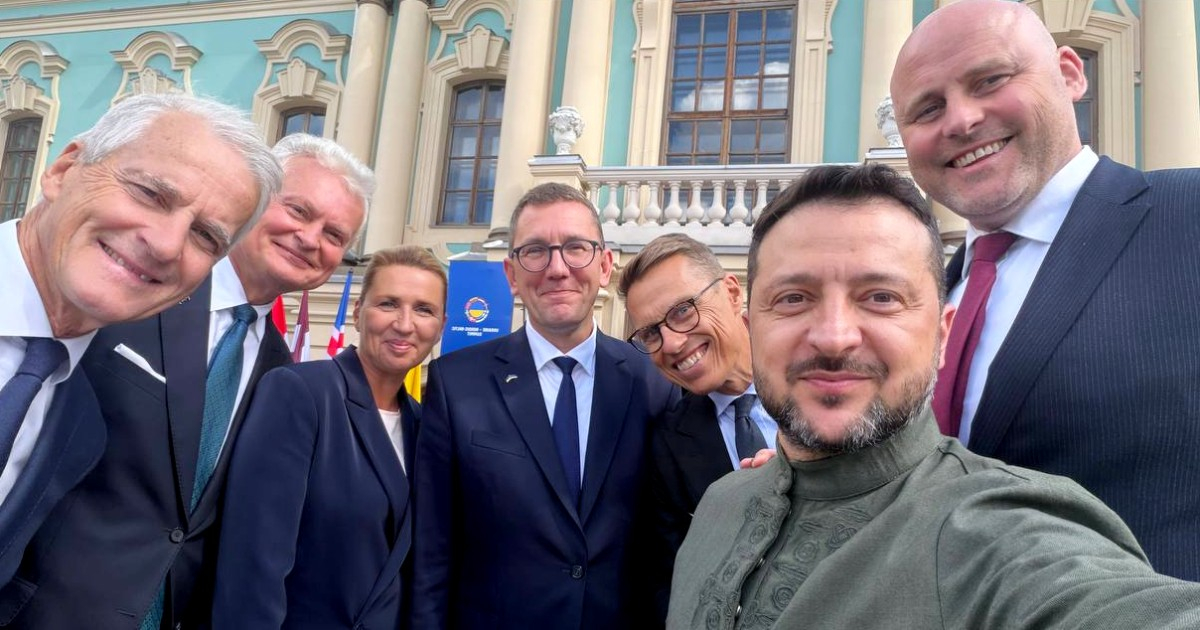
Ukraine commemorated its 35th independence anniversary this Monday with a strong presence of international leaders in Kyiv and a new Russian attack that left at least eight dead and 43 injured in 22 locations across the country, while President Volodymyr Zelensky reaffirmed that his nation will not yield to Russia.
The anniversary, which commemorates the declaration approved by the Ukrainian Parliament on August 24, 1991 — ratified months later in a referendum with over 90% popular support — was celebrated with the country reaching 1,643 days of large-scale invasion. In his speech, Zelenski was emphatic: «Ukraine wants peace, but will not relent», and added that «independence is in our hands and we will not let go».
The Ukrainian president also announced the introduction of a bill to Parliament to create a Ukrainian National Pantheon in honor of those who fought for the country's independence throughout the centuries.
Among the most notable visitors of the day was British Prime Minister Andy Burnham, who arrived in Kiev by train in what was, according to Reuters, his first trip abroad since taking office. Burnham co-chaired a meeting of the so-called Coalition of the Willing, the group of countries that militarily supports Ukraine, and met with Zelensky.
The most significant announcement regarding defense came from the British Prime Minister: the United Kingdom will authorize the European missile manufacturer MBDA to disclose classified information about the British components of the long-range cruise missile SCALP, enabling France and Ukraine to establish local assembly lines for this weapon on Ukrainian territory.
"Ukraine's security is our security", declared Burnham, who promised that the United Kingdom will support Kiev "for as long as necessary."
The measure becomes particularly significant in a context where Ukraine is intensifying its deep attacks against Russian oil refineries and logistics facilities, and where Moscow warned London last week of "consequences" for the supply of drones, following reports that British equipment was used for the first time in long-range attacks against Russian territory.
Alongside Burnham, the President of the European Council António Costa, the Prime Minister of Luxembourg Luc Frieden, and the President of Moldova Maia Sandu were present in Kyiv. Zelensky also held six bilateral meetings as part of the NB8 Summit with leaders from Lithuania, Finland, Denmark, Estonia, Latvia, and Norway.
The commemorative day was overshadowed by a nighttime Russian attack: Russia launched two Oniks missiles, six Kh-31P/Kh-59 missiles, and 143 drones against the country. According to The Kyiv Independent, the Ukrainian air defense intercepted 109 drones and several of the missiles, but the impacts resulted in casualties in more than twenty locations.
The pattern of massive Russian attacks in 2026 reflects sustained pressure: in May, Russia launched 90 missiles and 600 drones in a single barrage; in June, 70 missiles and 611 drones. Ukraine has responded by expanding its own capabilities, including the use of domestically manufactured FP-5 Flamingo cruise missiles, confirmed in August.
Last year, Ukraine also celebrated its independence under Russian fire, a constant that underscores the symbolic significance this date has taken on since the invasion of 2022.
Great Britain has committed more than £25 billion ($34 billion) in military and civilian support to Ukraine since then, being the first Western country to announce the supply of tanks and long-range cruise missiles following the onset of the war.
Related videos:
Filed under: