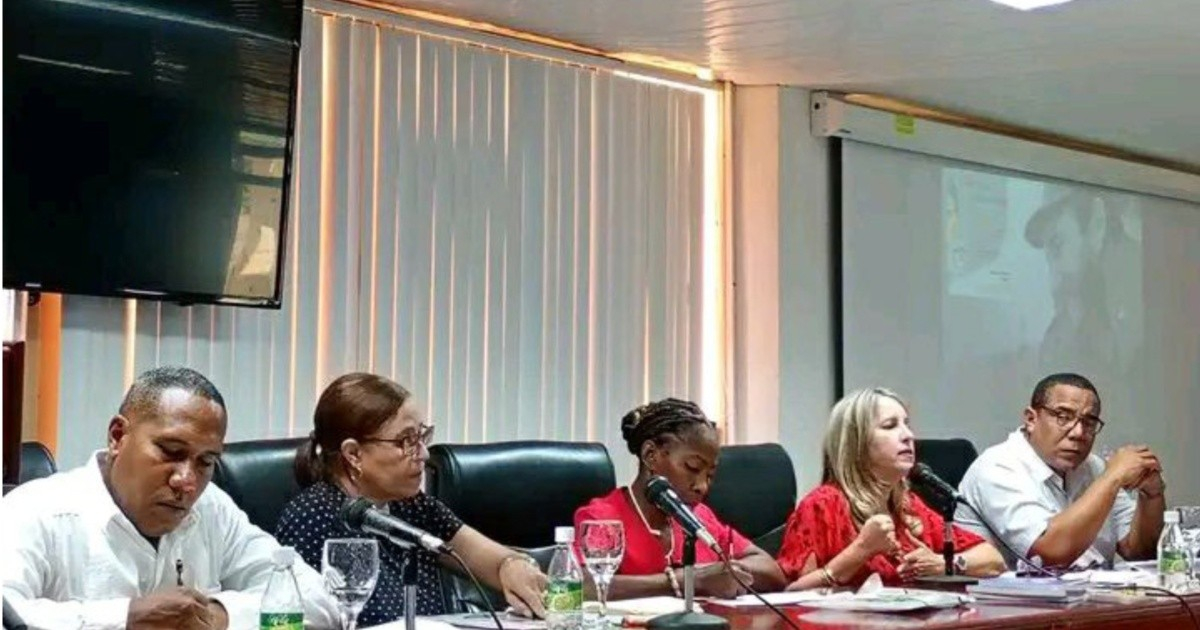
The Minister of Education of Cuba, Naima Ariatne Trujillo Barreto, visited the province of Guantánamo this Sunday to oversee preparations for the 2026-2027 school year and stated to official media that the start of classes on September 1 "will be a great celebration in Cuba."
The official was accompanied by the first secretary of the Communist Party in the province, Yoel Pérez García, and the governor Alis Azahares Torreblanca, during a tour of the 10 municipalities in the easternmost part of the country.
Trujillo Barreto acknowledged that the country is going through a "difficult situation," but assured that the educational needs of children and adolescents will be addressed "in line with the reality of each institution and community."
According to the Director General of Education in Guantánamo, Antonio Tamayo Romero, more than 79,000 students will begin the new school year in 818 educational institutions, with a teaching coverage of 93%, a figure he identified as one of the main challenges.
The minister also indicated that five educational institutions in the province are completing the transition to a new energy matrix and that work is underway on 35 additional projects for that task. She highlighted a "favorable" situation regarding the distribution of uniforms for the early grades, although she acknowledged that some are still in the process of being sold.
Official optimism clashes head-on with the reality described by Cuban families. At a national level, Trujillo Barreto herself acknowledged days prior that only 20% of the enrollment will have new uniforms when the school year begins, as production reached between 2.2 and 2.3 million garments out of the 3.6 million required.
The educational system also faces a structural deficit of at least 24,000 teachers, equivalent to 12.5% of the planned positions, due to migration and low salaries.
A teacher from Urbano Noris, Holguín, publicly denounced that teachers in that municipality have not received their salaries since May 2026, going more than three months without payment, despite the government approving a salary update in July with ranges from 6,130 to 7,735 Cuban pesos per month.
School nutrition adds another layer of precariousness: the World Food Programme reports that 48.5% of Cuban students aged six to eleven do not receive any meals or snacks at school, and supporting a child's breakfast and snack can exceed 10,000 pesos per month for families.
The previous course was closed early, between June 15 and 30, due to a lack of fuel and prolonged blackouts, a crisis that also forced the government to suspend the entrance exams for higher education and to send back 7,879 scholarship students to their municipalities.
In that context, Cuban mothers warned on social media that they would not send their children to school if minimum conditions were not ensured. "My children are kids; they shouldn't have to make sacrifices for anything. If there is no electricity, they won't go; if there is no snack, they won't go; if there is no water, they won't go; if there is no uniform, they won't go," wrote one of them.
While the minister called for celebrating September 1 as "a day of festivity," another internet user summarized the situation with a phrase that circulated widely: "In this country, the abnormal is normalized."
Related videos:
Filed under: