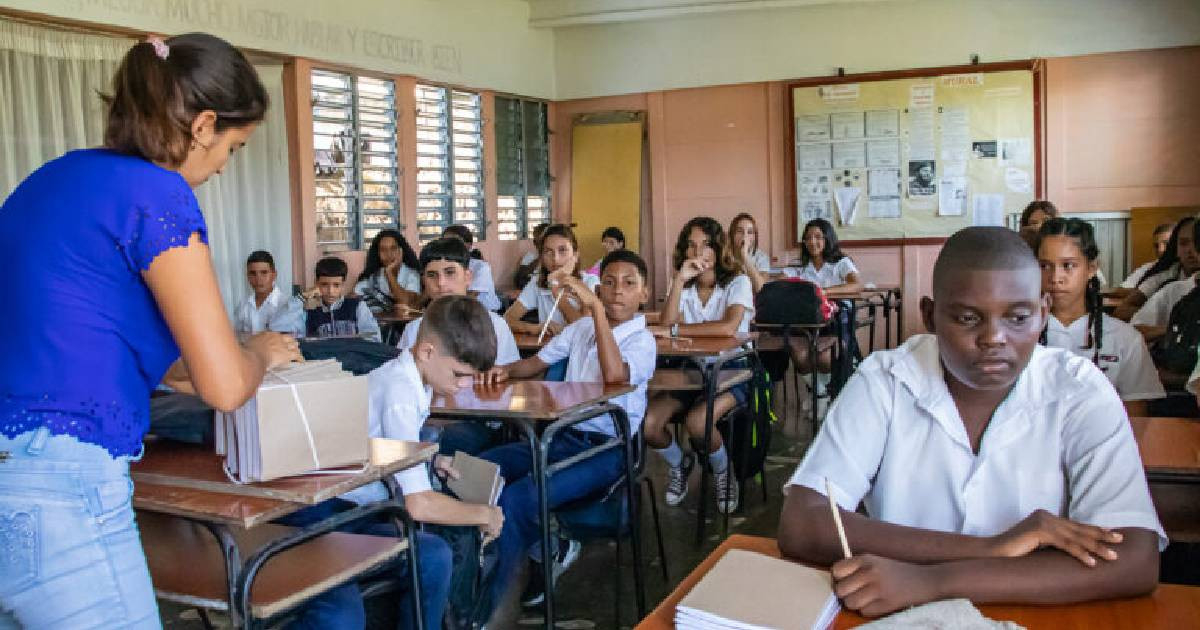
With the start of the 2026-2027 school year set for September 1, Cuban mothers ignited a heated debate on social media this Friday, where many warned that they would not send their children to class if the government does not ensure minimum conditions for electricity, food, and rest.
Dozens of comments in the Facebook group Madres Cubanas Luchadoras 2 reflected the desperation of families facing daily power outages lasting over 20 hours, deteriorating schools, unaffordable uniforms, and a food crisis that makes it impossible to guarantee even breakfast or snacks for the children.
"My children, when they can't sleep due to the extreme heat and the overwhelming number of mosquitoes, ARE NOT GOING TO ANY SCHOOL. Enough is enough of the abuse towards our kids," wrote a mother, capturing the sentiment of those who refuse to normalize what they see as abusive conditions.
Another participant was more blunt: "My children are kids; they shouldn’t have to make any sacrifices for anything. If there’s no electricity, they don’t go; if there’s no snack, they don’t go; if there’s no water, they don’t go; if there’s no uniform, they don’t go."
The picture described by the families is devastating. The World Food Program reported that 48.5% of Cuban students aged six to eleven do not receive any meals or snacks at school.
Maintaining a child's breakfast and snacks for a month can exceed 10,000 Cuban pesos, an amount that is unattainable for most, not including lunch, transportation, shoes, or school supplies.
"It's already August 20, and I'm still worried about so many things, about their shoes and school supplies. I really don't know what else to do... I depend on being called to work in private homes and hostels. Since there's no tourism, which is how I make a living," confessed a mother.
The educational system also faces a structural deficit of at least 24,000 teachers, representing 12.5% of the planned positions. The previous school year ended early between June 15 and June 30 due to a lack of fuel and power outages.
A few days ago, a teacher from the municipality of Urbano Noris, in the province of Holguín, publicly challenged the leader Miguel Díaz-Canel by emphasizing that "we haven't been paid since May," with a total of over three months without a salary.
Regarding uniforms, the situation is not any better. The Minister of Education, Naima Ariatne Trujillo Barreto, acknowledged that only 20% of the national enrollment will have new garments at the beginning of the school year, as production only reached between 2.2 and 2.3 million of the 3.6 million needed.
In Ciego de Ávila, uniforms will be prioritized solely for preschool, fifth, and seventh grades.
Not all voices point in the same direction. Some mothers advocate for sending their children despite it all. "Mine is going, and he's going with the same backpack he had last year and his same sneakers. He studies, I work, he does his homework, and I strive to provide him with the essentials," wrote one participant.
Another person added that she prefers children to be at school "talking with their little friends about childhood topics," rather than at home listening to the family's worries.
However, the most widespread criticism points to the involuntary complicity of the parents themselves. "In this country, schools have been functioning for a long time thanks to the parents who provide everything: paint, brooms, fans, lamps, and now, to top it off, we also have to buy uniforms ourselves because the school does not provide them," a mother reported, noting that this normalization is what allows the regime to continue without taking responsibility.
"In this country, the abnormal is normalized," summarized another internet user, with a phrase that encapsulates the frustration of thousands of Cuban families facing a new school year that the regime announces with optimism, while reality tells a different story.
Related videos:
Filed under: