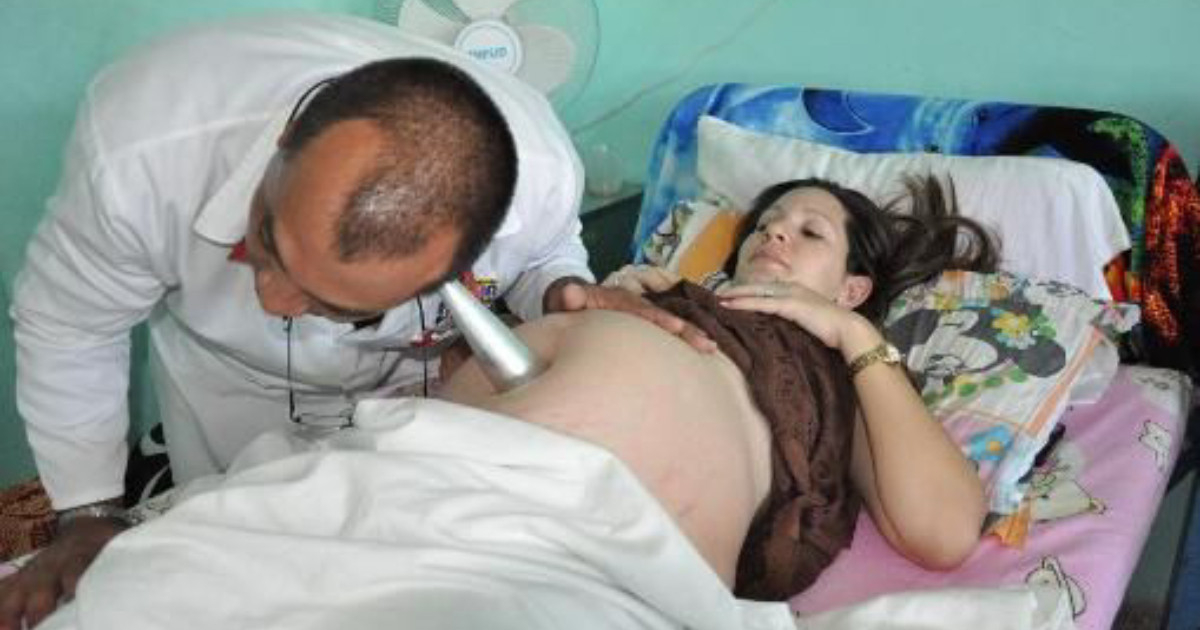
Lenia Lemus is 19 years old, has a two-year-old son, and a story that encapsulates the drama of teenage pregnancy in Cuba. She became pregnant at 16 unexpectedly, and by the time she wanted to terminate the pregnancy, it was already too late, even though abortion has been legal and free on the island since the 1960s.
Your case, reported by EFE, illustrates a phenomenon that the Cuban authorities themselves acknowledge as a "serious social and health problem."
"I didn't find out in time, and I couldn't have an abortion," Lemus recounts. Complications due to the fetus's low weight kept her hospitalized for four months before the delivery.
Today, she raises her little Mateo in La Lisa, a peripheral neighborhood of Havana characterized by overcrowding, inadequate housing, and substance use.
"I practically feel like a child as well. Over these almost three years, I have been learning along the way thanks to the advice of my mom and my grandmother (...) and that is how one learns to be a mother," she confesses.
Hers is not an isolated story. Between 18% and 19% of births in Cuba are to mothers aged 15 to 19. In 2024, there were 11,962 births to mothers under 20 years old and 327 to mothers under 15, according to the National Office of Statistics and Information (ONEI).
The most concerning aspect is the trend among younger girls: adolescent fertility in Cuba has practically remained unchanged in the group of 10 to 14 years old between 2021 and 2025, increasing from 1.3 to 1.4 births per 1,000 girls. In absolute numbers, births to mothers under 15 years old have even risen: from 381 in 2021 to 419 in 2023.
The eastern provinces have the most critical rates. Granma tops the list for adolescent fertility with 56.5 births for every 1,000 teenagers aged 15 to 19, followed by Holguín (53.3) and Guantánamo (50.9). In Las Tunas, adolescent pregnancy rose to 19% in the first half of 2026, three points higher than the previous period.
Grisell Rodríguez, representative of the United Nations Population Fund (UNFPA) in Cuba, warns that the issue extends beyond public health. “[Adolescent fertility in Cuba is] primarily a result or expression of gender-based violence,” she states. She adds that adolescent pregnancy on the island “is unintended in 99% of the cases” and occurs “with significant disparities in the ages of adolescent girls and their partners.” Data from 2025 indicate that 64.5% of adolescent pregnancies involved adult men.
This situation is compounded by the chronic shortage of contraceptives and condoms in state pharmacies since 2020, which drives teenagers toward unwanted pregnancies. The Ministry of Public Health approved Resolution 174 in May 2026, which mandates reporting every pregnancy in minors under 18 and ensures access to contraceptives, but data from the first half of the year suggests that this measure has not reversed the trend.
In La Lisa, the community project Afropoderosas works with Black and mixed-race girls and adolescents on menstrual education and prevention. Its founder, Tatiana Martínez, describes the community as an environment with "many issues related to drug use and alcoholism" and where "there is a high rate of pregnancy in this area, particularly among Black and mixed-race individuals." The project, born from a similar initiative in Mexico, has been replicated in Brazil, Ecuador, and Panama.
Lemus is part of Afropoderosas along with three other young women under the age of 20 who are also mothers. Her message for those her age is straightforward: "To the young girls my age, I would advise them to take care of themselves. Adolescence is for learning and gaining experiences." And her dream, while she cares for Mateo and awaits a job in tourism, reaches further: "My dream is to be an entrepreneurial woman in business so that my son has a secure future."
Related videos:
Filed under: