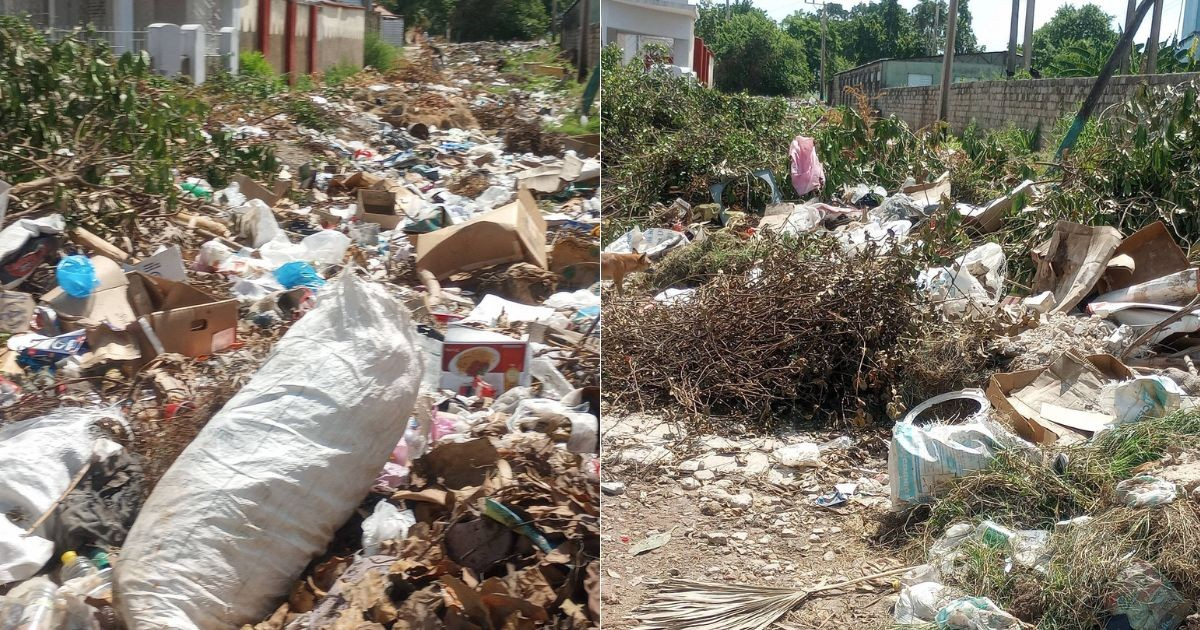
A resident of the city of Camagüey identified as Telma Oliva reported on Facebook the dump that a section of Camujiro street has become, which has been two months without garbage collection, to the extent that the waste occupies the entire roadway and obstructs traffic.
"There is no other alternative but to expose on social media the filth in which we live, as they only respond to what is reflected there," wrote Oliva, who accompanied her post with images of plastic bags, decaying cardboard boxes, containers, and household waste, branches, and other debris piled in front of residential buildings.
The author warned about the health consequences of neglect: "This is the dump (sic) in Camujiro between 10 and 9, which has already taken over an entire street, preventing any traffic. It has been two months since they collected the garbage, perhaps waiting for an outbreak of leptospirosis, dengue, or hepatitis to take a toll on the community; perhaps this will contribute to the solution."
In light of the official excuse of fuel scarcity, Oliva pointed out a negligence that goes beyond diesel: "So the excuse is that there's no oil, we know that, but there are no [...] wheelbarrows, etc., to prevent reaching this situation."
The post generated dozens of comments confirming that the problem is not limited to a single area. One user pointed out, "The saddest thing is that the whole city is like this; on General Gómez Street, I have counted nine garbage bins, even next to the Amalia Simoni Children's Center."
Another comment reported an even more serious situation next to a health center: "The dump beside the Camagüey Nephrology Institute where dialysis patients and others are treated is lacking considerably; it has been over six months since solid waste has been collected there, and nothing is being done."
The approaching start of the school year adds urgency to the complaint. An internet user pointed out that "the school year is starting and all kinds of bad odors are spreading; sometimes they even set fires, and the smoke is unbearable in front of a school." Another summarized the collective sentiment: "It's very sad to see the city of Camagüey like this, like a landfill, when we used to be the cleanest city in Cuba."
Oliva concluded her publication with a direct reference to the official speech: "This way, there is neither a safe neighborhood, nor a productive neighborhood, nor a participatory neighborhood," ironically alluding to the government’s community management program that the regime promotes while residents live alongside mountains of garbage at their doorsteps.
The crisis is part of a national collapse related to the shortage of fuel and the deterioration of equipment and machinery for waste collection.
Since 2025, persistent garbage piles have been reported on various streets in Camagüey, and last July a fire in a dumpster on Las Palmas street put residents on alert. In mid-August, residents from neighborhoods such as La Marina and Prieto reported living with overflowing wastewater and accumulated trash for over four years.
This same month, residents of Holguín reported a huge garbage dump next to a primary school, highlighting that the issue is recurring in various provinces.
The health context requires urgent action, but the authorities continue to provide no solution to the problem, which poses a high epidemiological and public health risk.
In April, the authorities of Camagüey recognized a "notable increase" of suspected hepatitis A cases in the main municipality, and the Ministry of Public Health warned that summer about the risk of a dengue epidemic on a national scale.
Related videos:
Filed under: