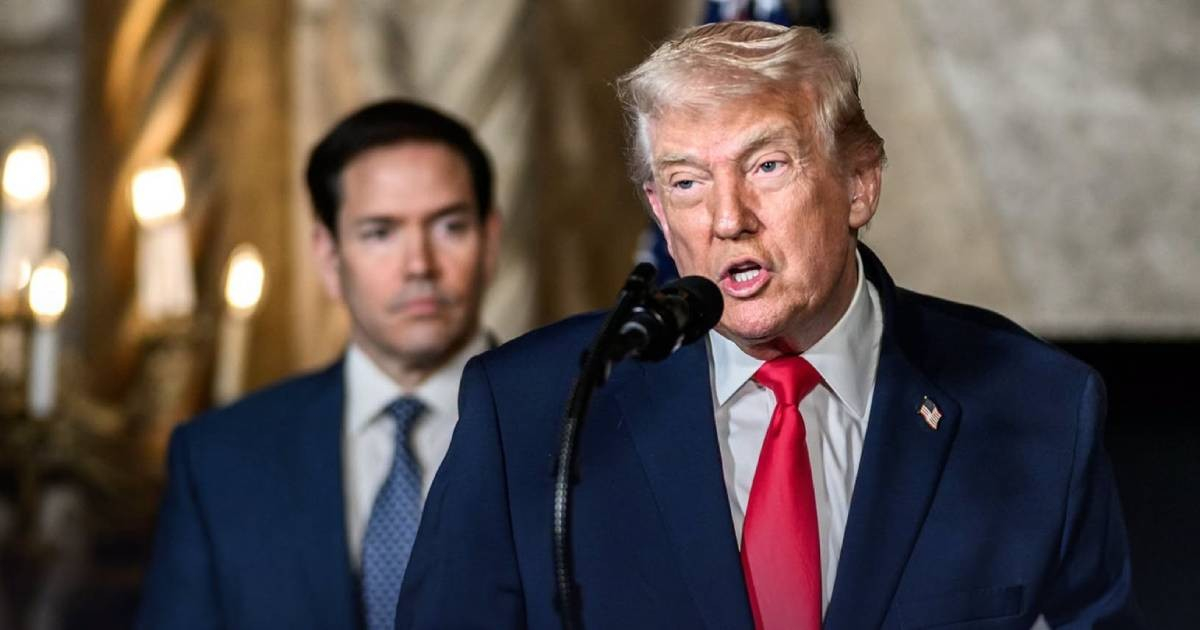
The President of the United States, Donald Trump, extended for one year the powers of the Trading With the Enemy Act (TWEA) applied to Cuba, a renewal that keeps in effect one of the main legal supports for U.S. economic sanctions against the island.
Trump signed Presidential Determination No. 2026-21 on August 20, which was published this Tuesday in the Federal Register, extending those authorities until September 14, 2027.
The document, addressed to the Secretary of State and the Secretary of the Treasury, states that "the continuation of the exercise of those authorities with respect to Cuba for another year is in the national interest of the United States."
The decision does not introduce new sanctions nor does it by itself modify existing restrictions. It is a renewal that U.S. presidents carry out annually to prevent the expiration of the authorities that support the Cuban Assets Control Regulations (31 C.F.R. Part 515).
Cuba is currently the only country subject to restrictions under the Trading with the Enemy Act, enacted in 1917. In 1977, the U.S. Congress limited its application in peacetime but preserved the existing measures against the island, which must be renewed each year since then.
Republican and Democratic presidents, including Bill Clinton, George W. Bush, Barack Obama, Joe Biden, and Trump himself during his first term, have upheld that renewal.
The U.S. embargo against Cuba has multiple legal layers. In February 1962, President John F. Kennedy formalized the embargo through Presidential Proclamation 3447, following the trade restrictions imposed by Washington in response to the nationalizations carried out by Fidel Castro's regime.
Decades later, the Cuban Democracy Act of 1992 and the Helms-Burton Act of 1996 reinforced and codified much of those sanctions, limiting a president's ability to unilaterally lift the embargo as a whole.
Although the renewal of the TWEA is a recurring procedure, this time it is taking place amid a strong offensive by the Trump administration against the revenue sources of the Cuban regime.
In May, Washington blocked assets linked to the military-business conglomerate GAESA under U.S. jurisdiction. That same month, the shipping companies Hapag-Lloyd and CMA CGM suspended their operations with Cuba, while in July the United States expanded sanctions on the Cuban oil sector.
The Cuban Foreign Minister, Bruno Rodríguez Parrilla, reacted this Tuesday on X and described the decision as part of a "genocidal policy that has been maintained against our people for more than six decades."
Rodríguez also rejected the idea that the renewal could be considered a mere formality: "The renewal of the so-called Trading with the Enemy Act until September 2027 is not a minor administrative act, but rather a confirmation that Washington persists in its intention to suffocate an entire nation."
The previous extension had been signed by Trump on August 29, 2025, and it maintained these powers until September 14, 2026. The new determination now ensures its continuation for another year.
Related videos:
Filed under: