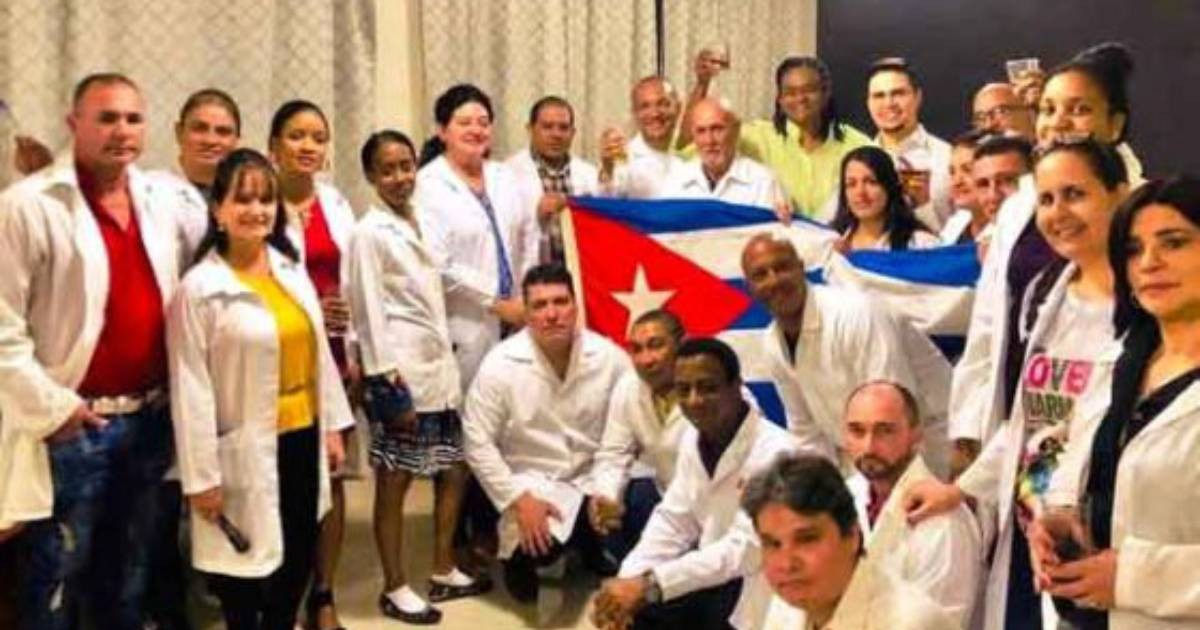
The Cuban regime receives over $4.2 million a year for the work of approximately 90 doctors and healthcare professionals sent to Botswana, while the collaborators receive less than a quarter of what the African country pays for their services.
A report by Prisoners Defenders, published this Tuesday, reveals that Botswana pays 3,500 euros per month—approximately 4,095 dollars—for each Cuban specialist, but the professional receives only 1,000 dollars.
The remaining $3,095, equivalent to 75.58% of the payment, is transferred to the Cuban state structure through the Cuban Medical Services Marketing Company S.A. (CSMC).
With around 90 professionals currently deployed, the scheme allows the Cuban state to retain approximately $350,500 per month and $4.2 million annually, according to the organization's calculations.
Botswana knows how much each doctor gets paid
Prisoners Defenders asserts that the government of Botswana, led by Duma Boko, is aware of how the money is distributed.
The agreement requires the Cuban party to issue monthly invoices that differentiate the amount allocated to the professionals from the amount transferred to Havana. Additionally, administrative documents from the Princess Marina Hospital, with a copy to the Botswana Ministry of Finance, have recorded stipend payments to the doctors since at least 2020.
For the organization, this evidence demonstrates that the authorities of the African country are aware of the economic conditions of the program.
"The current government of Duma Boko materially supports and is fully aware of the economic framework that enables a scheme of modern slavery," denounced Prisoners Defenders.
Restrictions on movement, receiving visitors, and even driving
The research also publishes an internal regulation signed on July 3, 2026, in Gaborone by the head of the Cuban medical mission in Botswana, Pablo Ricardo Betancourt Álvarez, which establishes strict restrictions on the lives of the collaborators.
"The departure of collaborators from their districts is limited only to professional or health matters, and always requires prior consultation with the Head of the Cuban Medical Brigade in Botswana," the document states.
The regulations also restrict receiving visits from individuals outside the brigade, sleeping away from the assigned accommodation, visiting Cubans who are not part of the contingent, acquiring or operating vehicles, and going out late at night without authorization.
The regulation also considers the "generation, distortion, manipulation, or disclosure of sensitive information" related to the brigade a serious offense and mandates the implementation of "surprise inspections."
The testimonies collected by Prisoners Defenders paint an even harsher picture. According to the organization, none of the interviewed doctors volunteered for the mission or received a copy of their contract, while all reported that their passports were withheld.
They also claimed to have been warned that if they abandoned the mission, they would be prohibited from returning to Cuba for eight years. The documented work hours ranged between 56 and 64 hours per week, with an average of 57.6 hours.
The Cuban Penal Code adds another tool of pressure. Its article 176.1 stipulates penalties of three to eight years in prison for certain public officials who abandon a mission abroad or refuse to return to Cuba.
Cuban medical missions under increasing scrutiny
The conditions of these programs have faced increasing international scrutiny.
In April, the Inter-American Commission on Human Rights published a 199-page report that identified serious indications of forced labor in Cuban medical missions and recommended that American countries withdraw from the program until labor guarantees are in place.
In July, the United States sanctioned the Cuban Minister of Public Health, José Ángel Portal Miranda, as well as the director of the Central Unit for Medical Cooperation, Gretza Sánchez Padrón, and the entities UCCM and CSMC S.A.
Prisoners Defenders summarizes the functioning of the Botswana agreement with a resounding conclusion:
"Botswana does not pay the professional for the work they perform in its hospitals: it pays the Cuban state structure that decides how much it pays, how much it withholds, and what personal penalties they will face if they break the employment relationship."
Related videos:
Filed under: