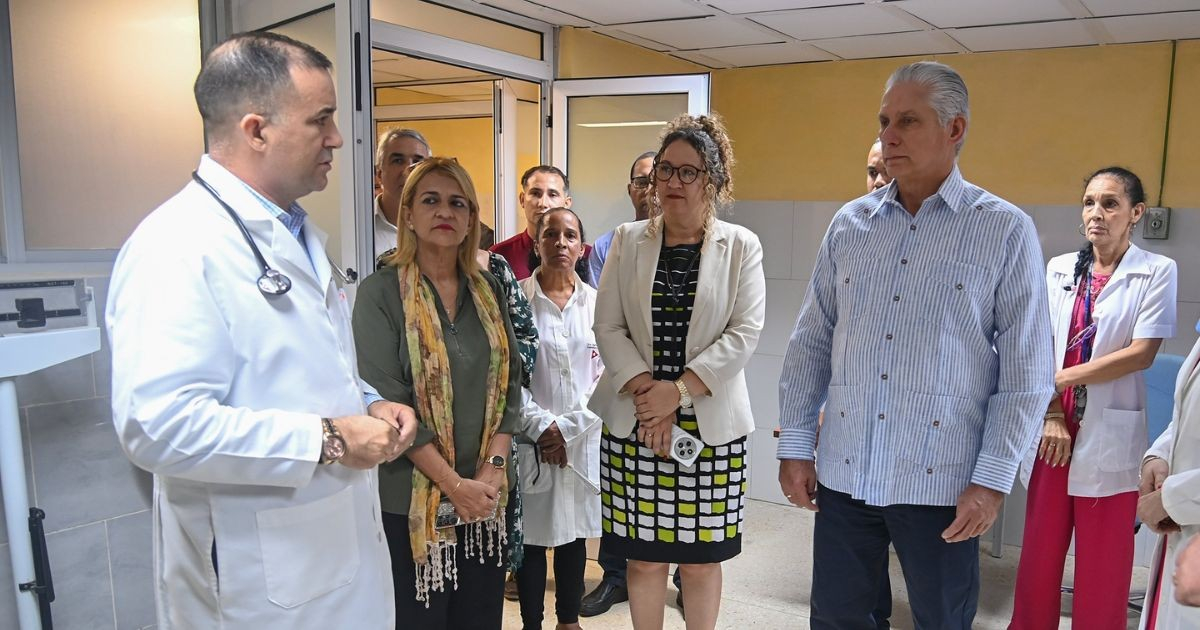
President Miguel Díaz-Canel visited the clinical-surgical teaching hospital “Joaquín Albarrán Domínguez” in Havana this Friday and took the opportunity to praise the "heroism" of health workers, just one day after Washington imposed sanctions on the Minister of Public Health and the main structures of the Cuban medical missions program.
The regime leader described to executives and staff at the center, popularly known as Clínico de 26, a reality that he himself acknowledged as dramatic: "Our doctors and nurses arrive every day after long nights without power, often on foot due to the lack of fuel, to take their places in our healthcare institutions."
What Díaz-Canel presented as heroism is, in fact, the result of decades of institutional neglect accumulated under the dictatorship he leads.
The Minister of Public Health, José Ángel Portal Miranda, admitted in February 2026 to the AP agency that the Cuban healthcare system was “on the verge of collapse”, and in July 2025 he had acknowledged before the National Assembly an “unprecedented structural crisis” with only 30% of the essential medicines available.
The numbers confirm this collapse: 461 out of 651 essential medications out of stock, over 96,000 pending surgeries, and power outages of up to 20 hours a day in hospitals, according to reports from May and June 2026.
Infant mortality, one of the indicators that Díaz-Canel himself mentioned during his visit, rose from 4.0 per 1,000 live births in 2018 to 9.9 in 2025, and in Havana, it reached 14 per 1,000 in the early months of 2026.
While the regime invokes the heroism of its doctors within the Island, it simultaneously sends them on missions abroad where the State withholds between 60% and 97.5% of their salaries, according to a report from the Inter-American Commission on Human Rights (IACHR) from April 2026, based on 71 testimonies from professionals deployed in 109 countries.
Those same doctors who walk to their hospitals in Cuba survive on salaries equivalent to about 16 dollars a month, while the medical services export program generated billions of dollars in 2025, with tens of thousands of professionals deployed in over 50 countries.
The US Department of State sanctioned Minister Portal Miranda on Thursday, along with the Central Unit for Medical Cooperation (UCCM), its director Gretza Sánchez Padrón, and the Commercializer of Cuban Medical Services (CSMC), labeling the mission program as "forced labor" and "human trafficking."
That round of sanctions, based on Executive Order 14404 signed by Donald Trump on May 1, 2026, designated a total of nine entities and two individuals linked to the regime.
The European Parliament had approved in April 2025 an amendment that described the Cuban medical brigades as "modern slavery" and "forced labor," in line with the findings of the IACHR.
During his visit to the Clínico de 26, Díaz-Canel also discussed the use of artificial intelligence and electronic medical records, noting that these tools "will open up tremendous possibilities, especially concerning staffing," one of the challenges facing the hospital.
On the same Friday of the presidential visit, the MINSAP confirmed on its account on social media platform X that the personal account of Minister Portal Miranda had been hacked, marking two blows to the Public Health Ministry in less than 48 hours.
Cuban netizens who reacted to Díaz-Canel's statements highlighted the contradiction between the official narrative and everyday reality: doctors without gloves, hospitals without electricity, and patients dying while waiting for medications that the state cannot provide, all while the regime earns millions by exporting that same workforce to the world.
Related videos:
Filed under: