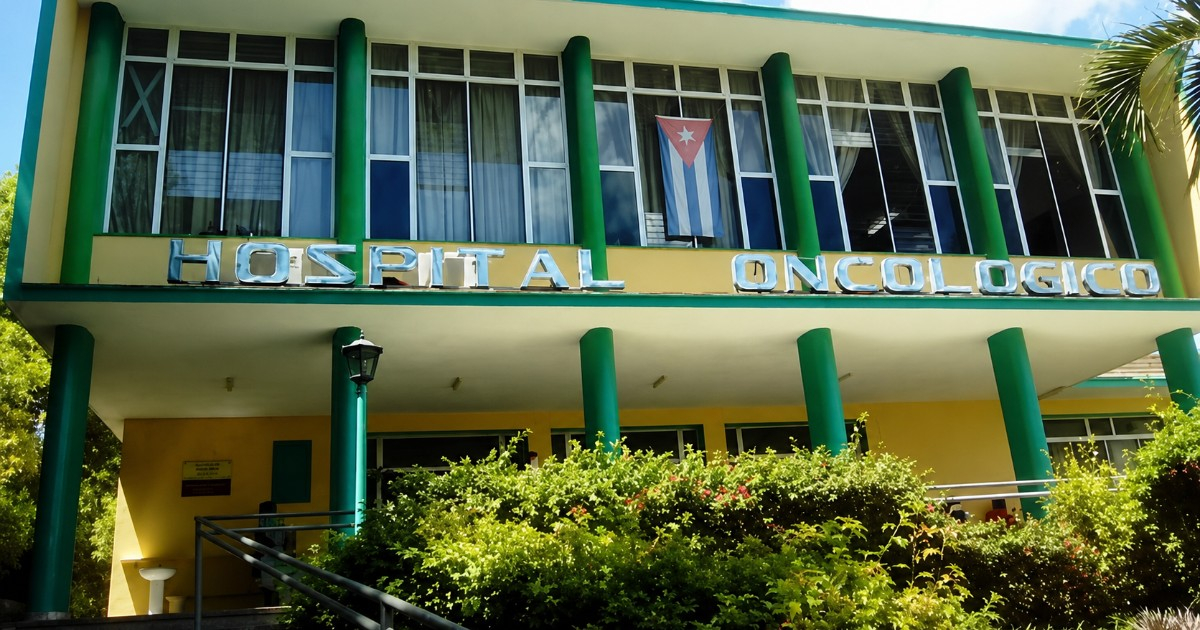
Workers at the Conrado Benítez Oncological Hospital in Santiago de Cuba reported that they had to pay 24 dollars for a gas cylinder for their homes and that, after paying the money, they spent hours waiting for the fuel to arrive this Thursday.
The communicator Yosmany Mayeta Labrada said this Thursday that employees of the institution reached out to him to report the situation.
According to the testimonies received, the gas had been paid for since Wednesday, but after 1:00 p.m. on Thursday, the vehicle responsible for delivering the cylinders had still not arrived at the hospital.
The complaint is particularly striking due to the currency required to purchase an essential product: workers within the Cuban state system receive their salaries in Cuban pesos (CUP), but in this case, the item was reportedly offered for 24 dollars.
According to Mayeta, the possibility of purchasing gas was initially welcomed as a relief by people who had gone months without having that fuel in their homes.
However, according to testimonies, the purchase was not made at the usual state price nor through the sales points corresponding to their communities.
The need drove many to seek out the required foreign currency by any means possible. Some workers claimed to have gathered the money little by little, while others turned to relatives living abroad to obtain the 24 dollars.
Others, despite needing the fuel, had to give up the purchase because they did not have that amount, according to the account shared by the communicator.
Those who were able to pay for it arrived early this Thursday at the Conrado Benítez Oncology Hospital to collect the cylinders, but the hours went by without the vehicle responsible for the transport arriving.
Until after 1:00 PM, the workers continued to wait and, according to the complaint, they had not received a precise explanation regarding the delay, the expected arrival time, or the source of the gas they had already paid for.
The situation once again highlights the significant gap between state revenues in Cuban pesos and the increasing access to essential products in foreign currency.
On the other hand, the report shared by the communicator leaves many questions unanswered: Who is actually selling these gas cartridges, a state-owned company or a private entity? Is it an exceptional sale or a mechanism that will start to be repeated? Why is the payment made in dollars and who has access to this option? What role does the hospital administration or the Provincial Health Directorate have?
Doubts also arose among users who reacted to the post. One person claimed that in Bayamo, a similar gas sale in dollars is being prepared for workers, although this statement has not been officially confirmed.
Others asked whether the option to purchase fuel would be available to all employees or just to selected groups.
The requirement to pay in foreign currency drew a lot of criticism. "One is saving lives and they offer us little bullets for 24 dollars as if they were paying us in dollars. It's a mockery," expressed one person, while another summed up the contradiction with a phrase: "As if they were paying in American."
There were also questions raised about the subsequent fate of the cylinders. Some users claimed, without providing evidence, that individuals were buying the small canisters to resell them later at prices of up to 60 dollars, taking advantage of the scarcity.
Another comment pointed out that at a Bandec branch near the funeral home, there was also an announcement about the possibility of purchasing gas for 29 dollars, but according to that report, the fuel had not yet been delivered.
The reactions also reflected concern for those who do not receive remittances or have access to foreign currency. "At least they have that option, but what about the others?," one person asked, while another pointed out that many health workers finish their shifts and return to homes where they have to cook with charcoal due to the lack of electricity and gas.
Several users also expressed fear of potential scams due to the advance payment. "How does a worker pay $24 without any security?" questioned one individual, while another advised caution regarding the possibility of fraudulent offers.
The contradiction is particularly evident within the healthcare sector itself: the salary scale effective since July set the monthly salary for a newly graduated doctor at 7,045 CUP, which is approximately 10.00 USD, with actual payment starting from the payroll in August.
The Resolution 17/2026 of the Ministry of Labor and Social Security also established 8,115 CUP for resident doctors, equivalent to about 12 dollars; 8,500 CUP for first-degree specialists, around 13 dollars; and 8,880 CUP for second-degree specialists or professionals with two specializations, also around 13 dollars.
In the Oncology Hospital, moreover, the report does not solely identify doctors among the buyers, but generally refers to institution workers, so their salaries may vary depending on their position and professional category.
The reported sale occurs amid a prolonged liquefied gas crisis in Santiago de Cuba and other eastern provinces.
In January, CUPET suspended the distribution of liquefied gas in Santiago de Cuba and the rest of the eastern region due to a lack of supply, a situation that drove up prices in the informal market and forced many families to seek alternatives for cooking.
At that time, gas cylinders were reported to be sold for between 10,000 and 12,000 CUP in some rural areas and for as much as 50,000 CUP in eastern cities, while numerous families returned to using firewood or coal.
The shortage has persisted throughout the year and has further increased the demand for offers outside the state system.
Just a few days before the complaint from the Oncology Center, an offer appeared in Santiago de Cuba for 65,000 CUP for the filling of a cylinder and 75,000 CUP if it also included the small tank.
Related videos:
Filed under: