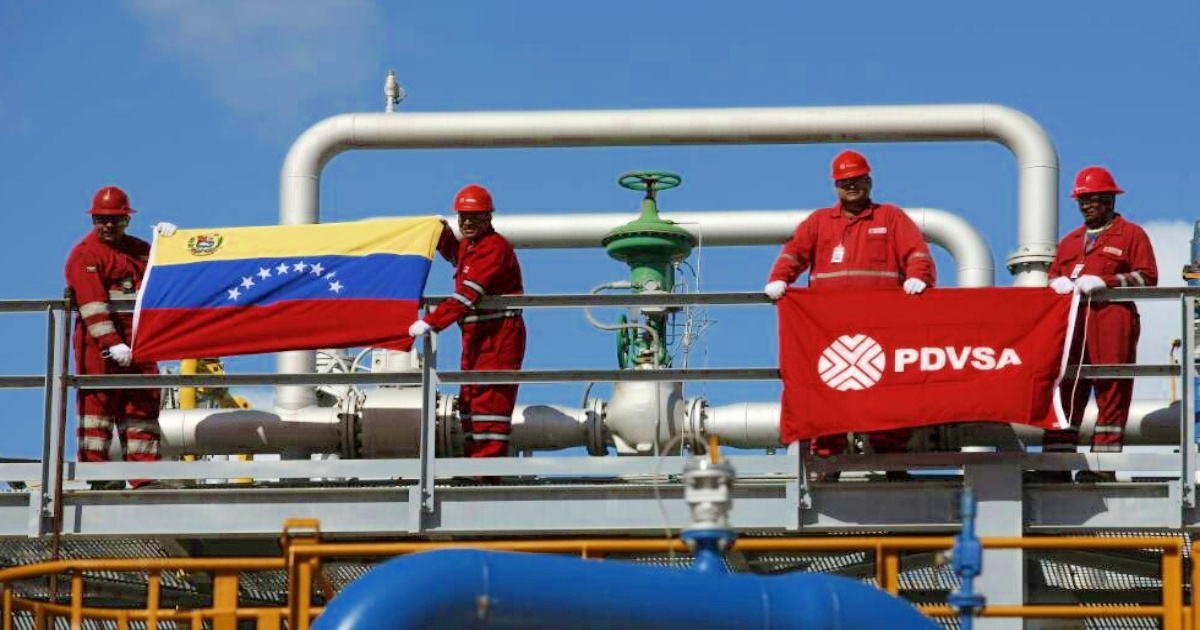
The Trump administration is negotiating with the Venezuelan government led by interim president Delcy Rodríguez for a stake in ownership of more than a dozen currently productive oil fields, in what U.S. officials describe as a historically significant agreement, according to a report by an investigation by Axios confirmed by Bloomberg and reported this Friday by the EFE agency.
The conversations, which have been ongoing for weeks, involve fields with approximately 90 billion barrels of proven reserves—about a third of the total in Venezuela—and could include a lease of up to 100 years on several of those fields, according to Bloomberg.
"Calling it enormous would be an understatement. It is massive," declared one of the two anonymous U.S. officials who confirmed the negotiations to Axios.
The agreement would allow Washington to more than double its oil reserves, a goal that has become urgent given the critical state of the U.S. Strategic Petroleum Reserve, which fell to 289.7 million barrels on August 24, its lowest level since November 1982, compounded by supply disruptions arising from conflicts in Iran and Ukraine.
The negotiations are led by Secretary of State Marco Rubio and Delcy Rodríguez, with active participation from White House Deputy Secretary Stephen Miller.
According to Axios, the fields in question were previously under the control of former Venezuelan officials—some with pending criminal charges—and interests linked to China, which adds a geopolitical dimension to the agreement.
In exchange for relinquishing participation to Washington, the Venezuelan government would receive the benefits of the development of those fields by private companies, mainly American.
A second official cited by Axios emphasized the strategic significance of the operation: "President Trump is about to secure America's energy future for generations, not just in the U.S. but throughout the hemisphere."
The Trump administration is aware of the political sensitivity surrounding the agreement. "We are doing everything we can to demonstrate how this will benefit the Venezuelan people, because it will," noted another official.
The pact is part of the so-called "Donroe Doctrine," Trump's strategy to consolidate the energy and strategic dominance of the U.S. in the Western Hemisphere, displacing the influence of China, Russia, and Iran.
According to Axios, Trump started to privately explore the possibility of obtaining stakes in Venezuelan oil fields even before authorizing the capture of Nicolás Maduro on January 3, 2026.
This agreement marks the most ambitious step in an opening that has been progressing since the beginning of the year: in March, the Treasury issued licenses allowing U.S. companies to operate in Venezuela; in April, the Office of Foreign Assets Control (OFAC) removed Delcy Rodríguez from its sanctions list; and in May, Rubio reported that over 10 million barrels of Venezuelan oil had already arrived in the U.S. since January, with revenues overseen by the Treasury and audited by KPMG.
Venezuela has the largest proven oil reserves in the world—over 300 billion barrels—but its production has plummeted from nearly three million barrels a day in the 1990s to around 800,000 in 2023, due to the deterioration of infrastructure and decades of mismanagement under Hugo Chávez and Maduro.
The Secretary of Energy Chris Wright is preparing a trip to Venezuela for next week with the aim of promoting an increase in production by American companies, which could signal the beginning of the implementation phase of the agreement.
Related videos:
Filed under: