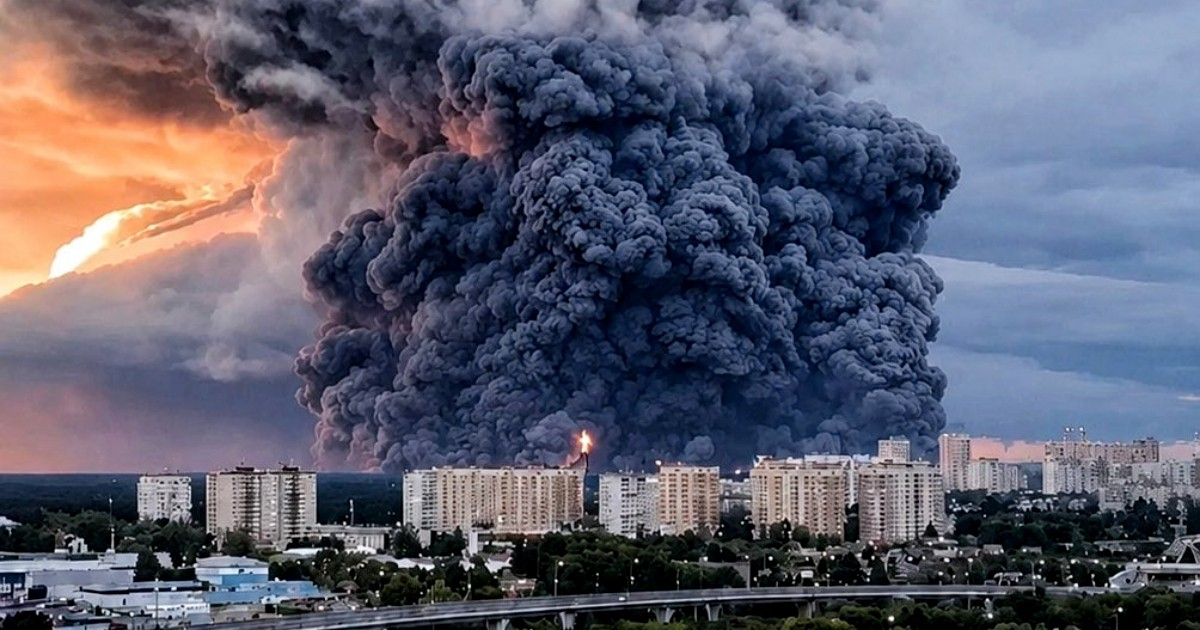
Vladimir Putin signed a decree that empowers the Russian State to temporarily assume control of critical private infrastructure when its owners fail to protect it from Ukrainian drone attacks or refuse to rebuild it after bombings, according to a report by the Associated Press.
The measure, announced on Monday, is the clearest indication so far that the war is directly impacting the Russian economy.
The decree encompasses strategic sectors: energy and fuel, electricity, industry, communications, transportation, logistics, and public services. Its potential reach is enormous, from oil refineries that have been repeatedly bombed to giants of e-commerce like Wildberries and Ozon, whose warehouses have been systematic targets of Ukrainian drone aviation.
The Kremlin attempted to downplay the measure. Vice Prime Minister Denis Manturov clarified that this is not about nationalization or a change of ownership, but rather about "state participation in the management of a company to address specific security issues."
He also stressed that "this mechanism does not imply widespread use: selective and carefully considered decisions will be made at the highest level."
However, the presidential spokesperson Dmitry Peskov hinted at the true pressure behind the decree by stating this Tuesday that "often business owners do not pay enough attention to taking measures to ensure safety, drone security."
The Russian political analyst Abbas Gallyamov, a former speechwriter for Putin, interpreted it as a veiled ultimatum.
In his Telegram account, he explained that the owners of refineries that have been hit three to five times are refusing to invest in repairs due to the risk of new attacks: “Why spend billions if they are going to be attacked again tomorrow?.” His conclusion was direct: the government is telling them “if you do not finance the restoration of the refineries, we will take them away.”
The pressure on the Russian economy is real and increasing. Ukrainian attacks on Russian refineries have drastically reduced hydrocarbon revenues, which fell by 45.4% in the first quarter of 2026. The federal deficit has already exceeded the full annual target during that same period.
In the early hours of Tuesday, Ukrainian forces launched another attack on the Afipsky refinery in the Krasnodar region—previously struck in June and July—causing a fire. That same night, operations at the Novoshakhtinsk refinery in Rostov were halted following another attack.
The decree is part of an accelerated trend of renationalization that reached unprecedented levels in the first half of 2026: according to the AK&M agency, the Russian state seized assets worth 10.16 billion dollars in 15 cases, a figure that represents 42.2% of the total mergers and acquisitions market for the period and is nearly equal to the total amount recorded in all of 2025. The largest operation was the transfer of the agro-industrial holding Rusagro, valued at 7.7 billion dollars.
Putin himself acknowledged days ago on state television that Moscow "must and will improve the air defense system and strengthen its capabilities," and he called for "streamlining coordination between defense, law enforcement, and civilian agencies at all levels."
With the new decree, that coordination could mean that the State takes direct control of private companies that, in light of the relentless campaign of Ukrainian drones, prefer not to risk their capital on repairs that could be destroyed again the very next day.
Related videos:
Filed under: