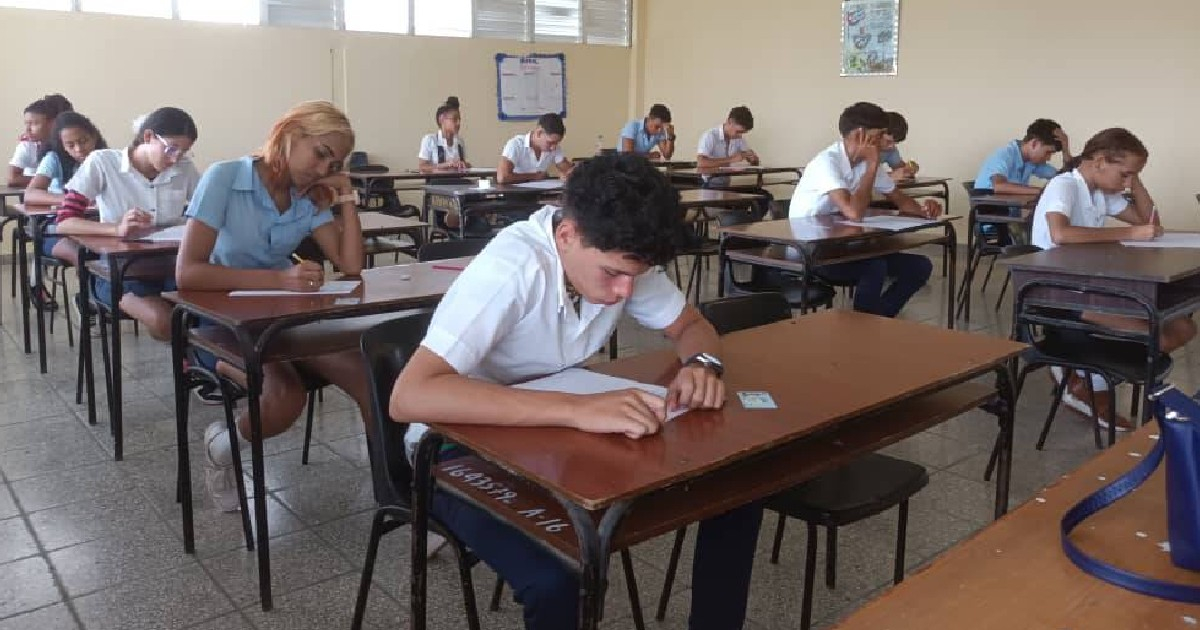
Just a few days before the start of the 2026-2027 school year, the Havana municipality of Plaza de la Revolución launched the movement "I Am the Teacher," a call to recruit around 50 people who, without leaving their regular jobs, will fill vacant teaching positions, as reported by the state agency ACN.
Representatives from various agencies and organizations in the area are promoting the initiative, with an emphasis on those who have academic training in pedagogy. The list of candidates was expected to be finalized by the beginning of this week, just as the new academic year starts on September 1st.
The name evokes the response of the literacy brigade volunteer Manuel Ascunce Domenech, a 16-year-old from Sagua la Grande, who was murdered on November 26, 1961, in the Escambray during the Literacy Campaign. According to the official narrative, when the bandits asked him who the teacher was, the teenager replied: "I am the teacher."
The initiative is not entirely new: in September 2022, in response to the shortage of teachers in Havana, the authorities launched the Special Detachment "I am the Teacher," as part of extraordinary measures to achieve educational coverage in the capital. This initiative revived a practice with historical roots in the Cuban system: relying on detachments of students and teachers mobilized from other areas to fill the gaps left by the lack of professors.
The context is of a unprecedented educational crisis in Cuba. On a national scale, the teacher shortage for the 2026-2027 school year is thousands of unfilled positions. Camagüey starts the school year with nearly 3,000 missing teachers for over 95,000 students in 690 schools, while Holguín faces over 2,000 vacancies to cater to 131,000 students in 1,319 institutions.
The causes are structural: the migration exodus has emptied classrooms of qualified teachers, and salaries in the sector remain laughably low. Although Resolution 18/2026 from the Ministry of Labor and Social Security, effective from July 1st, established monthly salary scales ranging from 6,130 to 7,735 Cuban pesos for teachers based on their qualification level, these amounts currently amount to less than 12 dollars at the informal exchange rate.
The Minister of Education, Naima Ariatne Trujillo Barreto, acknowledged that the course is starting under "exceptional conditions" and admitted: "We are asking for collaboration that we have never had to request before, not even in these last few years, which have also been difficult."
The shortage of teachers is compounded by the ongoing energy crisis. Cuba has experienced several total collapses of the National Electric System so far in 2026, and the previous school year had to close early, between mid and late June, due to a lack of fuel.
In that context, the Communist Party described the start of the school year as "another act of heroism and of firm determination not to yield," a statement that triggered a wave of criticism. "Truly, those who attend classes after long hours without electricity and in the midst of horrendous heat are heroes. Many go without breakfast and without a snack to take," responded an internet user. Another was more straightforward: "When there is no electricity: I don’t go. When there is no water: I don’t go. When I have nothing to give for breakfast: I don’t go."
Related videos:
Filed under: