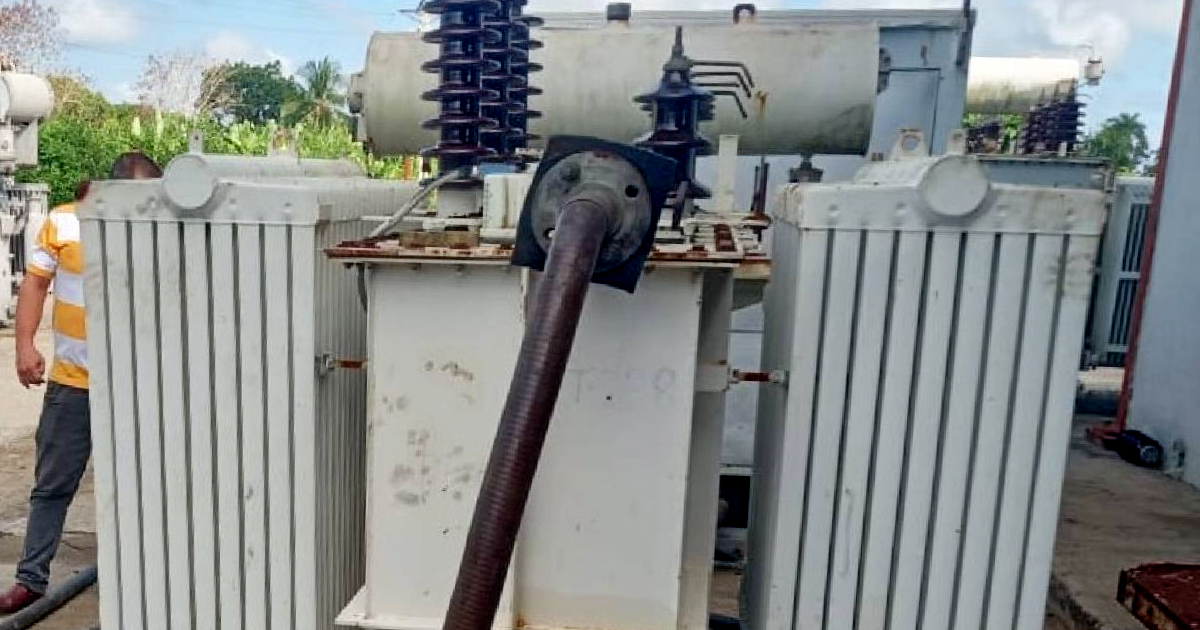
The Attorney General of the Republic of Cuba issued a public statement this Monday warning that those who steal dielectric oil from transformers or other components of the electrical system will be prosecuted for the crime of sabotage, a legal categorization that can lead to penalties ranging from seven years in prison to the death penalty, according to the current Penal Code.
The statement, disseminated through the page of "Minint Hoy" and reproduced by the state newspaper Granma, reveals that between 2025 and the first half of 2026, over 460 criminal investigations were opened for offenses against the National Electric System (SEN).
The most common offense is the theft of dielectric oil from transformers, which has accumulated over 300 reports across all provinces of the country.
The provinces with the highest incidence are Matanzas, Ciego de Ávila, Mayabeque, Santiago de Cuba, and Artemisa.
The oil, essential for cooling and insulating transformers, is resold in the informal market as a substitute fuel for tractors and agricultural machinery, in a context of extreme fuel shortages that the regime itself acknowledges with no date for resolution.
The most serious legal element of the statement is the legal qualification applied. Since May 2025, the People's Supreme Court instructed, through Opinion 475/2025, the country's courts to treat these thefts not as petty theft, but as sabotage.
The establish penalties for that crime ranging from seven to 30 years of imprisonment, life imprisonment, or death in the most serious cases.
The Prosecutor's Office indicates that it has imposed provisional imprisonment on 87% of the defendants presented, and that all individuals tried so far in 2026 for offenses related to the SEN have been convicted of sabotage, "with sentences predominantly ranging from 9 to 20 years of imprisonment."
Concrete cases illustrate the severity of the sentences. In August, a Cuban was sentenced to 12 years in prison for stealing 120 liters of dielectric oil. In May, a trial in Artemisa for the theft of just 70 liters resulted in a proposed sentence of the same duration. In July, another individual involved in electrical sabotage also received a sentence of 12 years.
In addition to imprisonment, the regime warns that vehicles and agricultural machinery used in the thefts may be confiscated or seized.
The statement also acknowledges that some of the individuals involved in these thefts have died from electrocution during their attempts to steal from energized lines, a detail that the Prosecutor's Office presents as an implicit warning.
The backdrop of this repressive escalation is the worst energy crisis Cuba has faced in decades. The generation shortfall exceeded 2,400 MW in August, with outages lasting over 20 hours a day in several provinces.
The Minister of Energy and Mines, Vicente de la O Levy, acknowledged in July that the recovery of the system is "a long road" and that the country lacks sufficient fuel to stabilize it.
In Holguín, authorities issued an alert about a "epidemic" of transformer oil thefts; a single theft in that province left 20,000 people without electricity. In Ciego de Ávila, previous investigations documented damage to 139 transformers and the theft of more than 18,000 liters of the fluid.
The Prosecutor's Office concluded its statement with a direct warning: "There will be no impunity for those who, in these complex circumstances, jeopardize the well-being of our people."
Related videos:
Filed under: