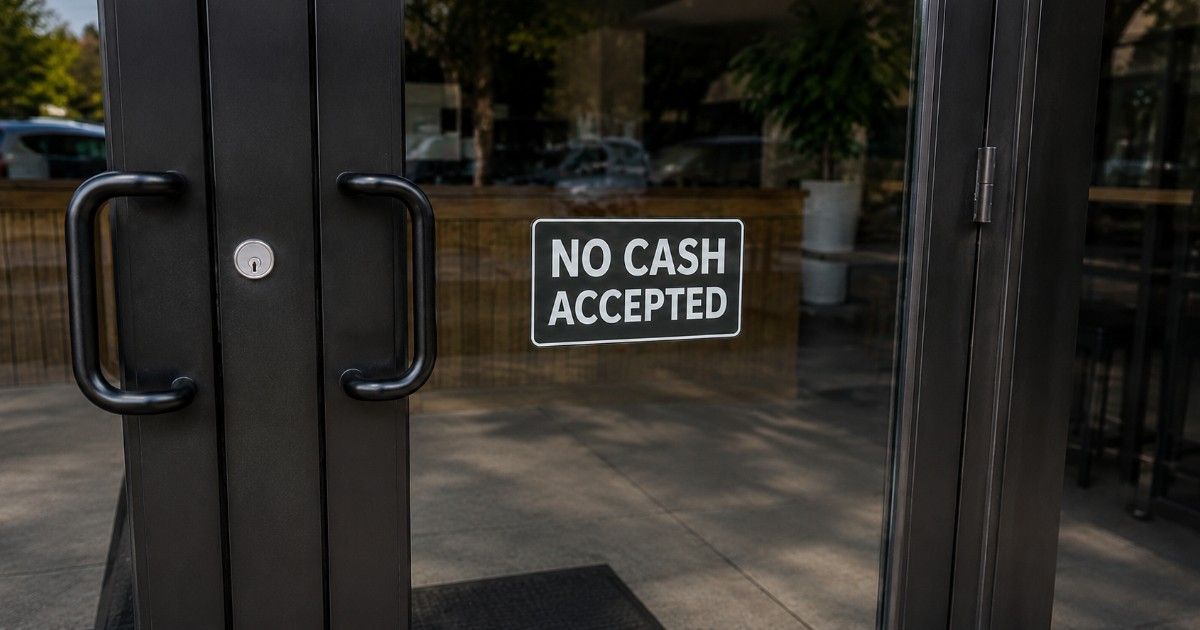
Retail businesses in Miami-Dade cannot just put up a sign saying “No Cash Accepted” and refuse cash from their customers.
An ordinance from the county requires the acceptance of bills and coins in numerous in-person transactions and specifies penalties that can reach $1,000 for those who repeatedly violate the regulation.
The provision became relevant again after the Miami Herald explained this Sunday what establishments that wish to operate cashless can do and reminded that, although Florida does not have a state equivalent obligation, Miami-Dade does maintain its own regulation.
The official county page is explicit: Miami-Dade prohibits businesses or entities that offer retail goods and services from refusing to accept cash. The rule applies to both incorporated and unincorporated areas of the county.
The prohibition is not limited to rejecting bills at the register. A business cannot display a sign indicating that it does not accept cash nor charge a higher price to those who choose to pay in cash in transactions covered by the ordinance.
Customers who believe their rights have been violated can file a complaint with the Miami-Dade Consumer Protection Division.
The regulation was unanimously approved by the Miami-Dade Commission in May 2022.
Miami Herald reported then that the initiative aimed to curb the expansion of fully digital establishments, especially due to the impact this model could have on seniors, low-income individuals, people with disabilities, and residents without easy access to cards or electronic payment systems.
"I want to ensure that our residents have the option to use the legal tender of our country," said Commissioner René García, a proponent of the measure, explaining that the aim was to preserve access for different sectors of the population to shops, events, and parks.
The sanctions are progressive. According to the approved text, the first offense results in a warning; the second, a fine of 100 dollars; the third, 200 dollars; and each subsequent offense may be penalized with 1,000 dollars.
There is, however, an important limitation: an establishment is not required under this ordinance to accept any denomination.
The regulation excludes payments made with bills larger than 20 dollars. There are also other exceptions.
Among them are purchases that are not made in person, including transactions by phone, mail, or internet; certain wholesale clubs that operate on a membership basis; rentals for which a deposit is usually required; operations involving suspected counterfeit money; and certain professional services, including those provided by lawyers, accountants, architects, engineers, financial advisors, and insurance agents.
The current page of the county also clarifies that those operations which Miami-Dade cannot regulate due to Florida legislation are excluded, citing certain transactions involving restaurants and private parking lots as examples.
Therefore, the obligation should not be interpreted as an absolute rule applicable to any business or service without exceptions.
Large sports venues have another option. They can operate with electronic systems as long as there is at least one point where a person can submit cash and receive a card in exchange that allows them to make purchases within the venue.
That exception was incorporated when the Commission approved the ordinance in 2022.
There is also an important distinction between dollars being legal tender and all U.S. establishments being required to accept them.
The Federal Reserve explains that there is no federal law requiring a private business to accept bills or coins. In the absence of state or local regulation, businesses are generally allowed to establish their own payment policies.
Miami-Dade is not alone in its effort to preserve cash in the face of the rise of digital payments.
New York also prohibits numerous retail businesses and food establishments from rejecting cash, with certain exceptions, including those that have authorized mechanisms to convert cash into a prepaid card.
Philadelphia has maintained a similar ban since 2019 that prevents retail establishments from refusing to accept cash for goods or services intended for consumers.
Massachusetts even has a state law that establishes that retail establishments cannot discriminate against those who pay in cash and must accept legal tender for goods and services.
Washington D.C. joined more recently. Since January 2025, its legislation prohibits numerous retailers from refusing cash, displaying "no cash" signs, or charging more to those who use it, although it also includes several exceptions.
Related videos:
Filed under: