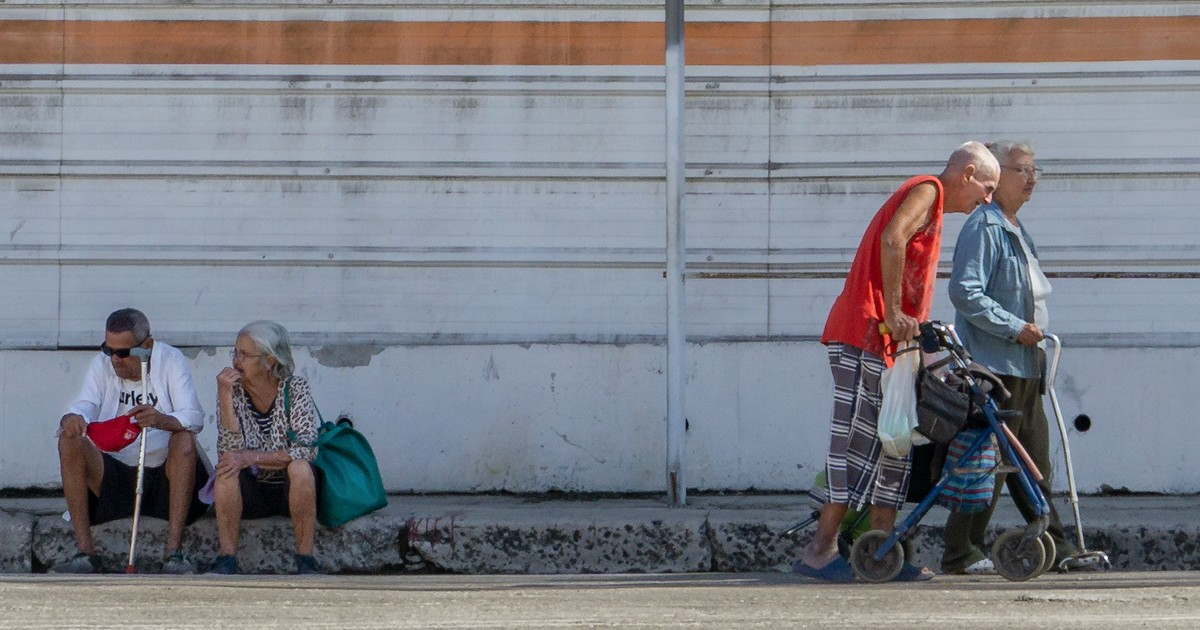
After working for decades and re-entering the workforce after retirement, some older adults in Cuba are facing waiting periods of six months or even over a year to find out how much their pension will ultimately increase.
The testimonies were gathered by the official newspaper Trabajadores, which highlighted the delays in the recalculation processes and consulted officials from the Ministry of Labor and Social Security (MTSS) about the causes and applicable regulations.
One of the cases is that of Julio Sánchez Rivas, who retired 12 years ago and then returned to work for another eight years at the Banco Metropolitano.
In February, he/she submitted his/her file to the Social Security Department of the Labor Directorate of the Diez de Octubre municipality in Havana.
According to what he recounted, he was assured that the process would be completed by April. August arrived, and he still did not know what his new pension would be.
"I have been waiting for six months, and I still don't know what the final amount of my retirement will be," Sánchez Rivas explained to the media.
But his main concern was summed up in another phrase: “I am an older man, and sometimes I wonder if I will be able to enjoy the increase that I am supposed to have.”
The retiree indicated that he was informed that once the procedure was completed, the new amount would have retroactive effect.
A similar situation is faced by Mario Ponce Álvarez, a veteran shoemaker who also worked for several years after retiring. He submitted the paperwork for the recalculation on January 26th and, seven months later, the process was still pending.
"The colleagues in that office told me that the solution is not in their hands, and therefore I had to wait," he said.
The two cases would not be exceptional. The official newspaper itself acknowledges that they are part of a large group of retirees awaiting those procedures and notes that some have been waiting for more than a year to receive a response.
In the case of the recalculation reported now, the authorities attribute a significant part of the delays to a factor that affects nearly all activities in the country: blackouts.
Adelaida Puente Aspillaga, General Director of Social Security at MTSS, stated that there are areas where the workers responsible for these procedures have to process them during the early morning hours, taking advantage of the times when they have electricity.
"Energetic impacts are what cause delays and complaints among the population. Recently, we have had to perform wonders to make progress," the official stated.
The explanation is striking because, according to the MTSS itself, the Social Security system is "completely computerized".
The procedures begin at the municipal level and are subsequently approved at the provincial level, although the database remains centralized.
The authorities acknowledged that they receive complaints, particularly in Havana, and also admitted the existence of organizational problems and difficulties related to the collection of files in some municipalities of the capital.
The scenario contrasts with the volume figures managed by the system. According to Puente Aspillaga, in 2025, 88,550 workers retired, while by June 2026, 51,265 pensions had been registered.
The recalculation that Sánchez Rivas, Ponce Álvarez, and other retirees are expecting pertains to those who re-enter the workforce after retirement.
According to the MTSS, these individuals retain the same rights and benefits as any active worker, and each additional year worked can lead to an increase in the pension when they permanently cease their employment relationship and request the corresponding procedure.
Those who have accumulated 45 years or more of service and work at least five additional years, whether consecutive or not, can exceed the 90% limit of the average salary.
If the original retirement amount was below that percentage, the following years may allow them to reach it.
To calculate the increase, the same mechanism used for the initial retirement is not applied exactly. In the case of age pension, the five best salaries from the last 15 years are selected, whereas to determine the increase corresponding to the period after retirement, the highest average salary earned during that new work phase is taken into account.
The officials also indicated that the re-contracted retiree can simultaneously receive 100% of their salary and 100% of their pension, and request the calculation of the increase starting from the first additional year of work.
Delays add another issue to the complicated reality of Cuban retirees. Receiving one’s pension has also become a lengthy ordeal for many elderly people, due to cash shortages, power outages, and difficulties with banking systems.
In various regions, lines have been documented since dawn, with people spending hours waiting to withdraw their money.
The problem persisted this August. In Santiago de Cuba, institutions began distributing food, drinks, and setting up chairs for retirees who were forced to wait for hours to collect their pensions.
There have even been reports of people lining up since the afternoon of the previous day to try to secure a spot at the bank.
Related videos:
Filed under: