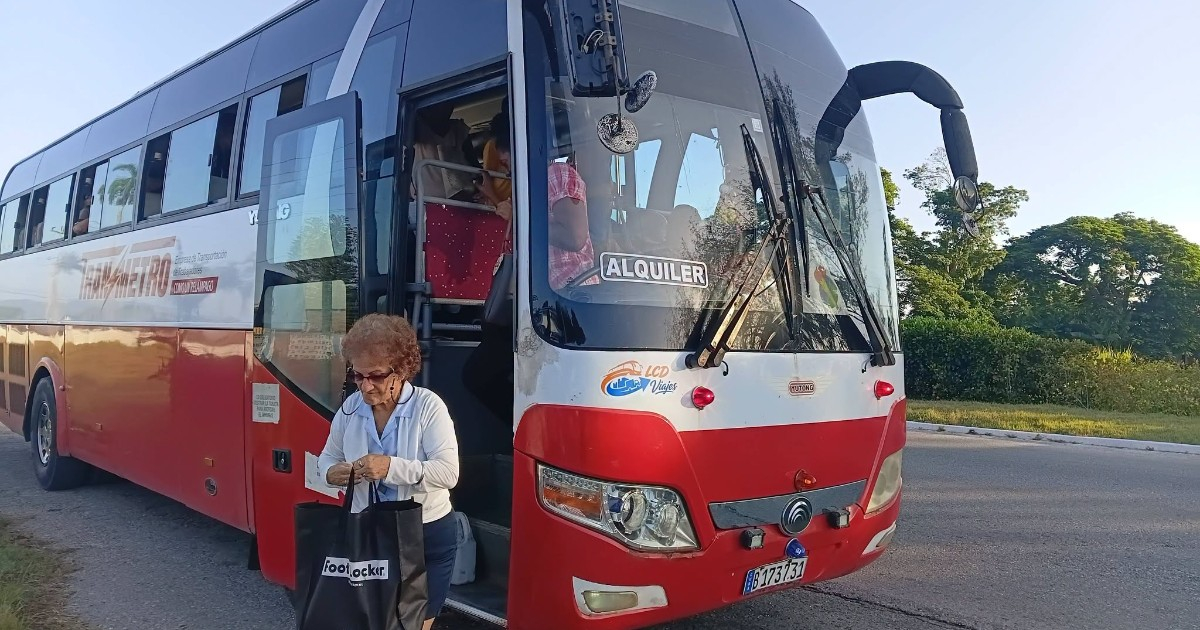
New bus routes have begun testing in Matanzas to connect various parts of the city with the Faustino Pérez Hospital and the University of Matanzas, an alternative that has generated interest among students and workers, but also raised numerous questions about how much it will cost to use it daily.
The journalist Yuni Moliner reported this Monday on Facebook, based on information from the LCD Viajes channel, about the tests conducted on three routes linking Canímar, Peñas Altas, Versalles, the provincial hospital, and the university.
One of the routes departs from Versailles at 7:30 a.m., passes the Viaduct around 7:35, the Terminal at 7:40, and Peñas Altas at 7:50, arriving at the University of Matanzas around 8:00 a.m.
According to the report, this first test "went well" and the recorded times would allow for maintaining that schedule.
The route starting from Canímar presented more difficulties.
The bus departed at 7:00 a.m., but a delay related to boarding at the Faustino Pérez Hospital caused setbacks and frustrations among passengers, particularly professors who needed to arrive on time at the university. As a result, LCD Viajes announced that it would modify that route.
The new schedule includes a departure from Canímar at 7:00 a.m., transit through Tirry, arrival at René Fraga approximately between 7:30 and 7:40 a.m., and subsequently passing through the Viaduct and the Terminal before arriving at the University of Matanzas around 8:30 a.m..
The return from university to pre-university is scheduled for 1:15 p.m.
A third route, between Peñas Altas and the Faustino Pérez Hospital, operated smoothly during the test: it departs at 7:00 a.m. and is scheduled to return from the hospital at 1:30 p.m.
The initiative quickly generated numerous questions in the comments, especially about the ticket price and whether students will have a discounted fare.
A user suggested selling tickets via transfer "for a value of 200 or whatever the price may be," to which another responded that "200 is something almost nobody can afford if they have to take the bus daily."
However, that conversation does not confirm that 200 pesos is the rate set by LCD Viajes.
Another user asked about a case in which, they said, a person would have had to pay 200 pesos from the Gelpis junction to Peñas Altas.
Moliner immediately clarified that this bus “is not from the Mipyme LCD”, so that price cannot be attributed to the routes just announced.
Other participants directly asked, "What is the price?", requested to know the rates per segment, and questioned whether students would pay the same as other passengers.
Concerns are not minor in a province where transportation costs already represent a significant burden for workers.
A trip in a tricycle to Peñas Altas currently costs 250 pesos, which is above the average daily wage of a worker in Matanzas, estimated at about 236 pesos.
The emergence of these new options comes after months of strict restrictions. In February, authorities acknowledged that Matanzas was practically left without urban and intermunicipal routes due to a shortage of fuel, with only a few services operating irregularly.
Additionally, LCD Viajes is now also operating in other segments of provincial transport.
In July, a route was launched between Matanzas and Havana for 3,000 pesos per trip, a fare that sparked numerous criticisms for representing a significant portion of the monthly salary of many Cubans.
Related videos:
Filed under: