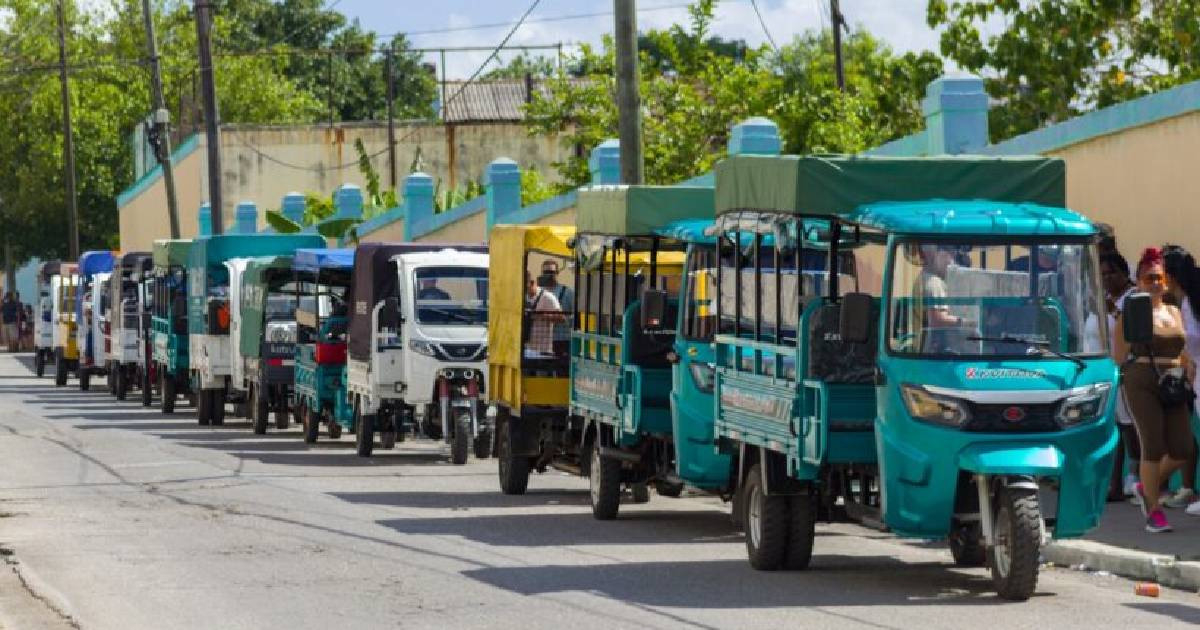
Private transportation in Matanzas faces a paradox that highlights the decline in purchasing power among workers, with tricycles available that remain partially empty while many passengers cannot afford the cost of a trip, reported this Saturday by the official newspaper Girón.
According to the source, a long line of tricycles waits for passengers every morning on América Street in Matanzas, in front of the Pre-University, while dozens of people wait a few meters away, unable to afford the fare.
The trip to Peñas Altas costs 250 pesos, which is above the average daily wage of a worker in Matanzas, estimated at 236 pesos. This gap leaves transport operators with semi-empty vehicles and few daily trips, while potential passengers look for more affordable alternatives.
The press organ of the Communist Party in the western province stated that economic conditions have changed since June, when the current rates were agreed upon.
Gasoline prices have been reduced by more than 50%, alleviating the operating costs for tricycle drivers. Additionally, electric and hybrid vehicles that primarily run on solar panels have been introduced. However, ticket prices have remained unchanged.
The drivers argue that they need to raise money to buy new batteries and cope with the rising cost of food and other family expenses.
The official media itself suggests, however, that a reduction in fares could attract more passengers and increase the number of daily trips.
The outlook contrasts sharply with the public transportation situation in the province. In February, the system was almost completely paralyzed, with no urban or intermunicipal routes available.
In light of that gap, private tricycles have become one of the main mobility alternatives for the population.
In June, the rates for those vehicles doubled overnight, which sparked outrage among users. The municipal government then agreed with transporters and the Communist Party on regulated fares: 250 pesos for the Preuniversitario-Peñas Altas route, 125 pesos for the Preuniversitario-Terminal or Versalles route, and 150 pesos for the Faustino Pérez Hospital. Those fares, agreed upon more than two months ago, are what the population can no longer afford today.
Now, despite the decrease in gasoline prices and the introduction of electric and hybrid vehicles, prices remain beyond the financial reach of a significant portion of workers.
The provincial government is exploring alternatives to reduce transportation costs in the meantime. According to Edilberto Casanova Armenteros, coordinator of Programs and Objectives for the Government in Matanzas, it is being considered that the leased buses charge between 30% and 50% less than the current rates of the private market.
The proposal aims to provide a higher-capacity and lower-cost option for those who cannot afford the 250 pesos for a tricycle ride.
Meanwhile, routes such as Pastorita, Canímar, Gelpis, and Guanábana remain unattended, according to the report from Girón, despite the existing passenger demand.
The scene of tricycles waiting for customers while people remain just a few meters away unable to use them encapsulates one of the contradictions of transportation in Matanzas: there is a private offer, but its prices keep it out of reach for those who need to travel.
The pattern of tolerance, proliferation, and delayed regulation of tricycles is repeating in other provinces. In Sancti Spíritus, authorities announced that they would begin to "crack down" on unregistered tricycles starting August 1, after years of informal operation.
Related videos:
Filed under: