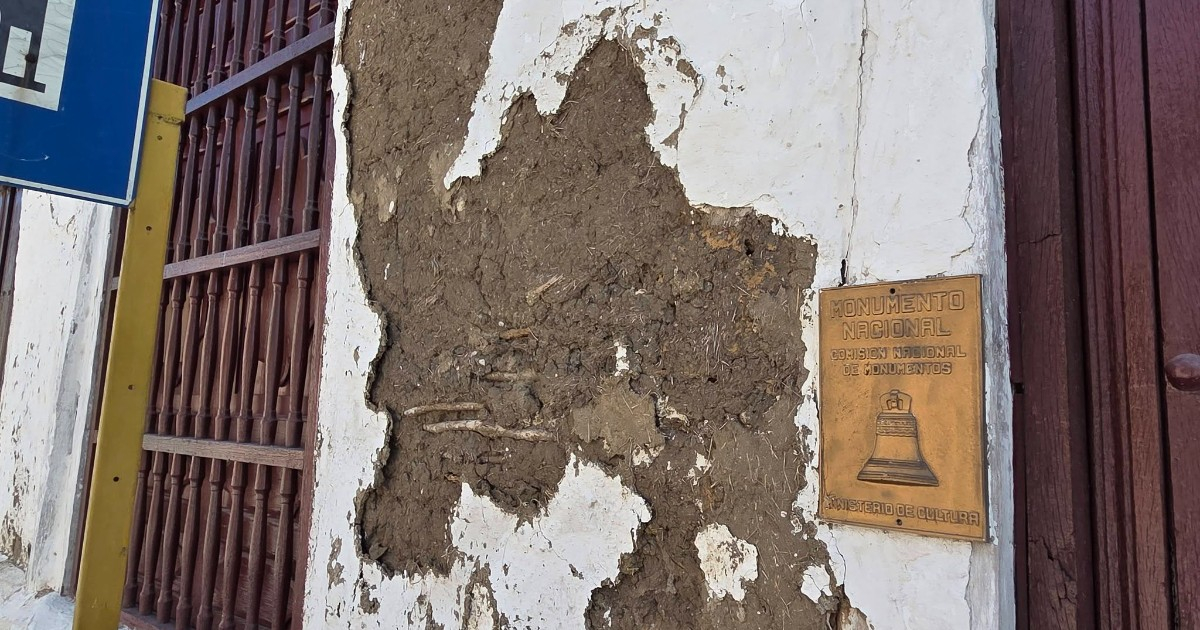
The Lieutenant Governor's House Museum in Holguín, popularly known as the "Mud House" and declared a National Monument, shows visible and alarming deterioration just four months after undergoing rehabilitation.
The images were shared by the Facebook page "Holguín en fotos" with the following message: "It is concerning that a newly rehabilitated work shows this type of deterioration in such a short time. One might wonder if the work carried out met the necessary conditions to ensure its durability."
The photographs show walls with flaking paint, cracks, deep holes, and the underlying material—mud mixed with plant fibers—exposed to the elements.
This property is the oldest preserved in the city, dating from the first half of the 18th century, and was the residence of the first Lieutenant Governor of Holguín since 1752. The National Monuments Commission declared it a National Monument through Resolution 195 on January 12, 2004.
"In the end, we are talking about one of the most historically valuable properties in our city, and it deserves to be preserved as such," concluded the publication that raised the alarm.
A century-old technique that few have mastered
The popular name of the property directly refers to its construction system: the rammed earth technique, which consists of a framework of wooden posts and sticks filled and covered with mud mixed with straw, dry grass, and clayey soil, finished with a coat of lime plaster.
The proper restoration of these walls requires specialized knowledge of this construction technique. A commentator explained in the publication that "the maintenance required for this construction technique is constant" and that the mix must pass consistency tests before being applied.
The user Fernando Bacallao Siré, who identifies on Facebook as an independent architect, stated: "The maintenance required for this construction technique is constant. When rain causes the material to fall, it must be immediately replaced and covered with a mixture of one third rotted lime and two thirds sand."
"The technique of plastering with sticks, straw, and soil (with the appropriate amount of clay for its plasticity) is very ancient, and the skilled craftsmen have been gradually disappearing," Bacallao added.
The urgency to restore the building now is greater because the rains forecasted for Holguín could accelerate the collapse of the exposed clay. "If the clay disintegrates with the water, this historic property could be lost," warned a citizen in the comments.
Doubts about the quality of the work and who carried it out
The post sparked dozens of reactions that question both the oversight of Heritage and the suitability of the materials used.
A neighbor who claims to live across from the building revealed that "they had patched it up after the cyclone by some individuals who were brought in from provincial prison," which raises concerns about the quality of the intervention.
Several comments suggest that the work was done hurriedly to meet a deadline, lacking the precision required for a National Monument.
"These heritage properties must be addressed seriously, not just to meet a commitment or a specific date," wrote one user. Another commented: "The problem is that everything here is done in tribute to a date."
In Holguín, this year a partial collapse of the roof of the Teatro Ismaelillo was reported in May and the collapse of the sculpture “The Woman with the Parasol” in the city's boulevard.
Nationwide, the pattern is consistent. In Matanzas, the historic center is home to nearly 100 buildings in serious disrepair, while in Havana, around 185,000 buildings are estimated to be in poor condition, with approximately 1,000 collapses occurring each year.
Related videos:
Filed under: