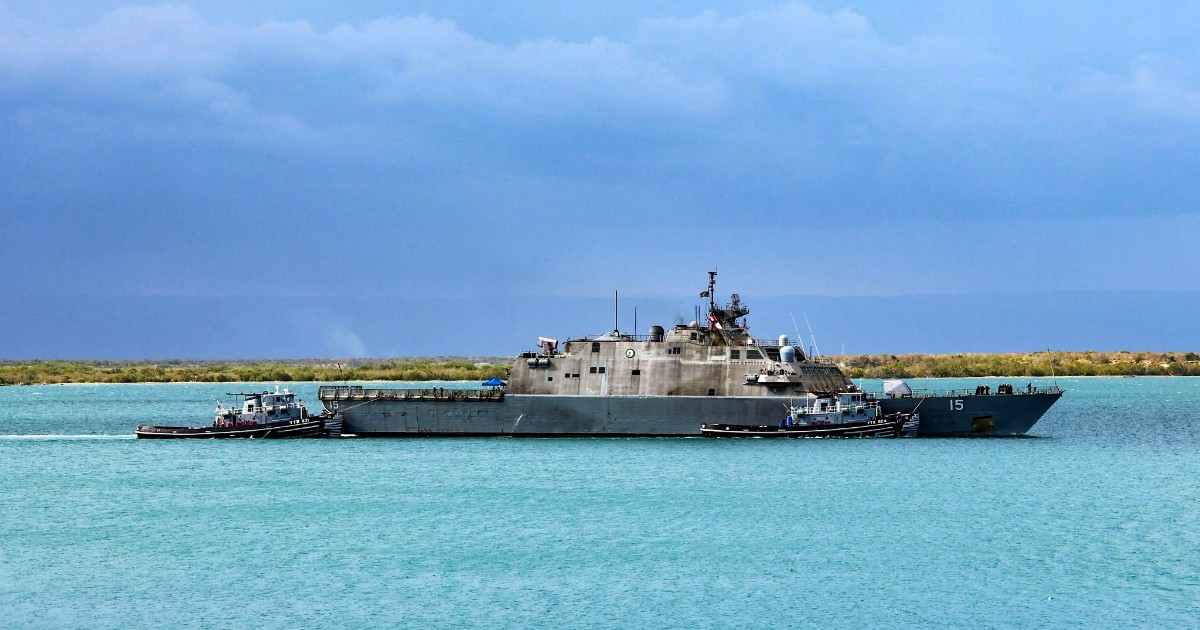
Two littoral combat ships of the United States Navy recently arrived at the Guantanamo Naval Base, in Cuban territory, marking yet another sign of the increasing military pressure that Washington is exerting on the island.
The Naval Station Guantanamo announced arrivals on its social media with welcome messages for both vessels and their crews.
The first to arrive was the USS Billings (LCS-15), the eighth ship of the Freedom variant of the littoral combat class, which docked in Guantánamo as part of its scheduled deployment in the Caribbean.
The USS Minneapolis-Saint Paul (LCS-21) followed, the 11th ship of that family of modern vessels, which departed from the Naval Base Mayport, Florida, on August 27 and arrived in Guantanamo this Monday.
Both platforms are designed to operate in shallow and coastal waters. According to the official description from the Navy, "the network of littoral combat ships addresses threats from coastal mines, terrorism, and stealth submarines."
The institution also emphasized that the ships uphold "the freedom of navigation for our nation through an innovative combination of ship design and construction, skilled personnel training, and operational programs that create a continuous maritime presence and protection."
Arrivals occur at a time of heightened tension between Washington and Havana, marked by a series of unprecedented recent diplomatic and military maneuvers.
In May, the CIA director, John Ratcliffe, met in Havana with high-ranking officials from MININT, including Minister Lázaro Álvarez Casas, delivering a message from the Trump administration: there is "a window of opportunity that will not remain open indefinitely."
Days later, the head of the Southern Command, General Francis L. Donovan, met at the base perimeter with Cuban General Roberto Legrá Sotolongo, First Deputy Minister and Chief of the General Staff of the FAR, in what constituted the first such meeting in recent times between both commands.
In mid-June, Secretary of War Pete Hegseth visited Guantanamo and warned that Cuba should not acquire weapons capable of reaching the base or U.S. territory.
"The future of Cuba is in the hands of its leadership", declared Hegseth, who also stated that the Department of Defense would consider "every possible option" in the face of any contingency.
In parallel, the U.S. military reinforcement in the Caribbean is not limited to Guantánamo. At the end of August, it was confirmed that the Roosevelt Roads naval base in Puerto Rico is operating at full capacity with more than 8,100 soldiers conducting maneuvers under SOUTHCOM's Operation Southern Lance, with a projected investment of 79 million dollars.
From Cuban civil society and the exile community, voices such as those of José Daniel Ferrer and Luis Manuel Otero Alcántara have expressed support for military action to overthrow the regime.
A digital independent survey from May, with over 42,000 valid responses, reported that 60.9% of participants supported direct military intervention by the U.S., with 58% of responses geolocalized from the island.
The regime, for its part, has responded with rhetoric of resistance. The leader Miguel Díaz-Canel promised in March an “impregnable resistance” against any military action, while the Foreign Minister Bruno Rodríguez Parrilla rejected the portrayal of Cuba as a threat to U.S. national security.
The USS Minneapolis-Saint Paul is scheduled to participate starting September 10 in UNITAS 2026, the 67th edition of the multilateral naval exercise with 24 nations, off the coast of Lima, Peru.
Related videos:
Filed under: