José Martí, the most universal of Cubans, wrote while reflecting on the work of the Russian painter Vasili Vereschagin (1842-1904): "Justice first, and art afterward! [...] When freedom is not enjoyed, the only excuse for art and its only right to exist is to serve it. Everything to the fire, even art, to feed the blaze!"
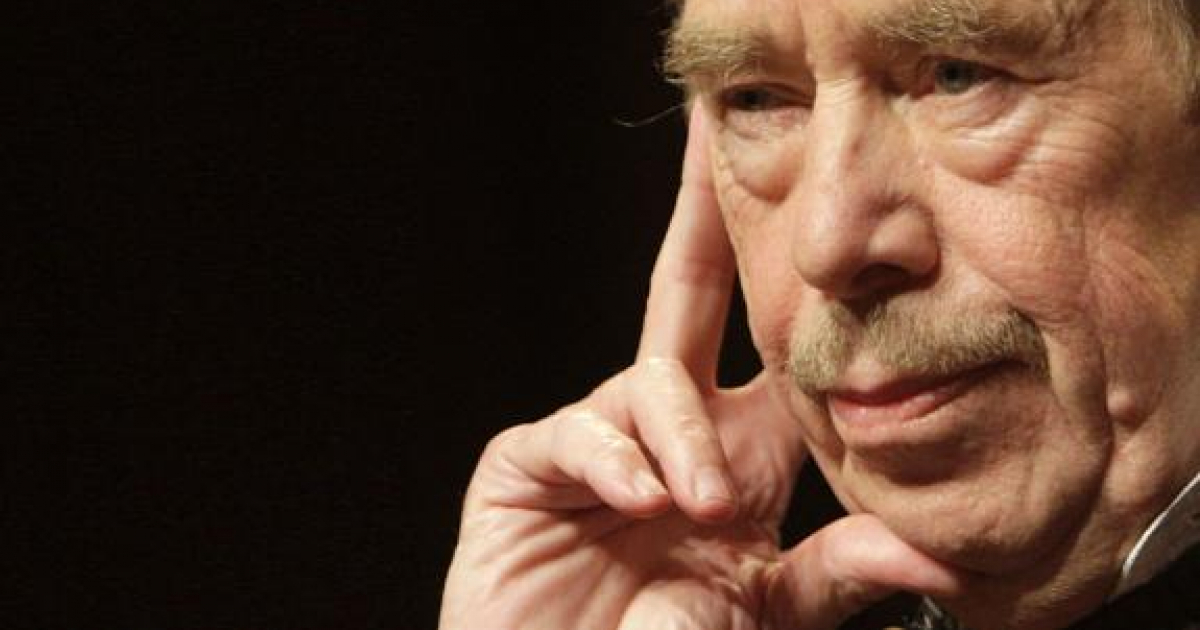
Today, I am going to share with the readers of CiberCuba about the life and work of a prominent Czech playwright who sacrificed everything to feed the flame of freedom: Václav Havel.
Who could have imagined that early morning of August 21, 1968, what would happen on December 29, 1989?
Havel was 31 years old. He was a playwright, writer, and theater man. He was in Liberec, north of Prague, when the Warsaw Pact troops, led by the Soviet Union, invaded Czechoslovakia to crush the Prague Spring.
Havel could have chosen to simply observe. He could have taken refuge in the argument that his job was to write plays and not confront power. He did not do so. He collaborated with a free radio station that continued broadcasting during the occupation. He wrote commentary and messages of civil resistance while tanks rolled through the streets. Thus, this young playwright began a path that would cost him bans, surveillance, interrogations, manual labor, imprisonment, and serious health issues.
I could not have imagined that 21 years later I would be president of a Czechoslovakia liberated from communism. This is precisely why his story retains such force. Havel was born in Prague in 1936, into a business and intellectual family. After the establishment of the communist regime, the family's properties were confiscated, and his "bourgeois" background limited his educational opportunities.
He found his place in the theater. He started as a stagehand and worked his way up to become a playwright and assistant director. Works such as "The Party in the Garden" and "The Memorandum" positioned him among the most important authors of his generation.
His theater already had a deeply political dimension. It mocked bureaucracy, the artificial language of power, mechanical obedience, and the progressive destruction of individuality within a society dominated by fear and pretense.
After the invasion of 1968 came the so-called “normalization.” His works were banned. His name vanished from Czechoslovak stages. While his texts were performed in other countries, within his own homeland the regime tried to turn him into a nonexistent writer. Between 1974 and 1975, that internationally recognized playwright had to work as a laborer in a brewery in Trutnov. But the communist regime did not succeed in silencing him.
In 1975, he wrote an open letter to the General Secretary of the Communist Party, Gustáv Husák, denouncing something even more serious than economic deficiencies: the moral degradation of a society in which millions of people were learning to publicly say what they privately knew to be false.
Two years later, he participated in Charter 77, a civic initiative that demanded the fulfillment of human rights recognized but not respected by the Czechoslovak state itself. Transitioning from criticism of the system in their works to organized action in defense of freedom remains an ongoing task for many intellectuals within Cuba.
Then the surveillance, searches, threats, interrogations, and detentions intensified. In 1978, he wrote "The Power of the Powerless." There, he developed one of the fundamental ideas of his thought: authoritarian systems do not rely solely on police, prisons, and intelligence agencies. They also require the daily collaboration of citizens who, out of fear or convenience, agree to behave as if they believed the lie.
Havel proposed as a response to live in the truth, even if it meant paying a high price. In 1979, he was sentenced to four and a half years in prison. From jail, he wrote much of the content that would later be included in "Letters to Olga." His health deteriorated significantly. In 1983, he was released. Havel could have decided that he had suffered enough. He did not; he went back to writing and defending the persecuted. He resumed participating in civic initiatives.
In January 1989, he returned to prison. At this point, it is worth pausing. In May 1989, Havel was released from jail again. The Soviet Union still existed, the Berlin Wall remained standing, and the Communist Party continued to govern Czechoslovakia. The political police maintained its barracks, files, agents, and interrogators.
Everything seemed lost. Seven months later, Václav Havel was president. In November, the Velvet Revolution began. Students, workers, actors, professors, writers, and ordinary citizens began to mobilize peacefully. The theaters also became spaces for deliberation and resistance. The Civic Forum brought together diverse forces around essential goals: ending the political monopoly, ensuring fundamental freedoms, and paving the way for free elections.
The system began to collapse. On December 29, 1989, Václav Havel was elected president of Czechoslovakia. The banned playwright was president. The brewery worker was at the helm of the nation. The one hunted by the political police, the political prisoner, had a great mission to fulfill: the transition to democracy and reconciliation with justice.
After the peaceful separation of Czechs and Slovaks, he was elected as the first president of the Czech Republic in 1993 and reelected in 1998. From his position, he advocated for the rule of law, civil society, human rights, democratic reconciliation, and the integration of his country into Western institutions.
His example inevitably raises a question about the role of culture in a nation's decisive moments. What is the purpose of an intellectual when society is undergoing a profound moral crisis? Should a writer confine themselves to writing novels? Should a playwright limit themselves to producing theater? Should a musician only play their instrument? Should a singer focus solely on singing? Should a filmmaker restrict themselves to filming? Can an artist completely distance themselves from the fate of those who lack the freedom to speak, create, travel, gather, or determine the future of their country?
Havel responded with his own life. And his response deserves to be contemplated today by many writers, artists, playwrights, filmmakers, musicians, academics, and creators from Cuba, both on and off the Island, regardless of their political stance.
Cuba needs critical thinking and action in favor of democratization. It needs an independent culture. It requires voices capable of defending human dignity. It needs citizens willing to contribute to a society where those with differing opinions can coexist.
The responsibility of an intellectual should not be to become a propagandist for an oppressive regime. On the contrary, they should defend spaces where no one has to seek permission from power to think and act.
The Cuba of the future will need freedom and democracy, but also reconciliation, institutional reconstruction, respect for diversity, economic recovery, and a profound ethical regeneration. Intellectuals and artists will have much to contribute to this task.
Havel understood that culture can be a refuge, a means of protest, memory, and conscience. But he also understood that there comes a time in the history of nations when writing about the truth requires a willingness to accept the consequences of defending it.
In May 1989, he was still a political prisoner; by December, he was president. He did not resist because he knew the outcome. He resisted because he believed that there were things worth defending, even if victory was not yet in sight. This is his greatest legacy and a worthy example for Cuban intellectuals and artists today.
Václav Havel expressed his solidarity on several occasions with the Cuban people and with those of us who peacefully fight for democracy. In September 2002, during a speech in Miami, he sent greetings to all Cubans, both on and off the Island, and expressed his hope that we could one day live in freedom, independence, and prosperity. He also explicitly supported non-violent civic resistance and figures such as Oswaldo Payá.
Years later, in June 2009, he delivered a message to several Cuban dissidents who were receiving the Democracy Award from NED, reminding us that challenging the lies of a dictatorship helps other citizens lose their fear. Havel evoked the experience of Eastern Europe and warned that totalitarian regimes may seem invincible, but they begin to crumble when they lose the ability to control and intimidate society. His final message was one of hope: the day would come when Cubans would be free to decide their own future.
And that moment is closer than ever before. It is only necessary for the intellectuals and the Cuban people to finally decide to live in truth and to conquer the freedom that has been denied for so many years.
Related videos:
Filed under:
Opinion article: Las declaraciones y opiniones expresadas en este artículo son de exclusiva responsabilidad de su autor y no representan necesariamente el punto de vista de CiberCuba.