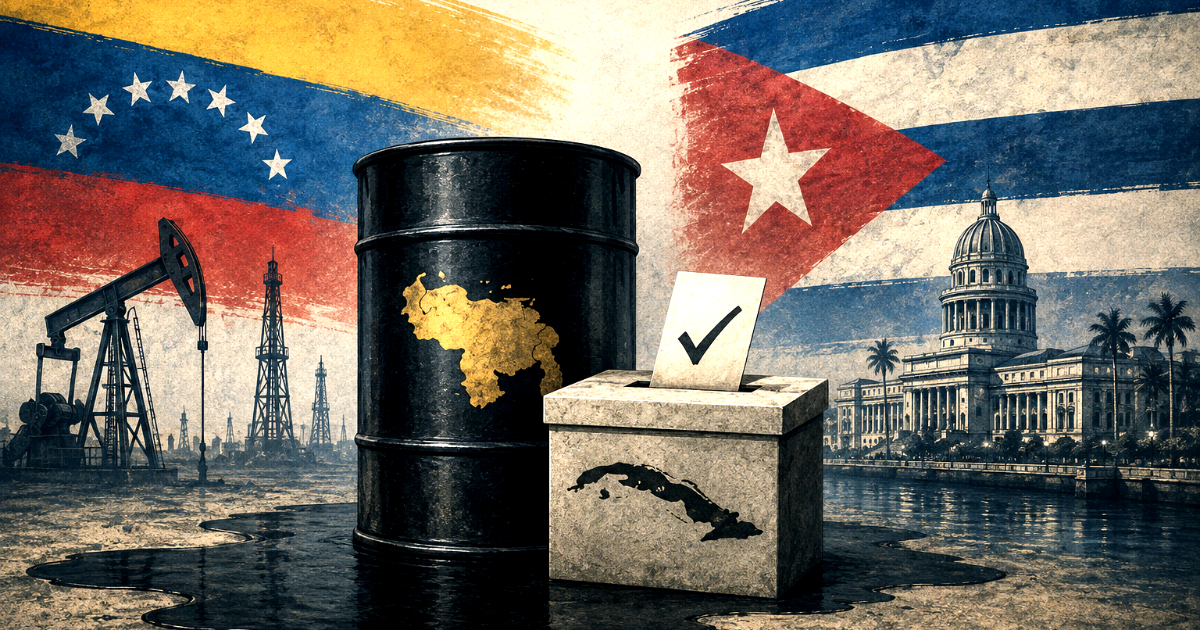
The oil agreement reached between the United States and the interim government of Venezuela not only opens a new chapter for that country's energy industry. It also introduces a significant question regarding Washington's policy towards Cuba:
Can a strategy that prioritizes stabilization and economic recovery ultimately produce, inadvertently, an incentive for authoritarian regimes to buy time and maintain power?
The question does not imply that the Trump administration has abandoned the goal of a democratic transition in either country. Nor is there evidence to suggest that Washington is deliberately negotiating a formula to preserve chavismo or castroism.
But the Venezuelan agreement requires a closer examination of the gap that may exist between the pressure exerted to provoke political change and the economic arrangements that may arise during the process.
For Secretary of State Marco Rubio, this distinction is especially important because his own political framework for Venezuela incorporated from the outset a third phase: the transition to a democratically legitimized government.
And in Cuba, although the language has changed and now insists on a far-reaching process, it has continued to maintain that the administration aims to lead the island towards an irreversible transformation.
The problem for Washington is that regimes have time. A presidential administration does not.
Rubio's shift in language about Cuba matters
On July 22, when directly asked whether the U.S. objective was still to provoke a regime change through economic collapse or if military intervention was still on the table, Rubio avoided committing to a timeline.
He stated that Washington was willing to be "very realistic" and "patient" regarding a process that would allow Cubans to achieve prosperity, security, and a better life. He added that he had never established a timeline for how or when the change would take place and reminded that this is a system that has been in place since 1959.
Three weeks later, on August 11, he was even more explicit. Rubio expressed his conviction that, before the end of the Trump administration, Cuba would be on an "irreversible path toward a very different future".
But he immediately realized that it was not reasonable to expect a system that had been in place for 70 years to be dismantled overnight. As a reference, he mentioned the experience of Eastern Europe and pointed out that countries like Poland needed between three and five years to complete their transformations.
That change does not necessarily equate to a resignation from the transition. However, it does lower an expectation that has accompanied much of American politics since January: political change no longer appears to be presented as an immediate outcome, but rather as a process whose success will need to be measured by the path it sets before January 2029.
And that difference can be decisive.
Venezuela demonstrates how difficult it is to control the sequence
The policy designed by Rubio for Venezuela had a relatively clear logic: stabilization, recovery, and transition. The first phase was to prevent chaos; the second to rebuild the economy and facilitate normalization; and the third to lead the country towards democratic legitimacy.
The subsequent evolution has made a structural difficulty evident: economic recovery can progress much faster than institutional transformation.
The oil agreement is the most obvious example.
Washington has reached an agreement with the government of Delcy Rodríguez to develop 17 oil fields and increase Venezuelan production to over 1.5 million barrels per day.
Rodríguez maintains that the agreement will last for 25 years and that Venezuela could earn approximately 209.335 billion dollars based on an oil price of 65 dollars per barrel.
At the same time, American sources and media have described structures of participation and concessions of longer duration, which leaves questions that can only be resolved when the contractual framework is fully understood.
The pact could be economically beneficial for Venezuela. However, politically it raises a different issue: the operation has progressed while the democratization process remains incomplete and without a clear date for fully competitive presidential elections.
There lies the strategic risk.
If the economy improves before there is an irreversible institutional transformation, recovery ceases to be merely a tool for transition. It can also become an incentive to preserve the statu quo.
Not necessarily because Washington is seeking it, but because every investment generates interest, and every interest creates incentives for stability.
The market is also saying something
The caution of major American oil companies adds another dimension to this debate.
When Trump gathered executives from the sector in early January and called for massive investments to rebuild the Venezuelan industry, the president of ExxonMobil, Darren Woods, responded that the country was then "unviable for investment", something that would only make sense after significant changes to its legal and commercial structures, lasting protection for investments, and modifications to petroleum laws. Other companies also expressed caution due to the political and legal uncertainty.
The business reasoning is quite straightforward: a company that commits billions of dollars to projects with a return measured in decades needs to know what government will be in place, what laws will govern, and whether contracts will be honored by future administrations.
It is an economic consideration, but also an institutional one.
It is therefore significant that the agreement that has finally come to fruition depends on an extraordinary structure and controversial actors, while the major oil companies continue to proceed with caution.
The Financial Times has highlighted the role of Alejandro Betancourt and the doubts surrounding the structure of the operation, while Associated Press has pointed out that uncertainties persist regarding the private operator, financing, and the duration of certain rights.
None of that demonstrates that the agreement is a mechanism to preserve chavismo. However, it does highlight something that should be of great concern to Washington: institutional uncertainty has a cost, and private capital acknowledges it before committing.
The lesson for Cuba is "time."
Here it is advisable to avoid an excessively mechanical equivalence.
Cuba and Venezuela are not the same issue, nor do they have the same economic structures, and Washington does not have the same levers in both cases. The useful parallel is another: in both countries there exists a political structure that has demonstrated an extraordinary capacity to survive external pressure and adapt its economic mechanisms without relinquishing fundamental political control.
The issue for Cuba, therefore, is not simply who controls a particular economic conglomerate. The question is much broader:
Can the regime grant enough economic, social, or diplomatic ground to convince Washington that progress exists while maintaining the institutions that ensure its permanence?
The risk is clearly recognizable.
A partial release of prisoners may be seen as progress. An economic opening may be viewed as reform. A dialogue with certain political actors may be perceived as reconciliation. New licenses for the private sector may be regarded as an opening.
And yet, none of those measures alone equate to competitive elections, political pluralism, institutional independence, or the rule of law.
The Cuban regime does not necessarily need to reject all U.S. demands. It can attempt to manage concessions in such a way that the pressure decreases faster than the political power of the system.
For an administration with a limited time frame, this is a particularly serious problem.
The Washington clock favors those who wish to wait
The midterm elections are scheduled for November 3, 2026, and the presidential term of Donald Trump ends on January 20, 2029.
This does not mean that the policy towards Cuba or Venezuela will depend mechanically on the U.S. electoral calendar. However, it does establish two political milestones that any long-term strategy must take into account.
An authoritarian regime may think about horizons spanning many years. An administration must demonstrate results beforehand.
That asymmetry creates a potential incentive for a strategy of partial concessions and waiting.
Havana may wonder how long it needs to endure for the political circumstances in Washington to change. Caracas may wonder how long it needs to establish an economic relationship that makes any future break more costly. And both governments may have an interest in keeping political issues within a negotiable process without a definite timeline.
For Washington, the challenge lies precisely in preventing "process" from becoming synonymous with "postponement".
The biggest risk for Rubio is that the phases could reverse
The Venezuelan strategy has a political logic if economic recovery leads to transition.
The problem arises if the opposite occurs: stabilization → recovery → economic normalization → institutionalization of the status quo → indefinite transition.
That would be the most dangerous scenario for Rubio.
Not because it necessarily meant that a mistake had been made in seeking investments or rebuilding the oil industry. Venezuelan economic development can be a perfectly legitimate and desirable goal.
The problem would arise if economic results were verifiable and swift, while democratic outcomes remained in the realm of promises.
In that case, critics could make a politically challenging accusation: that the United States managed to alter Venezuela's economic relationship with Washington without sufficiently changing the relationship between the Venezuelan government and its citizens.
For a Secretary of State who presented a democratic phase as part of the outcome of his strategy, this would entail a considerable reputational cost.
And Cuba observes that precedent
Havana has reasons to carefully study what is happening in Venezuela.
The Cuban regime has received a very clear signal in geopolitical terms: Venezuela, one of its main historical allies, has shifted from being a source of energy support to becoming a space where the United States seeks to exert extraordinarily deep economic influence.
But you can also observe another thing: Washington is willing to negotiate with the power it encounters if it believes that doing so helps advance its strategic goals.
This realization can have two opposite effects. It may convince the Cuban regime that absolute resistance is no longer sustainable and that it must make deep changes.
But it can also lead him to try a different strategy: concede enough for Washington to perceive progress, without giving up what allows the system to maintain its power.
The second path would be much harder to detect than an open confrontation.
Rubio has also introduced a new metric: "irreversible."
The word that Rubio chose in August is important.
He did not promise that Cuba would be a democracy before the end of his term. He stated that it would be on an irreversible trajectory towards a different future. This allows for room for gradual transformation. However, it also raises a question that Washington should answer clearly:
What does «irreversible» mean?
A more open economy? Less dependence on the state? Greater freedom for the private sector? Release of political prisoners? Return of exiles? Freedom of association? Electoral system reform? Pluralism of parties? Judicial independence? Or a combination of all these elements?
Without concrete indicators, "irreversible" runs the risk of becoming a political category that is too broad. Almost any concession can be presented as a step in the right direction.
And a regime that seeks time can comfortably live within that ambiguity.
The warning for Rubio should be very specific
If the American goal is for economic pressure to lead to political transition, Washington should prevent economic agreements from taking on a life of their own, separate from the institutional process.
In Venezuela, this means that the oil recovery should not be measured solely by produced barrels, mobilized investment, or fiscal revenues. It should also be measured by the evolution of the conditions that Rubio identified as necessary for free elections: credible electoral institutions, political freedom, the capacity of parties to organize, and guarantees for the opposition.
In Cuba, the same logic demands something even more fundamental: that economic and diplomatic concessions be linked to verifiable political changes, and not just to promises of future transformation.
The principle should be simple: relief can accompany change, but it cannot replace it.
And also the other way around: a greater economic openness should not be automatically equated with a democratic transition.
The issue of Rubio's political capital
This point deserves special attention.
Rubio has made Cuba and Venezuela issues linked to American national security, but he has also built a personal political narrative around them. In the case of Venezuela, he presented a sequence that leads from stabilization to transition. In the case of Cuba, he has insisted that the current model is unviable and that the Administration aims to lead the country toward an irreversible transformation.
Therefore, his legacy will not solely depend on how many sanctions he imposes or how much economic damage he is able to inflict on the regimes.
It will depend on something more difficult:
if at the end of the Administration there is indeed a political process that regimes can no longer easily reverse.
That is a much more demanding standard.
And it is also the reason why Venezuela is so important to Cuba. If the Administration manages to demonstrate that economic recovery can be accompanied by an effective political transition, it will have established a powerful precedent for its strategy regarding Cuba.
If the opposite occurs —if the recovery solidifies a new economic relationship with the existing power while democratization is postponed— Havana may learn a completely different lesson: that it is possible to survive U.S. pressure by making sufficient concessions to keep negotiations open and buy time.
A public policy warning for Rubio
The question that should accompany each new agreement with Caracas and, subsequently, each negotiation with Havana is not solely: "What do we gain today?".
It should also be: «What power does the regime retain after obtaining what we concede?».
An agreement that generates investment, oil, stability, or humanitarian relief can be beneficial.
But if at the same time the capacity of a non-democratic structure to finance, legitimize, or perpetuate itself increases, one must ask whether Washington is inadvertently strengthening what it intended to transform.
The priority, therefore, should be to preserve the original sequence of the strategy: stabilize without freezing; rebuild without indefinitely legitimizing; negotiate without turning negotiation into a substitute for transition; and use economic influence to create political conditions that later allow for free elections and the rule of law.
For Rubio, the danger is not that Venezuela or Cuba simply say "no."
The danger is quite more sophisticated: to make them say “yes” enough to make it seem like the process is moving forward, while they use that process to buy the time they need to survive.
That would be the most difficult scenario to reverse before the political calendar in Washington changes.
And also the one that could most erode the political capital of the Secretary of State: not because he failed to exert pressure, but because after having achieved an extraordinary capacity for pressure, he was unable to convert it into the result he himself presented as the final objective: an institutional transition that allows Venezuelans and Cubans to freely decide their future.
Related videos:
Filed under: