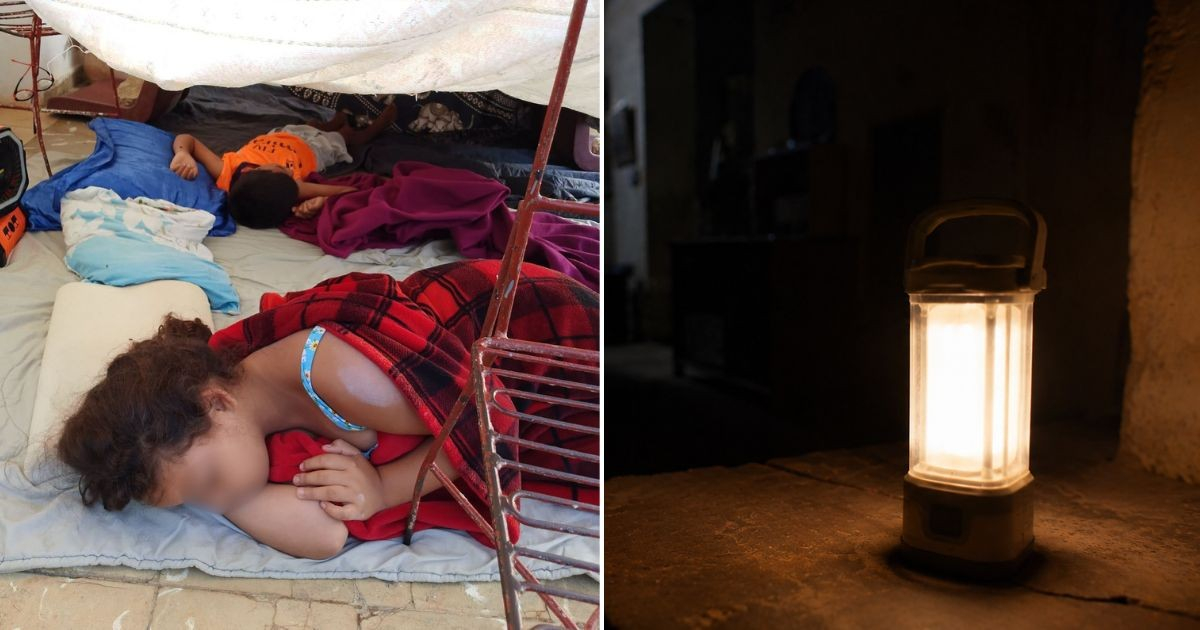
A Cuban mother delivered a strong message following the start of the new school year, stating that she will not send her children to school as long as power outages prevent them from sleeping and resting, amid a crisis that, as she describes, also hinders her from providing them with food, cold water, and other basic necessities.
Marianela Hernández made her decision public this Tuesday in the Facebook group Alamar calle ancha, the same day the 2026-2027 school year began in Cuba.
"When Cubans learn to say enough, then there will be a change in this country." she began her post.
The woman described herself as a "completely exhausted" mother from watching her children grow up without prospects and from seeing how the daily crisis affects fundamental aspects like sleeping and eating.
Hernandez explained that even buying food becomes a problem due to prolonged power outages, as the lack of refrigeration makes it impossible to preserve them.
He also made it clear that he speaks from the reality of a family that does not have the resources to buy alternative solutions during power outages.
"I am an ordinary Cuban, and I can't afford panels and EcoFlow to at least provide some cooling for the ground beef," she noted.
The mother stated that she was tired of not being able to guarantee “the basic needs that any human being requires” and, above all, of worrying that her children could remain trapped in a situation that, according to her, worsens every day.
"And the worst part is seeing my children who will continue in this misery that gets worse every day," he lamented.
The start of classes only increased her frustration. According to her account, her daughter experienced exhaustion after nearly no sleep the night before and standing for more than an hour in the sun while waiting for the activities to commence at the start of the school year.
For Hernandez, the return to the classrooms now opens what he described as “a new torture for the children and even more so for the parents”.
Among those difficulties, he mentioned the need to find water and electricity to wash school uniforms.
He stated that at his children's school, the teachers require uniforms and that students who arrive in civilian clothing cannot enter, a situation that contrasts with the hardships many families are facing.
"To look for water and running water to wash the uniforms because at school the teachers are from another planet who have no needs and demand that if they come in civilian clothes, they are not allowed to enter the school," he reported.
Several people reacted specifically to that point and noted that the Ministry of Education had announced flexibility in the use of uniforms due to the difficulties with electricity and water.
One of them wrote that "since last semester there has been flexibility regarding the use of the uniform," while another insisted that "even the minister said that the uniform is not mandatory given the conditions we are living in."
The mother also brought up another daily challenge of going back to school: providing snacks for the children and keeping water or soft drinks at a tolerable temperature during the long school days.
"It's torture to look for snacks for the children, torture to drink their water and warm soda in this heat," were his exact words.
Her conclusion was even harsher: she believes that parents themselves end up subjecting their children to more difficulties when they send them to school after sleepless nights and in conditions of scarcity.
"As a mother, I sacrifice myself to put a plate of food in front of them, not very good, but at least they can say they ate something. However, I can't ask children to sacrifice themselves for something that already has no future here," she concluded.
The post sparked numerous reactions, many of them from mothers and fathers who said they identified with the situation. "If I can’t make food and breakfast for them to eat well, mine aren’t going to school," one person remarked.
Another person recounted a similar situation with her son: "How do you prepare breakfast —I mean a piece of hard bread and something liquid— during a blackout? My son has to leave at 6:00 a.m. to make it to school. After a night without power."
That person stated that they also will not send their child when they cannot prepare something for breakfast and take it with them: "I can't allow him to be out on the street for almost eight hours with just a piece of bread."
Among the reactions, there were also complaints about the lack of food. One person stated that in an area of Havana, they had not found bread at the bakery for two days because "the flour hasn't arrived."
Others questioned whether, given the current conditions, children should remain in schools for the entire day.
A person suggested that classes be limited to a single session and criticized that some schools ask families to send both snacks and lunch.
"With so many challenges going on, I don't understand the obsession with keeping children in schools all day," she wrote.
"They cannot demand something that they don't even give you the opportunity to acquire," one comment pointed out, while another stated that each family should decide when their child is ready to attend classes.
Several responses directly supported Hernandez's decision. “Every mother should do that,” one person wrote.
Another one assured: «Mine aren't going either»; and another stated: «That's how it should be done, not sending them to school to see what happens».
There were also opposing viewpoints. One person warned that keeping children out of the classrooms could ultimately harm their academic performance, while others pointed out that parents can indeed send them in civilian clothes and address the school when they believe certain demands are excessive.
Hernandez's message comes at a particularly difficult time for families.
The school year began this Tuesday amidst widespread blackouts, after a day when the electricity service was affected for 24 hours and with generation deficits exceeding 2,000 MW.
The Education Minister herself had acknowledged before the start of classes the impact that nights without electricity could have on students and families, in a situation also marked by issues with uniforms, school supplies, food, and teacher availability.
The social unrest over the conditions faced by minors was also evident this Tuesday in Arroyo Naranjo, where several mothers blocked a street along with their children to demand a solution to issues affecting the start of the school year.
Related videos:
Filed under: