Cuba began this Tuesday the 2026-2027 school year amidst an extreme electricity crisis: after a full day of blackouts and a maximum impact of 2,323 MW, the Electric Union (UNE) projected a deficit of up to 2,310 MW during the peak hours of September 1st.
In its official update on the status of the National Electric System (SEN), the state-owned company reported that on Monday, the electricity service was affected by a generation capacity deficit throughout the 24 hours, and that outages continued all night into Tuesday. The maximum impact reached 2,323 MW at 8:50 PM.
However, the outlook for this Tuesday does not offer any relief. For peak consumption hours, the UNE estimates a availability of just 1,020 MW compared to a projected maximum demand of 3,300 MW, placing the forecasted impact at 2,310 MW.
The entity was expecting to incorporate 60 MW from unit 6 of the Antonio Maceo thermoelectric plant in Renté, which was in the process of being started up.
The system begins September with numerous thermoelectric units out of service. The UNE reported failures in units 5, 6, and 8 of the Máximo Gómez plant in Mariel; unit 2 of "Ernesto Guevara" in Santa Cruz del Norte; unit 4 of "Carlos Manuel de Céspedes" in Cienfuegos; unit 2 of Felton in Holguín; and unit 6 of Renté in Santiago de Cuba.
Furthermore, other units remain under maintenance and 106 distributed generation plants are out of service due to a lack of fuel. The Regla and Melones barges, as well as the fuel plants in Mariel and Moa, are also unavailable.
According to the official report, the photovoltaic solar parks produced 4,624 MW/hour on Monday and reached a maximum output of 719 MW, a contribution that has not prevented the country from continuing to experience massive deficits and prolonged blackouts.
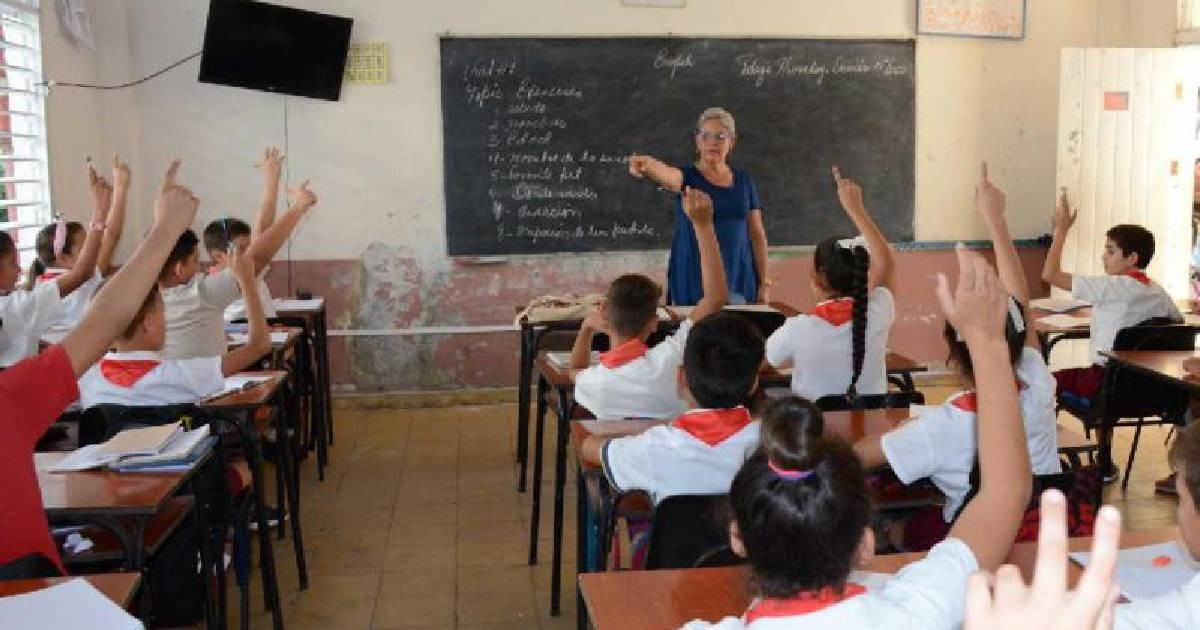
The date makes the electrical situation an especially sensitive issue: this Tuesday students return to the classrooms after a previous school year that had to be shortened, among other reasons, due to fuel shortages, blackouts, and transportation difficulties.
Indeed, the Minister of Education, Naima Ariatne Trujillo Barreto, acknowledged just hours before the start of the school year that schools would open under "very difficult" conditions, with shortages of uniforms, school supplies, teachers, and challenges in providing meals for the students.
The official admitted that the notebooks will be subject to a "standardized basic norm," which has not been uniformly guaranteed for all students, and that teacher coverage continues to be one of the major issues within the educational system.
Trujillo also acknowledged the direct impact of nights without electricity on the school day. “After a night without power, going to school for the child [...] is a challenge,” he stated, also referring to the exhaustion of teachers affected by the same outages.
The critical electrical situation forced the Government to move the end of the 2025-2026 school year to the period between June 15 and June 30 last year, even though the original calendar was scheduled to last until July.
Among the officially recognized reasons were chronic blackouts, a lack of fuel, and difficulties in transporting students and teachers.
Months earlier, the Ministry of Education had decided to keep classes going despite the energy crisis, adjusting the double session according to the electrical conditions of each center.
The challenging scenario contrasts with the political discourse used to announce the return to classes. The Communist Party recently described the start of the new school year as "another act of heroism", at a time when families were reporting difficulties in obtaining food, supplies, uniforms, and other resources necessary to send their children to school.
Related videos:
Filed under: