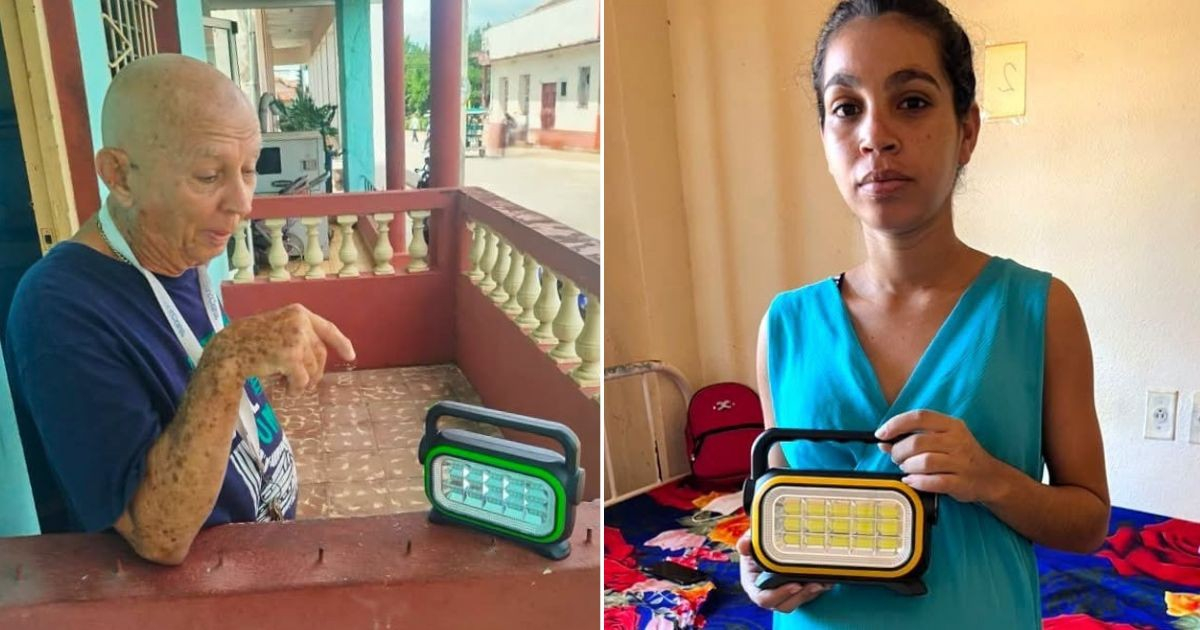
More than 16,000 rechargeable lamps arrived in Cuba this Wednesday as part of the assistance mobilized by the United Nations for families in the eastern part of the country affected by Hurricane Melissa who are still facing difficulties accessing basic electricity services.
PNUD Cuba and the United Nations System in Cuba announced on their social media that the new shipment consists of 16,020 rechargeable lamps, aimed at helping restore basic living conditions in the affected households.
According to the publication, the devices are part of a batch of about 24,830 lamps purchased to support the affected population.
Other 8,590 have already arrived in the country and "are currently being distributed," they indicated.
The funding comes from various sources of international cooperation, including the United Nations Central Emergency Response Fund (CERF), through the United Nations Office for the Coordination of Humanitarian Affairs (OCHA).
The General Directorate of Civil Protection and Humanitarian Aid Operations of the European Union (ECHO) and the Organization of African, Caribbean and Pacific States (OACPS) are also participating.
The PNUD itself acknowledged that “access to critical energy services is one of the current fundamental challenges for the Cuban population,” a situation that becomes even more complex for those who lost homes or suffered other damages due to Hurricane Melissa, which hit eastern Cuba on October 29, 2025, as a category 3, with sustained winds of 195 km/h, heavy rains, and flooding.
The agency explained that it works alongside Cuban institutions and international partners to provide basic energy coverage to vulnerable individuals, whose situations have worsened due to the combination of hurricane damage and the prolonged energy emergency facing the country.
The initiative is part of the response in the energy sector coordinated by UNDP as the leading agency of the United Nations System in Cuba.
This is not the first delivery of this kind made by the organization after Melissa.
Even before the impact of the cyclone, UNDP mobilized basic resources to Cuba to prepare the response in the eastern provinces, including materials intended for housing and essential services.
After the passage of the hurricane, the UNDP installed electric generators and photovoltaic systems in several communities in Granma, including Guamo Viejo, Grito de Yara, Vado del Yeso, and Cauto Embarcadero.
The equipment allowed, among other uses, to charge basic communication and lighting devices in areas affected by both Melissa and the electrical crisis.
Days later, a UNDP plane landed in Santiago de Cuba with 4,375 tarps intended to temporarily protect homes damaged by the hurricane.
That operation was part of a United Nations action plan valued at 74.2 million dollars to assist one million people in eastern Cuba.
By mid-November, the UNDP had mobilized over 2.2 million dollars for recovery efforts following Melissa.
The aid included thousands of roofing sheets and tarps, mattresses, tools, chainsaws, and electric generators intended for Granma, Santiago de Cuba, and Guantánamo.
Related videos:
Filed under: