
Related videos:
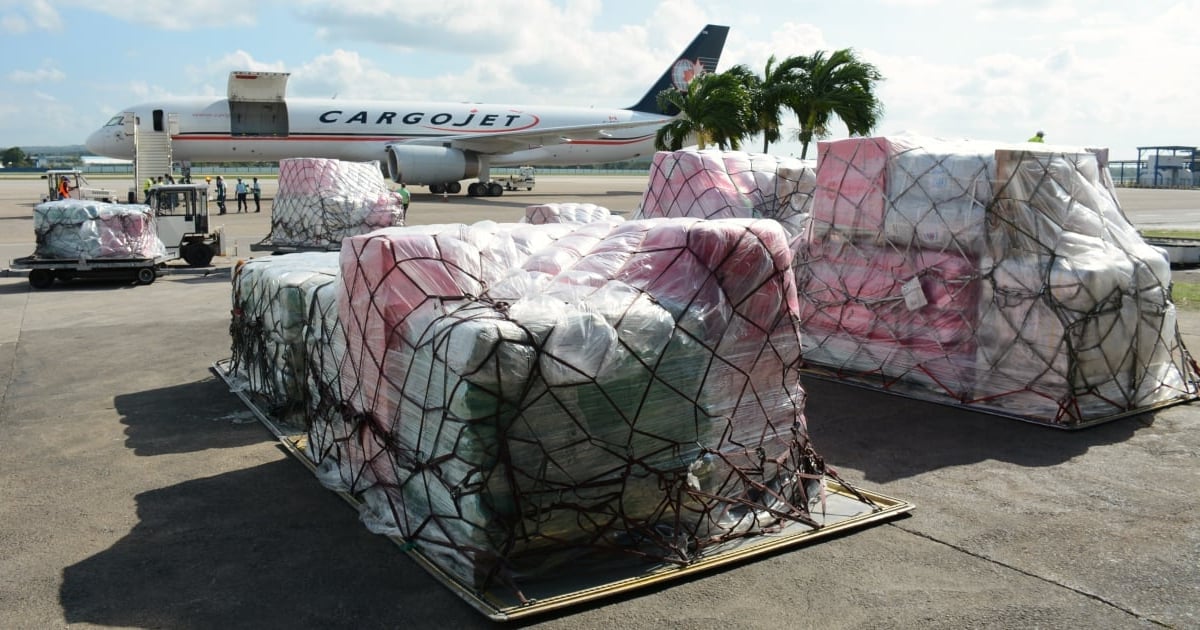
The United Nations Development Programme (UNDP) reported on Monday the dispatch of a to Cuba to support early response to the imminent impact of the hurricane Melissa in the eastern provinces of the country.
According to the organization on Facebook, the support includes essential materials and equipment aimed at mitigating the damage to homes and basic services following the passage of the tropical cyclone.
Among the resources sent are:
4,000 tarps for temporary roof coverage.
7 electric generators.
6 chainsaws.
259 specialized and basic tool kits for cover repairs.
2,000 single mattresses.
Analysis and mobilization of additional resources as conditions evolve in the affected areas.
UNDP explained that these supplies are part of its strategy for rapid preparation and response to natural disasters, and they are kept prepositioned in strategic locations throughout the country to facilitate immediate distribution in case of emergencies.
These actions are carried out with the support of the United Nations Central Emergency Response Fund (CERF) and as part of the United Nations System in Cuba, which coordinates efforts alongside national authorities and the Civil Defense to address the impact of the meteorological phenomenon.
"The objective is to support national efforts for early recovery and reduce the suffering of affected families," the organization stated in its communiqué.
Melissa's step
Melissa continues its advance toward the east of Cuba as a powerful Category 5 system on the Saffir-Simpson scale, with sustained winds of 270 kilometers per hour and higher gusts, placing it among the most intense cyclones that have threatened the island in over a hundred years.
If it maintains its current strength until landfall, Melissa could match or even surpass the most powerful hurricanes in Cuba's history, such as those of 1924 and 1932, both category 5 storms and regarded as the most devastating in the country's meteorological records.
The hurricane of 1924 struck the west with winds estimated at 265 km/h, while the one in 1932 battered the central region with over 240 km/h and left thousands of victims.
In contrast to those historical events, Melissa is heading towards the eastern part of Cuba, an area that has not faced a direct impact of such magnitude and has a more fragile infrastructure with already deteriorated basic services. Experts warn that the combination of extreme winds, storm surges, and torrential rains could cause catastrophic damage in provinces such as Guantánamo, Santiago de Cuba, Holguín, Granma, Las Tunas, and Camagüey.
According to historical data, the most destructive cyclones recorded in Cuba include Hurricane Michelle (2001), which made landfall as a Category 4 with winds of 225 km/h; Hurricane Ivan (2004), which brushed the western part of the island as a Category 5; and Hurricane Flora (1963), whose prolonged rains caused over 1,000 deaths, despite having lower wind intensity.
Melissa, on the other hand, combines all the elements of an extreme hurricane: sustained winds exceeding 250 km/h, a central pressure below 910 hPa, and a slow movement that increases the risk of flooding and landslides. Meteorologists have described its behavior as "explosive intensification," which could make it one of the most violent tropical systems in the recent history of the Caribbean.
If its direct impact on Cuban territory is confirmed at its current intensity, Melissa would be the most powerful hurricane to touch the island since reliable records began. Civil Defense authorities have maintained the Cyclonic Alarm Phase in six eastern provinces, while rescue brigades and electrical technicians are preparing to act once the effects of the phenomenon subside.
The country is facing this new challenge amid a complex context: widespread blackouts, resource shortages, and a limited communication network that could complicate the response to a major emergency. Forecasts indicate that the eye of Melissa could approach the southeastern coast between Tuesday night and Wednesday morning, with a destructive potential that could leave a lasting mark on Cuba's weather history.
Filed under: