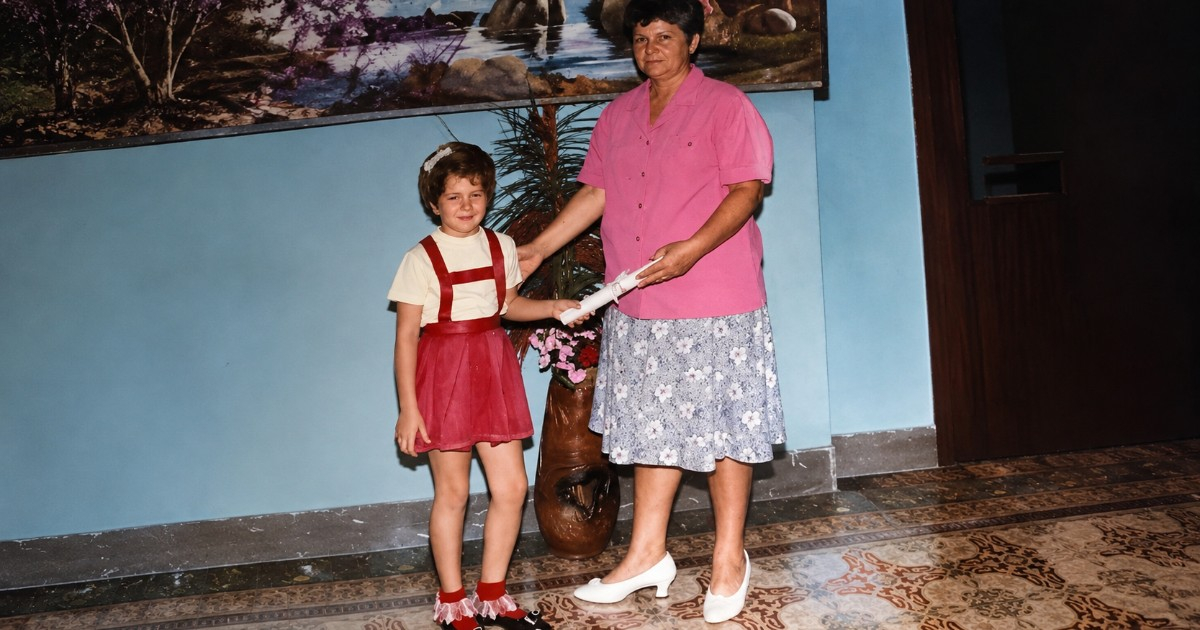
Julia Elena Jareño Varcárcel, a graduate in Education from the University of Las Tunas, published on Facebook a testimony that summarizes decades of structural contradiction in Cuba.
The content creator, specializing in English, explains how she worked hard for more than half of her life studying, believed in the promise that education would make her "someone in life," and in the end, it was her emigrated aunt who funded the laptop, the clothes, and even the graduation dress.
"Study, my daughter! Study so you can be someone in life! And I believed it! For many years, I swear I believed it," writes the author at the beginning of her narrative.
Jareño graduated in the 2020-2021 academic year with a GPA of 4.52 and a diploma thesis graded with five points, after five years of study at the Municipal University Center of Puerto Padre. However, the journey was filled with questions that no one could answer.
“Why did the dollar seller have a motorbike, while my Physical Education teacher rode an old bicycle he inherited from his grandfather? Why did the man selling pork on the corner have a nice house, while the doctor at the clinic lived in a rented place because she couldn't even afford her own home?” she comments in her post.
In Cuba, those who study the most are not always the ones who live the best. In 2026, the basic salary of the budgeted sector was set at 3,210 Cuban pesos per month. University professors earn between 6,130 and 8,880 pesos depending on their category. A newly graduated doctor earns around 7,045 pesos per month.
The problem arises when those who receive such salaries have to spend 5,000 pesos for a liter of oil. They cannot engage in social activities, nor can they dream of gathering enough money one day to become independent and buy their own home, because their salaries are not sufficient for living, and their professions are not valued.
The other axis of the narrative is immigration as economic support. "My laptop, my shoes, my clothes, my food, and even the outfit I wore at my graduation were, to a large extent, subsidized by my aunt. Yes, my aunt! The one who emigrated!" writes Jareño.
"Emigration not only took people away. It also became, over generations, a source of income for the families that remained in Cuba. While some studied, worked, and survived inside the island, others, from abroad, sent money, clothing, food, medicine, appliances, shoes, and even what was necessary for their relatives to graduate. That's why, when I'm told that everything was free, I always think: Free for whom?" she said.
Similar cases that have resonated in Cuba
Jareño's testimony is not an isolated case. For years, there have been documented stories of professionals who earn more as drivers or informal sellers than by practicing their careers.
In January 2026, a Cuban on TikTok debunked the myth of free education by highlighting the actual costs that families bear.
The comments underneath the post follow the same pattern. One reader defines it precisely: "It's something we've been dragging for years, an inverted pyramid: a professional lives on a miserable salary, unlike someone who hasn't even completed high school and earns profits beyond their capacity."
Another commentator, who left medicine along with her specialty and her master's degree, sums it up without beating around the bush: "I did the math, and it just didn't add up to support my son and live like a person. I became a self-employed worker. I'm not rich, but I am a person. When I was a professional, I wasn't a person."
A professional with two degrees and a gold diploma writes that after twenty years, she is supported by her son because her salary doesn't even last her a week.
An accountant who worked for four decades cannot withdraw more than 1,000 pesos from her pension. An economist who graduated in 1995 states that she is still waiting for her life to change.
Other commentators highlight the value of knowledge beyond the system: "The good thing about studying is that even though a degree may not mean anything here, that knowledge can help you leave this country and forge a path elsewhere," notes a reader.
Academic training does open doors, but for many Cubans, the only one that ends up opening is the one for leaving the country.
Related videos:
Filed under: