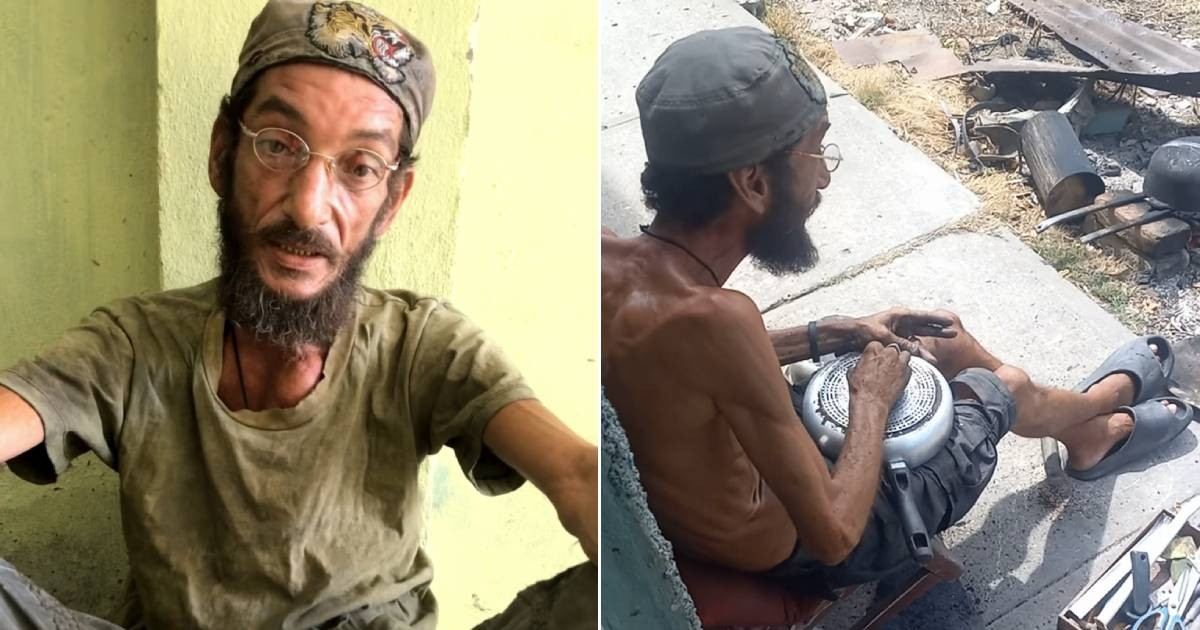
The Cuban Marco Antonio Morán spent years in front of a classroom in Guantánamo, but today he works from dawn until dusk, manually cleaning pots, cauldrons, and pans to make ends meet.
His story, gathered by the independent media CubaNet, starkly portrays the decline in living conditions for large segments of the Cuban population, including university-educated professionals.
With a degree in Sociocultural Studies and pedagogical training, Morán explains that he left the classroom by conviction: "I abandoned teaching because I no longer felt identified with it, as the educational system changed completely; it was not the one I was taught in pedagogy."
He indicates that in recent years he has made a living traveling to homes to clean cooking utensils. "From the biggest to the smallest, that's how I'm earning my living, with rustic tools," he said.
"I don't work with any kind of electric machinery. I work by hand; everything is manual," he said.
Morán acknowledges that there are days when the orders pile up and he cannot keep up. The problem is what he earns: on some days, he only makes between 300 and 400 Cuban pesos, an amount that forces him to choose between eating or buying medication, which he obtains in the informal market due to the impossibility of finding them in traditional pharmacies.
This dilemma has a serious medical background. Morán suffers from nodules in the liver and pancreas, a gastrointestinal condition, and works daily in pain. Furthermore, he attributes an increase in blood lead levels to his profession.
The medication crisis described is not an isolated case: only about 30% of the basic medication list is available in Cuban state pharmacies, with 461 out of 651 essential drugs completely lacking or poorly stocked, which has normalized purchases in the black market at exorbitant prices.
The difficulties faced by Morán also extend to the kitchen. He cannot afford coal —the price has soared to between 3,200 and 5,000 pesos per bag in various provinces— and cooks with firewood on an improvised stove in the doorway of his home.
To fuel that stove, he has turned to what he has at hand: door frames, slats from blinds, pieces of wood picked up from the street, and his own furniture. "I have cooked with books," he stated.
The official average salary in Cuba was 6,930 pesos per month in 2025, equivalent to about 13 dollars at the informal exchange rate, while independent studies estimate that a person needs at least 96,000 pesos a month to meet their basic needs, nearly 14 times that salary.
A survey conducted between February and March 2026 with nearly 1,800 participants revealed that 86.6% of Cubans turn to the informal economy to avoid hunger.
The exodus of teachers described by Morán also has concrete figures: Cuba has an accumulated deficit of around 24,000 teachers, driven out of the classrooms by insufficient salaries and rampant inflation.
The former professor does not present his story as a personal tragedy, but rather as a reflection of collective reality. "This is the reality I live as a Cuban, and a few others live like I do. Instead of a positive metamorphosis, it is an inverted metamorphosis: I was well and now I am not," he summarized.
Related videos:
Filed under: