They started by promising what everyone wanted to hear. They spoke sweetly and deceived all the Cubans.
They promised to overthrow a bloody dictatorship and restore the Republic to us: elections, a Constitution, courts, a free press. The videos, messages, and interviews are all there; they have a clarity that today feels embarrassing. They promised a normal country.
What we were given was another dictatorship, worse than the previous one.
Worse because Fulgencio Batista's regime lasted seven years and this one has lasted 67. Worse because that one left behind dead, and this one has left behind dead, exiles, divided families, and an empty country. Worse because Batista left on a plane when things got bad, and these people have led us to ruin without wanting to let go.
The executions began immediately. In Santiago de Cuba, in January of '59, with summary trials and an open trench. It was led by Raúl Castro. Not Fidel: Raúl. That was his first government responsibility, and he fulfilled it efficiently. Wall for those who opposed, for those who conspired, for those who merely spoke.
Later came the UMAP, where homosexuals, religious individuals, and anyone who didn't fit in were confined under military command. Also theirs. And in 1996, the planes of Brothers to the Rescue were shot down over the sea by order of the then Minister of the Armed Forces.
Almost half a century at the helm of the military. No one in the world has held a position like that for so long. It was not a decorative role.
From the first year, people began to leave.
Those who had something to lose left first, followed by those who had nothing. Thousands of children went away alone during Operation Pedro Pan, sent by their parents to a strange country because anything was better than what they were facing. They left through Camarioca. They left through Mariel, and before letting them go, mobs were organized in front of their homes to spit on them and hit them in front of their children. They left on rafts in ’94. They continue to leave today, through Nicaragua, through the Darién, wherever they can.
And they all called them worms, scum, stateless...
That is the part I struggle to forgive the most, because it wasn't just a word. It was a policy. They turned emigrating into a betrayal, and having a relative abroad became a stain that cost you your job, your career, your place at university. Thousands of Cubans stopped writing to their own mothers to be able to continue living. There were fathers who never saw their child again. There were siblings who learned about each other's deaths from a third party, months later. That wasn't fate. It was done intentionally by a government, to punish.
Many have left Cuba. Most to the United States, but also to Spain, Mexico, Italy, Brazil, and even Haiti. As if a grenade had been thrown in the middle of the island and every Cuban had fallen like debris into a different corner of the planet.
Many did not fall anywhere.
There are those who remained in the Florida Straits, so many that no one will ever be able to count them. There are those who stayed in Darién, in the mud, and their families only have a phone number that stopped answering. There are those who gave everything they had to a coyote and ended up in a mass grave in Mexico, or never appeared at all. There are those who drowned in a tugboat that was overwhelmed by waves seven miles off the coast of Havana. Among them were children.
None of them had a doctor by their side. None had a team to keep them alive. None had a family watching over them.
Raúl Castro will indeed have them. When the time comes, at his ninety-something years, there will be doctors, there will be equipment, and his family will be there.
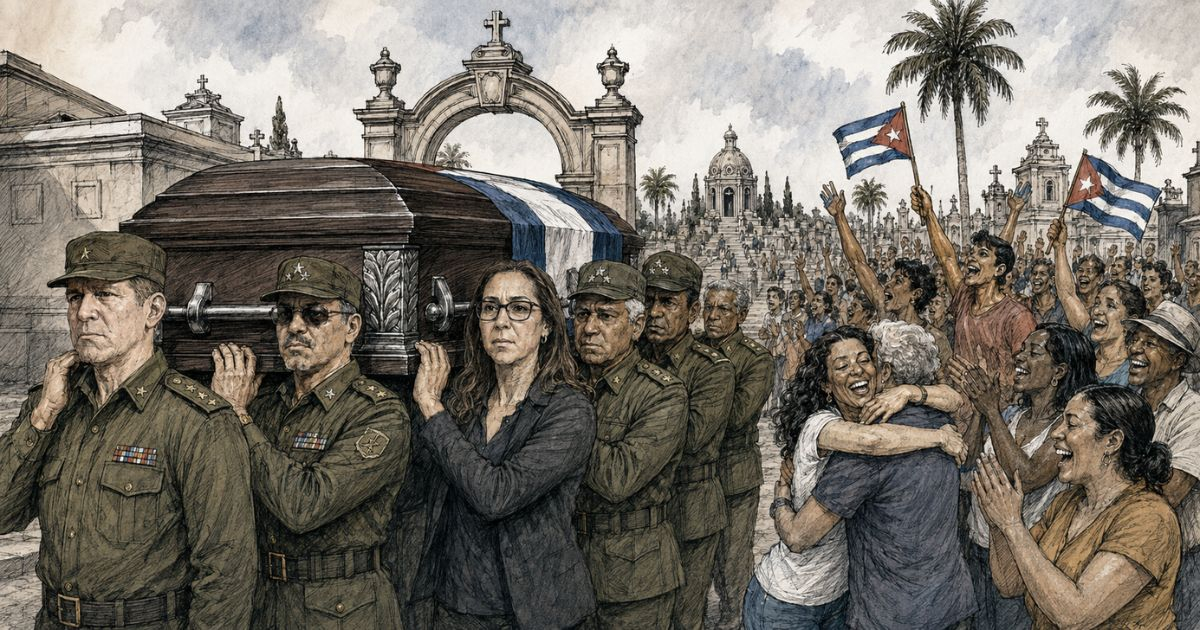
I don't know when he will die. It could be this week or it could be next year; he has been "killed" on social media so many times that when it really happens, half the world won't believe it. But he will die. And on that day, millions of Cubans will feel joy. I will feel joy, just like we felt in November 2016, and we won't have to apologize to anyone for feeling it. It’s not hate. It's what our people feel when the man who shattered our lives disappears.
There will be Cubans celebrating in Miami, in Madrid, in Valencia, in Mexico City, in Moscow, in Rome. In every corner where that grenade threw us. And perhaps there will be Cubans taking to the streets in Cuba to ask for the change that no one has allowed them to demand for 67 years.
But we are not the only ones waiting. Within the power structure, there are also those who wait, and that needs to be said. There are figures in the regime who know that the country is crumbling, who have been watching the noose tighten for months, and they understand that something needs to be negotiated. Some will consider this out of conviction, while others will do so purely out of opportunism, to secure a place in whatever comes next. It doesn’t matter. They all have their hands tied to the same man. As long as Raúl Castro is breathing, there is not a single conversation possible about the future in Cuba, because no one dares to have it in his presence. It’s not that those who come after him are better; they cannot even be worse on their own.
And that’s why it’s also important to say the other thing, even if it hurts: his death may not bring anything. Fidel Castro's did not bring anything. Today we are here, ten years later, with Cuba in a worse state than it was before, suffering blackouts, hunger, and experiencing the largest exodus in our history. It’s possible that this time nothing will happen either. The system may continue to function on its own, because that’s how it was designed.
But that day, even if nothing changes, one of the two culprits of our misfortune is going to die.
Her death will not bring back the dead, nor the years, nor the families. The damage is done. Even so, when the day comes, we will have to celebrate her death and prepare to build a new country.
Related videos:
Filed under:
Opinion article: Las declaraciones y opiniones expresadas en este artículo son de exclusiva responsabilidad de su autor y no representan necesariamente el punto de vista de CiberCuba.