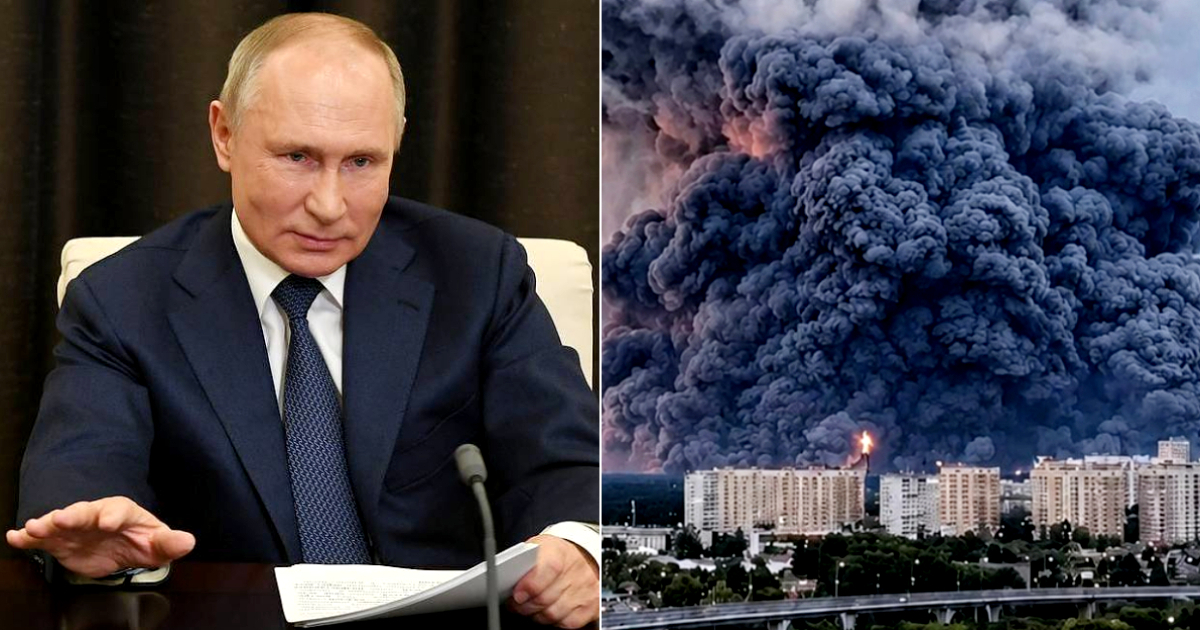
The Russian president, Vladimir Putin, has reportedly admitted to people in his inner circle that he fears for his own life if he brings an end to the war in Ukraine without achieving the minimum goals set by the Kremlin.
They will hang me, Putin reportedly said at some point during the war to several of his close associates, according to an internal source cited by The Economist in an analysis published at the end of August.
The alleged confession appears in an article from the British magazine that analyzes the reasons why the Russian leader might choose to escalate the conflict again, despite the enormous human, economic, and political cost that the invasion is imposing on Russia.
Putin's fear of showing weakness
According to The Economist, one of the main factors that would explain Putin's refusal to back down is not solely related to his geopolitical objectives, but rather to the very nature of the power system established in Russia.
The publication argues that the Kremlin operates under a logic where showing weakness can be extremely dangerous for those at the top of power. While the Russian system may have a high tolerance for violence, it is much less forgiving of failure.
In this context, Putin likely believes that ending the war without even achieving his minimum objective—fully controlling the eastern Ukrainian region of Donbas—could jeopardize not only his position in the Kremlin but also his physical safety, according to the analysis.
It is precisely when explaining that fear that The Economist quotes the striking phrase attributed to the Russian leader: "They will hang me."
The magazine does not identify the informant who attributes those words to Putin, nor does it specify when or to whom exactly the comment would have been made, making the statement unverifiable independently.
Wear and tear is increasing within Russia
The analysis also indicates a deterioration of the passive support that for years allowed the Kremlin to keep the war relatively distant from the everyday lives of many Russians.
The Ukrainian drone strikes against refineries, logistics centers, and other facilities within Russian territory, combined with the internet restrictions imposed by the authorities, are undermining that sense of normalcy.
According to data from the independent Levada Center cited by the magazine, 57% of Russians currently describe the situation in the country as "tense." Among the concerns mentioned are the war, deaths, mobilization, drone attacks, and uncertainty about the future.
The discomfort is also reportedly increasing among sectors of the Russian elite. One of the sources consulted by The Economist argues that the issue is not solely the state of the economy or the lack of a decisive military victory, but rather the duration of a war that is nearing five years.
Another source describes a growing perception among the elites that Putin's leadership is losing some of the image of strength that has sustained it for decades.
A possible escalation as a way out
Against this backdrop, sources close to the Kremlin cited by the publication claim that Putin decided over the summer to pursue an escalation.
Among the mentioned possibilities are intensifying hybrid operations and sabotages against countries allied with Ukraine, attacking the routes used to transport European supplies, and increasing pressure on facilities related to military material production.
Western intelligence agencies, however, believe that the Kremlin would not deliberately seek direct military confrontation with NATO, according to the magazine.
Within Ukraine, the escalation could primarily translate into an intensification of tactics already employed by Russia. The Russian Ministry of Defense announced on August 30 that it was preparing a massive attack against Ukrainian energy infrastructure.
Russian sources cited by The Economist also claim that Putin would be willing to send an additional 300,000 to 400,000 men to the front. The Kremlin may avoid announcing a new national mobilization and instead resort to regional recruitment and pressure mechanisms.
The analysis concludes that none of these measures would solve the structural problems facing Russia. On the contrary, a new escalation could increase the suffering of the population and fuel greater instability both inside and outside the country.
Related videos:
Filed under: